

In France in the last century, around the 1950s, residents faced a new demographic reality that forced them to develop strategies for social integration. These were times of migration when the country received considerable population flows from various parts of the world, with two waves standing out: Italians and Algerians. At the time, a clear discourse was developed to favor those from the neighboring country and devalue Algerian culture.
Algerian culture, which, despite being equally Mediterranean, was perceived as unable to integrate into the allegedly more developed Parisian society. The Italian was good. The Algerian was bad. In the years that followed, Italy gave way to Portugal. During the 1960s, a long, long corridor between Lisbon and Paris allowed the entry, often illegal, of thousands and thousands of Portuguese women and men, fleeing oppression and compulsory conscription in search of an opportunity to live freely. In the eyes of those who now want to rewrite history, Portuguese immigration was done in a resilient way under the yoke of one of the biggest slums, the famous Bidonville. Essential positions were won in French society, and people rose to high positions and distinctions, making the Portuguese the good guys. The Algerian remained the bad guy.
The truth tends to be crueler. When we look at the few studies that exist on the subject, as well as using the most basic common sense, it’s not difficult to understand that those who went from Portugal to France lived under the fear of
deportation, with deplorable conditions, which led them to be considered as third-rate people. Only with the support of the French state of the time was it possible for the Portuguese to become a significant force in immigration. Support was never really given to the Algerians.
The situation has not been very different in Canada, Brazil, and the United States, where Azoreans have followed similar paths. The policy was always more favorable to certain skin tones and lifestyles, creating a false narrative based on moral and religious proximity, when, in fact, a person coming from when, in fact, a person from Portugal would have very little in common with the way of life of someone from the way of life of someone from Toronto in 1972.
The world hasn’t changed that much. Today, the narrative proliferates that people from Africa and Asia do not wish to integrate into the communities where, be it Lisbon, Berlin, or Paris. By contrast, an American will be entitled to a red carpet and a real estate deal with favorable taxes. The only difference is how the Portuguese state accepts and develops its social policies. Instead of engaging in dialogue, the narrative of suspicion and mistrust is fed, seeking to turn the most empathetic person into a source of moral doubt.
This is Ventura’s (Anfré Ventura is the leader of CHEGA an extreme right-wing party) discourse and that of those who came to him from the Azores to take part in a demonstration on September 29th. To take part in a demonstration that left Rossio (one of Lisbon’s main squares) half empty was enough to reveal the proper dark side of the society they wanted to create. That day, side by side with the outspoken neo-Nazis of the 1143 group, members of that party wielded megaphones. They shouted at the top of their voices words of encouragement against immigration, humiliating human beings and promoting violence. The leader spoke with a flag tucked into his waistband as if it were a throwing weapon, defying the concept of doing good and resorting to all the most basic tricks he had learned in his days as a soccer commentator.
We once debated the constitutionality of that political group, which we should never have accepted as a party but instead as a tool to break our democratic system. It includes people who have gone to France and other countries, but to other countries, but have forgotten their global vocation to now close their doors to those who doors to those who need them most. Christians, believers in the goodwill of man, standing shoulder to shoulder with skinheads and arms tattooed with iron crosses and other veiled symbols of the most pernicious totalitarianism. In the midst of all this, at least at least two people were arrested while they shouted “April 25 always” and other words of freedom. It’s incomprehensible.
On September 29, Lisbon reminded us of what is at stake. From the Azores, an entourage of citizens who only want their good march alongside Ventura, Mário Machado, and the hundreds of people there. Some because they knew the
evil they were promoting. Others because they had been fooled by the lard of a venomous poisonous snake that Umberto Eco would call fascism.
For the Portuguese immigrants of Bidonville, the Algerians who were never truly accepted, every Azorean and Azorean who once set foot on the continent, and all the people who fought for their lives to reach Europe, wishing for a better world, we must recognize the shame of what happened in Rossio. We must demand that a party that marches alongside the swastika be
understood for what it really is. It is up to every citizen with empathy to say never again. Even if they have to risk imprisonment to do so.
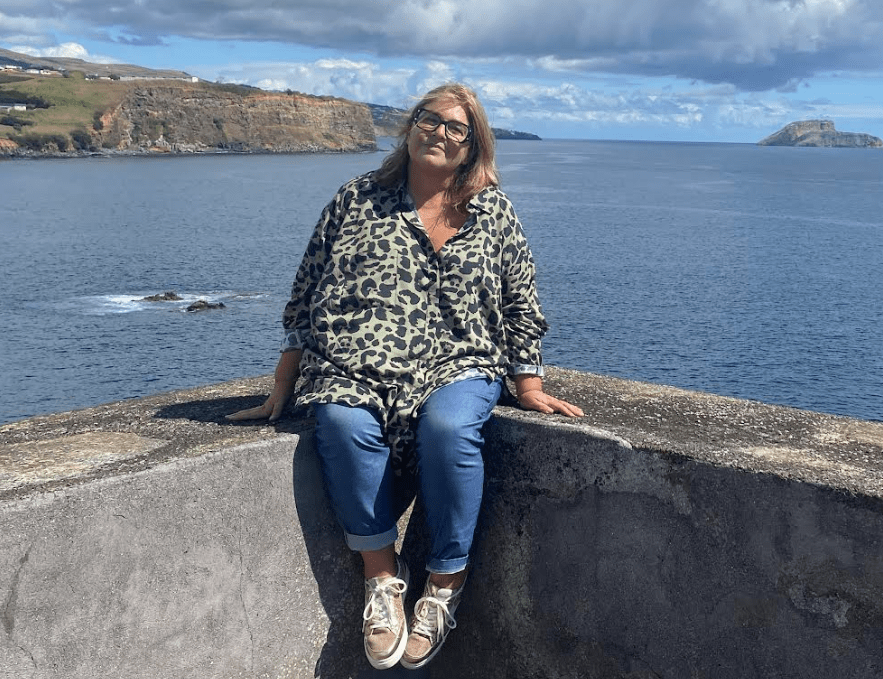
Alexandra Manes publishes regularly in Azorean newspapers. She is originally from the island of Flores and currently makes her home in Angra do Heroísmo, Terceira, Azores.
NOVIDADES will feature occasional opinion pieces from various leading thinkers and writers from the Azores to give the diaspora and those interested in the current Azores a sense of the significant opinions on some of the archipelago’s issues.
Translated to English as a community outreach program from the Portuguese Beyond Borders Institute (PBBI) and the Modern and Classical Languages and Literatures Department (MCLL)
 Novidades - The Islands and the Diaspora