

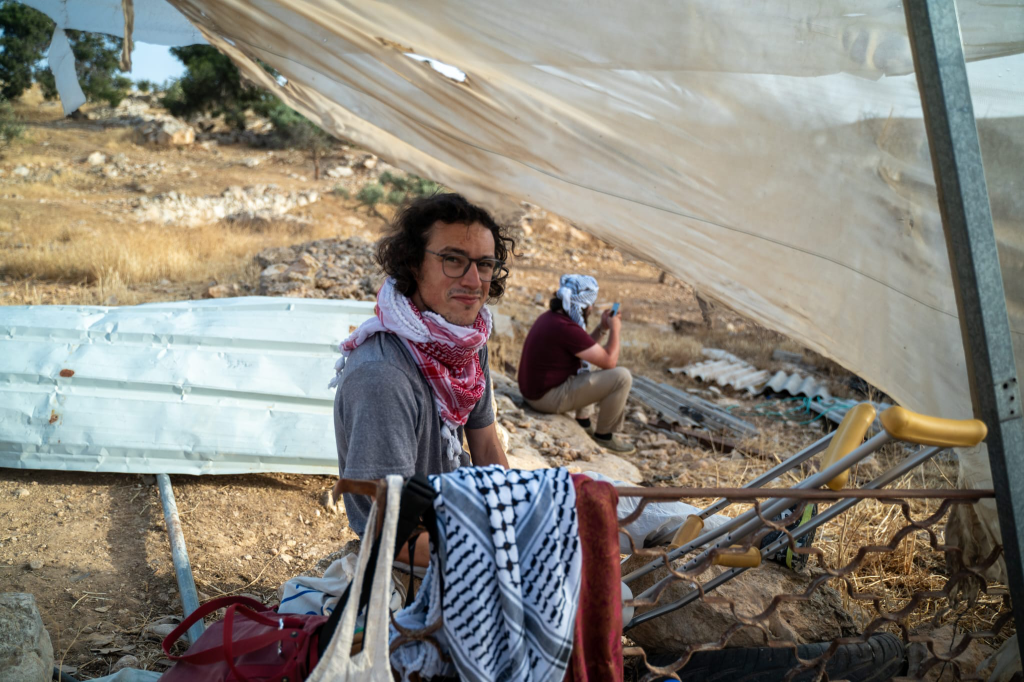
Nuno Viegas, from the investigative newspaper “Fumaça,” has been collecting testimonies from women in the Palestinian resistance and was involved in producing a documentary about agriculture and pastoralism as an act of resistance in the West Bank. “It’s not innocuous to treat Palestinians and the Israeli regime as entities in confrontation, as equals in a ‘conflict’,” says the journalist.
Correio dos Açores – You’ve been working in Palestine. Can you tell us what you’ve been doing concerning the invasion of Palestinian territory?
Nuno Viegas (journalist) – With Portuguese and Palestinian colleagues, I’ve been capturing a series of testimonies from women in the Palestinian resistance, from different generations, in Tuani, Ramallah, Jerusalem, Nazareth, and Haifa. We are also producing a documentary on agriculture and pastoralism as acts of resistance in the West Bank. In Hebron and Massafer Yatta, we captured the daily harassment of shepherds by Zionist settlers, the destruction of homes by Israeli troops, and reconstruction. Near Bethlehem, we followed grape picking and syrup production. We recorded the stories of a Palestinian farm in Area C, which they can’t build, which has been entirely surrounded by settlements since the Oslo Accords.
What is your opinion of the Portuguese media’s coverage in this context?
The Portuguese media, like many foreign media, often give in to the narrative that equates occupier and occupied, allowing the decades-long exercise of reframing the Zionist colonial project to continue. It is not innocuous to treat Palestinians and the Israeli regime as opposing entities, as equals in a “conflict.” The perception of what constitutes due support, a just solution, or a form of legitimate resistance is different when one recognizes the existence of an occupied people and the daily reality of a military occupation, which controls everything from access to water to the right to build an outbuilding, finances the expansion of settlements by continuously stealing land for cultivation, grazing, and housing, and assaults, imprisons, kills and censors in abandonment.
Having been physically in Palestine, what differences do you see between Western thinking and the wishes of the peoples of the Middle East when it comes to the Israeli occupation of Palestine?
The European attachment to the “two-state solution” signed in Oslo finds little support in a West Bank shredded by hundreds of fortified settlements, roads forbidden to Palestinian license plates, military training camps in occupied territory, and areas under the explicit control of Zionist civilian militias and the troops defending them. There is the daily, concrete struggle to end the occupation rather than theorizing about the day after. The daily reality of the occupation is omnipresent: in the lack of water and electricity, road cuts, cattle theft, crop destruction, aggression, psychological intimidation, arbitrary arrest, or torture. You can’t go a day without being confronted with the occupation and how it makes it impossible to live a free life.
What bibliography or movie/documentary would you recommend to understand the Palestinian cause?
Ghassan Kalafani’s “Return to Haifa ” portrays the 1948 expulsion and the struggle to return to those territories. Ben Ehrenreich’s “And The Way To The Spring” is an account of Palestinians’ daily lives as the occupation surrounds them.
Leaving the subject of the interview, how do you see the press situation at the national and regional levels?
Without any public or philanthropic means of funding the media, we allow ourselves to be swallowed up by funding models that encourage immediate, sensationalist, and superficial coverage. At the rate we work, editing, fact-checking, and the time to critically assess the importance of events, the credibility of sources and our editorial framework disappear. Low salaries, permanent job insecurity, and unpaid out-of-hours work lead journalists to the point of fatigue and frustration that allows for professional failures and leaves little room to demand decent working conditions and ethical protections.
Any messages or anything you’d like to add?
The Media Action Plan is insufficient without individual reporting grants, multi-annual structural grants for non-profit journalistic media, access to a specific category of public utility, and the conditioning of all support on compliance with the sector’s collective bargaining agreement.
José Henrique Andradeis a journalist for Correio dos Açores – natlaino Viveiros, director
Translated to English as a community outreach program from the Portuguese Beyond Borders Institute (PBBI) and the Modern and Classical Languages and Literatures Department (MCLL) as part of Bruma Publication and ADMA (Azores-Diaspora Media Alliance) at California State University, Fresno, PBBI thanks Luso Financial for sponsoring NOVIDADES.
 Novidades - The Islands and the Diaspora