


Conclusions and suggested action items
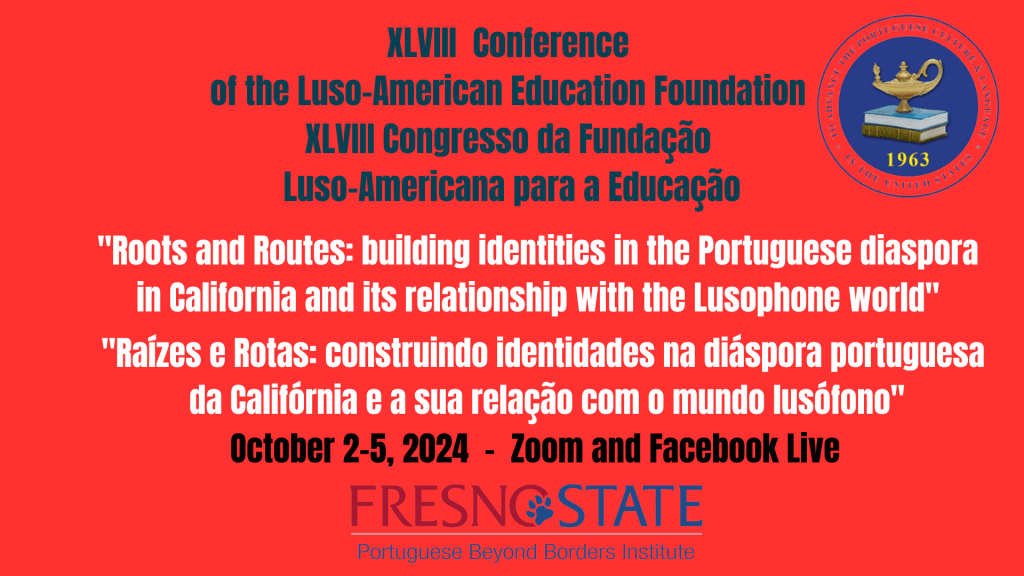
The 48th Luso-American Education Foundation (LAEF) Congress on Education and Culture, a significant event held October 2-5, 2024, under the auspices of the Portuguese Beyond Borders Institute (PBBI) at California State University, Fresno, once again provided a context for reflection on the Portuguese and Azorean diaspora in California, other parts of the North and South American continents, and the connection to the Lusophone diasporas. This year’s conference featured 25 presenters and panelists, launched via the Zoom webinar system, Facebook Live (in more than 40 groups), and archived on PBBI’s YouTube channel, Fresno State-PBBI, and the university’s oral history archive at the California State University Library in Fresno. According to attendance figures available on Webinars, Facebook Live, and YouTube metrics, the conference reached over 20,000 attendees.
The four days of panels, presentations, and debates were under the theme: Roots and Routes: Building Identities in the Portuguese Diaspora in California and its relationship with Lusophone Countries. This theme guided our discussions and led to the following conclusions and suggestions:
1. The establishment of an ongoing dialogue on the new multicultural, multiethnic, and multiracial identities of the Portuguese diaspora in California and the American West, under the auspices of the PBBI-Fresno State, was not just a suggestion but a crucial call to action from various panelists. All our voices are essential in this dialogue, and our participation as a community is vital for the success of this initiative. We urge everyone to join us in this endeavor, as it will significantly contribute to understanding and appreciating our diverse identities.
2. The potential of new technologies to connect Portugal to the diaspora and the diaspora to Portugal is immense. These technologies can bring social, cultural, and educational institutions closer together without government ties and directives through interdisciplinary and innovative projects involving civil society. This is not just a possibility but an exciting prospect that opens new opportunities for collaboration and exchange. We look forward to seeing the impact of these initiatives in the future, and we are optimistic about the positive changes they can bring.
3. Promote community talent in our diaspora’s events in California and the American West, particularly events connected to the American mainstream. Promote more vigorous events such as the Luso-American Education Foundation’s summer camp for young people.
4. Raise awareness among multiple generations of our diaspora about the publication of books and studies on the links between Portugal and the United States, and in the specific case of California, the link with the Azores, such as the book Jazz, Golf e American Dream by Tânia Santos, which, by analyzing the social impact of the US presence on Terceira Island during the dictatorship, links the historicity of the Azorean islands and Portugal to the world of the diaspora on the North American continent.
5. Alert government entities in the Autonomous Region of the Azores to the discrimination of the Azorean Diaspora Council towards California and the American West. It is unthinkable that California, the largest community of Azorean descendants in the US, should have only one councilor and that the councilors elected to represent the other states of the American Union should not be geographically biased, totally forgetting the reality of Hawaii and other states in the American West, with growing populations of Azorean descendants.
6. Create more opportunities to connect the diaspora by building on the Sister Cities programs of Portuguese cities with American and Brazilian counterparts, for example, to bring more benefits to the sister cities movement and link, through local government, the various latitudes of our diaspora.
7. Develop efforts to ensure that the literary creativity of our diaspora in North America has a more significant presence in the Portuguese market, that works translated into English are more widely recognized on this side of the Atlantic, and that there is a plan for national and regional entities linked to the diaspora to buy copies of translated works to be offered to university and high school libraries with Portuguese language courses and to the associative movement with libraries, including the Houses of the Azores. The literature created in English in the USA and Canada by the second and third generations is extremely important for a diasporic country like Portugal. Books like How to Clean a Fish by Esmeralda Cabral, presented and discussed at this congress, must be known in Portugal.
8. Advocate once again to the regional and national governments in mainland Portugal and the Autonomous Regions for creating new support areas for Portuguese organizations abroad based on concrete projects considering each association’s economic possibilities. The specifics of each organization, its scope within the diaspora in California, and its interaction with mainstream society should be included in evaluating each proposal, removing the excessive bureaucracy that removes many innovative projects and the patronage of some entities.
9. Create a new era of activity between the diaspora associative movement and civil society in Portugal and the Autonomous Regions. In the Azores, the Associação dos Emigrantes Açorianos (Association of Azorean Emigrants) could serve as a lobbying body with the Azorean authorities for a new defense of the diaspora and a more significant presence of the Azorean diaspora in regional education and society in general. In the Autonomous Region of Madeira and at the national level, we also need to establish agreements with non-governmental partners to connect our associative movement to create lasting projects that are not subject to temporary government projects, party politics, and the vices of the past, carried over to the present. Creating “horizontal memory” projects is essential, as the presenter, Sérgio Luís Ferreira from Brazil, said.
10. Use the history of Portugal, all its roots and routes, from the most sublime to the least positive, to make the diaspora in the American West aware of the reality of their ancestry, combat nativism, exaggeration, and ultranationalism.
11. Encourage a greater connection with the Brazilian community in California. Take advantage of the Portuguese diaspora’s infrastructure to create a link with the Portuguese-speaking world, for example, by organizing Brazilian evenings at Portuguese salons, among other projects. The Brazilian community is growing in California and numbers more than 200,000 people.
12. Use new technologies more extensively to create even more spaces for debating ideas concerning our diaspora. Use the Espirito Santo halls, a unique heritage in our diaspora, to create activities that involve the American mainstream, as is already done in some areas: spaces for debating candidates during political campaigns, spaces for polling stations, multicultural fairs, and events themed around festive seasons.
13. Start the transition to English as soon as possible, before some traditions disappear, such as the Terceira Carnival in California, to safeguard the cultural and identity elements that will disappear with the inevitable Americanization of our diaspora. This transition will also bring the second and third generations back into our associative movement and into the daily life of our diaspora.
14. Study the history of diasporas such as Hawaii to learn from what happened in a state where emigration ended 110 years ago and establish projects and initiatives with different results.
15. Consistently and more comprehensively link the forums, congresses, conferences, and meetings held throughout Portugal to the reality of the diaspora, as is happening with the LAPZ forum on the island of Santa Maria and its recent publication linking the geostrategic presence of the Acores with the diaspora.
16. Persist in a dialog with parents and citizens interested in implementing more Portuguese language and culture courses in California’s public high schools. With only 14 of California’s 4400 high schools teaching Portuguese, the language will die in California if we don’t urgently implement the strategic plan for teaching Portuguese language and cultures, published in 2018 and constantly ignored by Portugal. The diaspora in California must recognize that without a drastic increase in the number of Californian public schools teaching Portuguese, our reality will be very different in a quarter of a century, and the few university courses that exist will have serious consequences.
17. Create more spaces in the Portuguese diaspora in California and the American West to give greater prominence to our diaspora’s creativity. For example, use children’s books conceived in our diaspora, our associative movement’s schools, and integrated education. Let’s use and value community values.
18. Insist on a robust dialogue with the political sectors in Portugal (through the California Luso-American Coalition (CPAC) and other organizations), including the autonomous regions, focused on the experiences of the California Diaspora and not on the priorities and interests of these sectors in Portugal. We must insist on the creation of a Ministry of the Diaspora, as is the case in other European countries, and that the autonomous regions, particularly the Azores, which have more immigrants and descendants of Azoreans living in California than the current population of the islands, should transform the Regional Directorate for Communities into a Regional Secretariat for the Diaspora. We are not just communities living abroad but a full-fledged Diaspora in California. Moreover, we should insist that the political entities that occasionally visit us and the diplomatic entities here temporarily do more “listening tours” – visits to listen and learn – and less propaganda. They should talk about the reality of the EU and Portugal, the Azores, and Madeira, as well as the enormous challenges.
19. Embrace the realities, challenges, and opportunities of the Diaspora in California, which is increasingly dispersed (Californians of Portuguese descent live in more than 500 cities and towns in this mega-state), more integrated into the general landscape of California, and more influential in their respective professions within our multicultural world, with innovative and pragmatic projects, and that have the potential to move our Diaspora into a new and different 21st century, with a range of opportunities, including constant dialog and reflection that includes everyone who identifies with our history and culture, being mindful of the various religions, races, ethnicities, sexual orientations and physical disabilities that make up our families.
20. Re-emphasize that Portugal and the Autonomous Regions must recognize the critical mass of the Diaspora in California, dispersed in new latitudes, as a force for creating regional and national projects that reflect and act with new paradigms aimed at perpetuating the Portuguese legacy (mostly Azorean and also Madeiran) in this state. With the most prominent Portuguese descendant population in the US, Portugal – the state, governments, and institutions dealing with the Diaspora – must commit to the vision and mission of its new Diaspora without interfering in its destiny. Our California Diaspora should not accept nationalistic discourse or condescending remarks and inferences.
21. Initiate a more relevant and continuous dialogue between all the innovative forces of the Portuguese Diaspora in California, working collectively and inclusively to create a series of common strategies that will guide us throughout the 21st century. Initiatives that will have to be more comprehensive, with opportunities for everyone. This dialog must also include our Portuguese Diaspora media in this state as it moves into a new phase. It should also explore all avenues and possibilities, from mergers to sharing resources, from alternating events to creating more opportunities for our identity, culture, and language to have the presence needed to survive and expand in the largest US state. Our roots are the same, but even within this vast state, the routes have been different, and the continuation of the diaspora, or at least of a living and active diaspora, will depend on absorbing all the identities that we build every day in the American world and in our Californian multiculturalism.
We sincerely thank everyone who presented and participated in panels at this year’s conference and those who attended throughout the state, the country, and the world.
 Novidades - The Islands and the Diaspora