

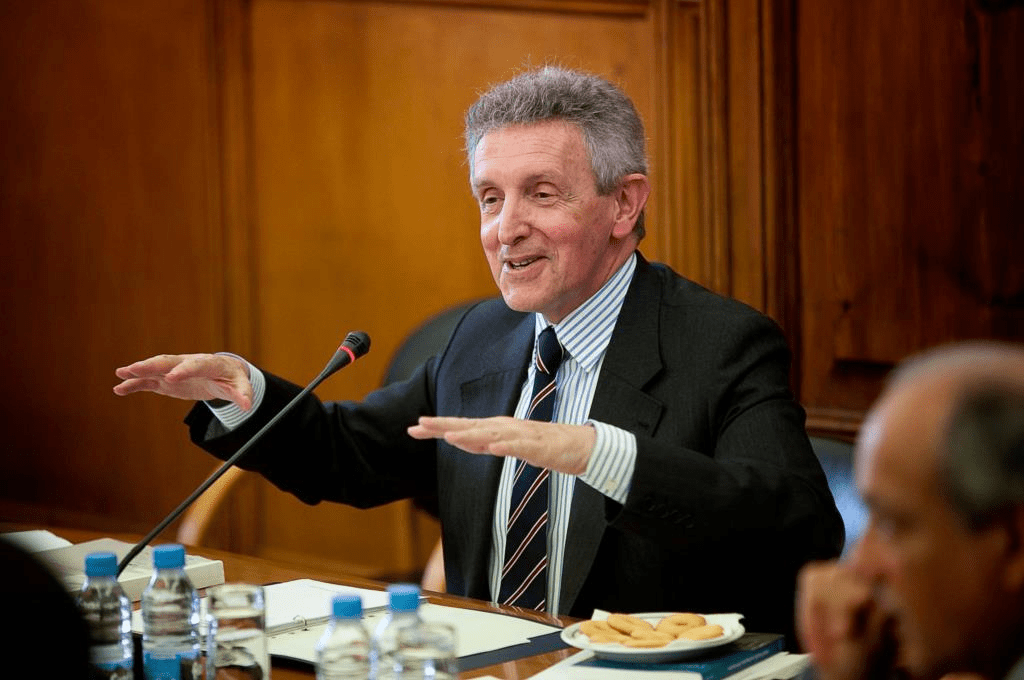
Last week, the University of the Azores paid tribute to its Founder and First Rector (President as we say in the US), Professor José Enes, at a colloquium organized by the Center for Humanistic Studies of the Faculty of Social Sciences and Humanities, whose Director is Professor Maria do Céu Fraga. Unfortunately, I could not attend due to illness, which I greatly regret. So I hasten to join in this tribute, evoking in my turn a character with a fundamental and even decisive role in the construction of the present and future of the Azores.
Familiar with philosophical reflection at the highest levels of abstraction in metaphysics, José Enes was both a strongly committed citizen and a man of action.
The unforgettable Study Weeks of the sixties of the last century are there to prove it. But his most outstanding achievement is undoubtedly the University of the Azores, of which he was the main driving force, as Chairman of the Installation Committee of the University Institute, which preceded it for a short period, and its first Rector. It is also fair to remember some of the people who accompanied him in these tasks, namely Professor Gustavo de Fraga, who left his chair at the University of Coimbra to lay the foundations for humanities studies, without which there is no real university value in any higher education institution; and the then young researcher Vasco Garcia, who later also became Rector (President) of our University for two full terms.
Even after leaving office as Rector, José Enes maintained his management responsibilities in various university organizations, carrying out tasks of critical significance for the establishment and prestige of the University as a fundamental institution in affirming Azorean identity.
His in-depth knowledge of the history of the Azores and the much he had meditated on over the years gave him a vision of great wisdom about our realities and his duty. Therefore, he was consulted and listened to attentively when doubts or new problems arose in the construction and consolidation of the present and future of the Azores. This was also an undeniably effective form of civic intervention.
In 1984, I invited him to give a lecture promoted by the PSD/Açores to commemorate the tenth anniversary of the April 25 Revolution. The text was included in the volume “Açorianidade e Autonomia,” published during Mário Soares’ Open Presidency in the Azores in 1989, and is also included in the book Portugal Atlântico, which contains scattered texts by José Enes.
José Enes’ speech made a deep impression on most people who came to hear it in the cloister of the old Convento da Graça, which had been converted into an auditorium.
I immediately remembered the vital reference to the Central Government’s refusal to authorize the construction of a port on the island of Faial, proposed by the American government shortly after the independence of the former British colonies in America, but without any initiative to proceed with such an improvement on the Portuguese initiative. In fact, it took a lot of insistence and constant pleading with Lisbon to finally get permission to levy a tax on the taxes paid on our islands and received in full by the Crown to finance these port developments in Horta and Ponta Delgada, almost a century later. In this last phase, the role of José do Canto and other Azorean citizens was influential in bringing this claim to an end, which ultimately put the payment for the ports on the shoulders of our people to benefit the whole country. Fortunately, we are working on different terms today, thanks to our Constitutional Autonomy!
With accurate prophetic intuition, José Enes spoke in the text mentioned above of misunderstandings and difficulties in the autonomous process on the part of the Central Power. By the way, once the initial tensions had been overcome, we went through a period of calm in relations between the Azores and Lisbon. But it wasn’t long before a real campaign was unleashed to reclaim the powers of the state, which had been usurped by our new institutions of democratic self-government, in an interpretation of the precepts of the Constitution that was too bold, in the opinion of the leaders of this campaign and their agents on the island.
The firmness with which we responded to these moves was based on the conviction, also expressed by José Enes in the exact text, of the truth and legal value of the Azorean autonomist aspirations invoked in a constitutional precept. Nor could we let go of prerogatives that, in the end, express, in his words, “the fascination of the surprising realization of an ideal with such fullness that it surpasses all the expectations of the generations that ardently dreamed of it.”
Without ever having held office in the autonomous body, José Enes undeniably has a rightful place in the gallery of honor of the Patriarchs of the Autonomy of the Azores.
João Bosco Mota Amaral Was the first President of the Autonomous Region of the Azores From 1976 until 1995.
NOVIDADES will feature occasional opinion pieces from various leading thinkers and writers from the Azores to give the diaspora and those interested in the current Azores a sense of the significant opinions on some of the archipelago’s issues.
Translated to English as a community outreach program from the Portuguese Beyond Borders Institute (PBBI) and the Modern and Classical Languages and Literatures Department (MCLL)
 Novidades - The Islands and the Diaspora