

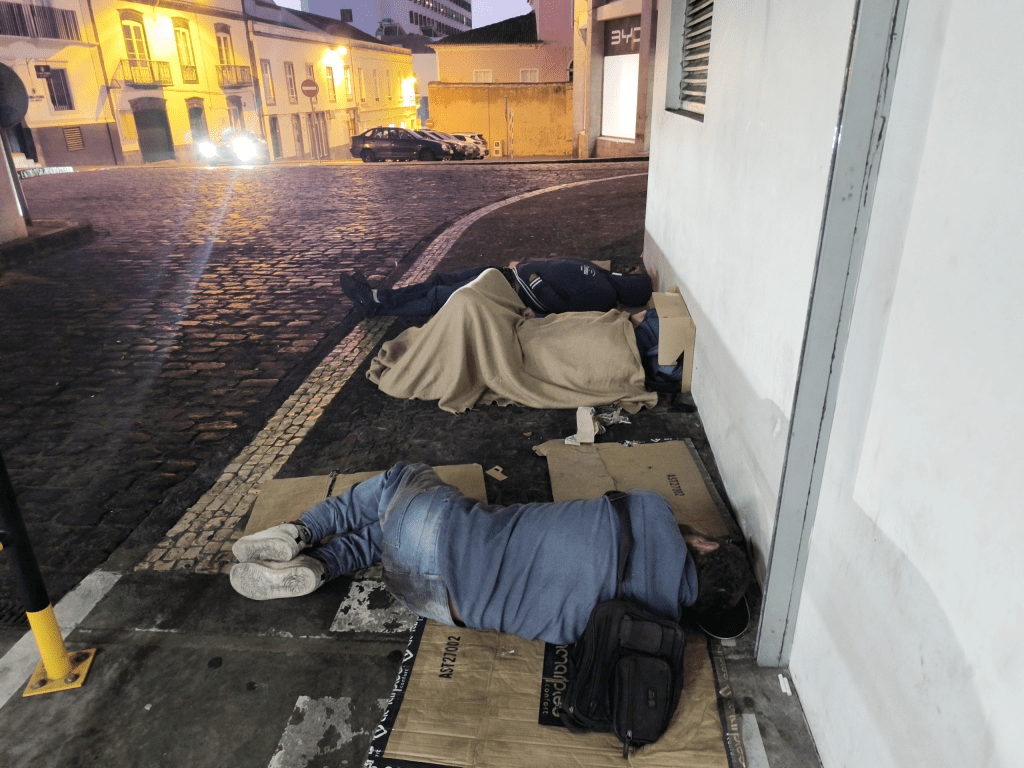
The Parish Assembly of São Sebastião in Ponta Delgada, the largest city in the Azores, has invited all public entities and active forces in society (the public prosecutor’s office, governmental and judicial entities, police and judicial forces, political forces with regional and national parliamentary seats, the city council and parish council of São Sebastião, public schools, social centers, and public and private associations, and the entire population of the parish) to participate next Monday in a discussion and debate on the “Problem of drug addiction and drug trafficking in the parish of São Sebastião and possible legal measures to be taken to mitigate it.”
This pertinent subject will be debated at the parish’s Multipurpose Pavilion, starting at 8:30pm, and is because there has been “an increase in drug addiction and drug trafficking” in the parish of São Sebastião. “Unfortunately, this is not only the case in our parish and its neighboring parishes but also in most of the parishes in the municipality of Ponta Delgada and the other municipalities on the island. This scourge afflicts us all and is worrying if urgent measures are not taken to mitigate its harmful and serious consequences, which are foreseeable in the not too distant future,” as stated in the Memorandum released by the São Sebastião Parish Assembly.
According to the same memorandum, “the problem of drug addiction and trafficking has been a recurrently debated issue in successive ordinary sessions, in which the president of the respective parish council has repeatedly shown his concern, warning of the serious problem that, with the growth of the indigence as mentioned earlier of spirit, has been verified in the parish, especially in well-identified places, where the frequent gathering of drug addicts and homeless people is clearly worrying, leading us to believe that these places are authentic markets for the sale of illicit substances, as well as real “kicking rooms,” thus increasing a feeling of insecurity on the part of the population. The case of Arquinha is one of these paradigmatic places in the parish,” they say.
This issue, according to the same organization in the memorandum, “not only affects drug addicts and the homeless but an entire population that is thus subjected to their excesses, many of whom are already in some degree of danger due to their need to obtain, by any means, the means necessary to satisfy their addictions (this means, naturally and especially, the acquisition of illicit substances for their own consumption).”
The Parish Council also refers to the fact that everyone is aware that “the consumption of these substances has increased greatly with the use of so-called ‘synthetic drugs’, which experts say are more accessible, but much more serious in their effects, making the reactions of their consumers absolutely unpredictable, and they don’t look at any means to achieve their ends. Any attitude of coercion towards people in order to obtain the means to support their addictions, for them it is indifferent whether they do it in a more or less rational way (as if that were possible) or by resorting to gratuitous violence. For them, leaving those affected, physically or psychologically, with their approaches is the same as giving them a warm hug or a friendly handshake.”
Happily, the note goes on to say, “It seems that we haven’t yet reached a generalization on this point, apart from a few difficult situations that have already occurred among the ‘drug addict and homeless community’, but unfortunately we are on the way there with the occurrence of some well-known episodes in which people, mostly the elderly and tourists, have been ‘bothered’ and harmed by members of that community who circulate freely in our city.”
The parish council recalls that “this is not the first time that the São Sebastião parish council has promoted an awareness-raising campaign among the population, with the participation of the city’s active forces, to debate this issue and discuss possible measures to mitigate it. This was the case, for example, at an information session held in October last year. A year on, “there is a perception that the problem has worsened dramatically and that the number of drug addicts has been on an upward curve.
Monday’s debate aims to try and find measures to mitigate this situation. The São Sebastião Parish Council is “aware, however, that the solution to this problem will not be an easy task, but that perhaps something useful can be done if we all unite in combating this real scourge of our society. What everyone can do in their own area of action can contribute to a whole that, in some way, prevents greater evils and avoids more serious and irreversible consequences for our society in the future,” the memorandum reads.
It should be remembered that the problem of drugs and homelessness has concerned the various parishes in the center of Ponta Delgada. Still, it is a problem that extends, in particular, to the island of São Miguel. The island’s mayors have expressed great concern about the increase in drug users.
Nélia Câmara is a journalist for the Correio dos Açores-Natalino Viveiros, director
Translated to English as a community outreach program from the Portuguese Beyond Borders Institute (PBBI) and the Modern and Classical Languages and Literatures Department (MCLL) as part of Bruma Publication and ADMA (Azores-Diaspora Media Alliance) at California State University, Fresno, PBBI thanks Luso Financial for sponsoring NOVIDADES.


 Novidades - The Islands and the Diaspora