

Three out of 10 Azoreans were at risk of poverty or social exclusion in 2023. According to a report by the National Observatory for Combating Poverty, released on Wednesday, with data for 2023, the Azores are the most vulnerable region in the country, with a risk of poverty or social exclusion rate of 31.4%. Since 2021, the region’s poverty indicators have gone against the downward trend observed since 2018.
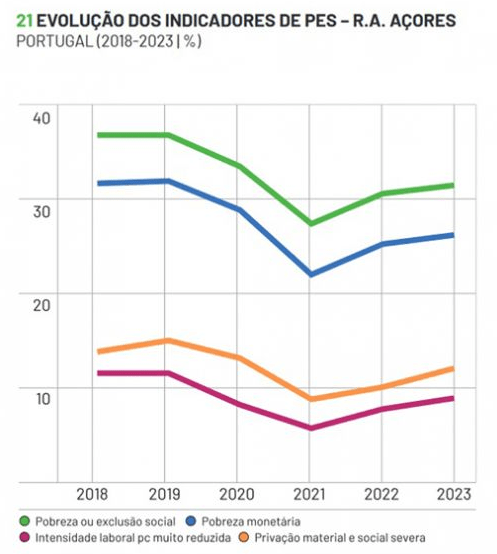
“The Autonomous Region of the Azores (RAA) recorded a rate of 31.4% at risk of poverty or social exclusion, standing out as the most vulnerable territory in the country, with an increase of 1.1 percentage points (p.p.) compared to the previous year. The monetary poverty rate in the ARA also rose to 26.1%, while severe material and social deprivation reached 12%, more than double the national average,” reads the report.
In 2018, the region was already positioned “as the territory with the highest level of poverty or social exclusion, with the highest rates of monetary poverty, severe material and social deprivation and very low work intensity.”
Compared to that year, the region’s at-risk-of-poverty or social exclusion rate is now 14% lower. The at-risk-of-poverty rate has fallen by 17.4%, very low per capita labor intensity by 21.9%, and severe material and social deprivation by 11.8%.
Increase in poverty
However, the region’s trajectory between 2021 and 2023 went against the one recorded since 2018.
“Between 2018 and 2021, we saw a dynamic reduction in these indicators, marked by a strong intensity (-24.7% at-risk-of-poverty or social exclusion rate; -30.7% at-risk-of-monetary poverty rate; -51.8% very low per capita labor intensity and -36.0% severe material and social deprivation),” the document states.
“From 2021 to the present, there has been an increase in all the indicators (+14.2% at-risk-of-poverty or social exclusion rate; +19.2% at-risk-of-cash poverty rate; +61.8% very low labor intensity per capita and +37.9% severe material and social deprivation),” it adds.
The autonomous regions continue to have the highest levels of at-risk-of-poverty in the country. Still, unlike the Azores, in Madeira, where the risk of poverty or social exclusion reaches 28.1%, “there are downward annual variations in all the indicators.”

Distance from the national average
In the Azores, the at-risk-of-poverty or social exclusion rate (31.4%) increased by 1.1 percentage points between 2022 and 2023 and distanced itself by 11.3 percentage points from the national average (20.1%).
The same happened with the risk of monetary poverty, which in 2023 was 26.1%, 9.1 pp more than the national average (17%).
Apart from the Lisbon Metropolitan Area, which saw an increase of 4.2 p.p., only the Azores increased their risk of monetary poverty (1 p.p.).
The very low work intensity per capita, which measures the proportion of people under 60 living in households whose adults aged 18 to 59 (excluding students) worked less than 20% of their potential working time, also rose by 1.3 p.p. in the Azores.
The rate reached 8.9% in 2023, 2.6 p.p., more than the national average (6.3%).
Severe material and social deprivation increased by 2.2 p.p. in the Azores, reaching 12%, “more than double the national average rate (4.9%).”
The “Poverty and Social Exclusion in Portugal—2024 Report” offers a detailed analysis of people at risk of poverty or social exclusion based on data from the 2023 Survey of Living Conditions and Income.
At the national level, “the at-risk-of-poverty or social exclusion rate remains the same as in 2022 (20.1%), but is accompanied by an effective increase of 20,000 people at risk of poverty or social exclusion compared to the previous year, amounting to 2,104,000 people”.
In 2023, considering 2022 incomes, “the at-risk-of-poverty rate corresponded to the proportion of people with a net monetary income per equivalent adult of less than 7,095 euros/year or 591/month”.
Portugal “recorded an at-risk-of-poverty rate of 17%, covering 1,781,000 people”, 85,000 more than the previous year.
This rate “is calculated after social transfers, i.e. including benefits for illness and disability, family, unemployment and social inclusion, and contributes to an additional reduction in the risk of poverty of 4.2 p.p. (from 21.2% to 17%)”.
In Europe, “only Romania has a lower impact than Portugal on the objective effects of social transfers in reducing the risk of poverty.”
in Diário Insular – José Lourenço, director
Translated to English as a community outreach program from the Portuguese Beyond Borders Institute (PBBI) and the Modern and Classical Languages and Literatures Department (MCLL) as part of Bruma Publication and ADMA (Azores-Diaspora Media Alliance) at California State University, Fresno, PBBI thanks Luso Financial for sponsoring NOVIDADES.


 Novidades - The Islands and the Diaspora