

The debate was concentrated on guaranteeing this “private/public service” and the independence of media companies and journalists.
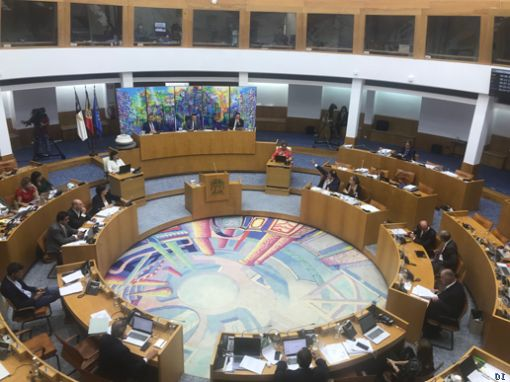
Yesterday, the Azores Legislative Assembly approved an extraordinary support program for the region’s private media. The bill passed with PSD, PS, CDS-PP, and PPM voting in favor and Chega, BE, and IL voting against.
At the initiative’s presentation, the Regional Secretary for Parliamentary Affairs, Paulo Estevão, said that these media “exercise a mission of unquestionable public interest, whose importance assumes particular relevance as mediators for information and the formation of a qualified public opinion, making them indispensable as a guarantor of democracy.”
He also mentioned the “mission of uniting all Azoreans and keeping the specific characteristics of each local community alive.”
“This extraordinary support is intended to safeguard jobs in all private media companies and aims to guarantee mechanisms that prevent a reduction in professional coverage of political, social, economic and cultural news, whether regional or local,” he said.
The extraordinary program, which has a total value of up to 480,000 euros, was announced at the beginning of the month by the President of the Regional Government, José Manuel Bolieiro.
“I am deeply convinced that it is the duty of democracy and our rule of law to support the free and impartial media, with the sustainability to provide its service,” he said at the time.
The regional executive president also stated his intention to launch a new support program for private media at the beginning of next year.
The proposed regional legislative decree states that these companies are facing “serious accumulated problems” due to successive crises and a drop in advertising and subscribers to their publications.
The initiative establishes an extraordinary regional support program for private media with headquarters, activity, and tax domicile in the region.

At stake is a non-refundable subsidy “equivalent to four guaranteed minimum monthly salaries.” This support is awarded to each worker with a fixed-term or open-ended employment contract for at least four full months.
The support can be combined with that granted through PROMEDIA (Regional Support Program for the Private Media).
José Pacheco, CHEGA’s parliamentary leader, began the debate by saying that Estevão was reminiscent of Goebbels, the Nazi propaganda minister.
“I only know one argument. We only pay the media when we want to dominate it. There’s only one reason, there’s no other. Any media company has the right, the duty, the opportunity to compete for any business support. What do we need more? Is it bread or news? Because today there is news everywhere,” he said.
“We have an RTP/Açores, which I love very much, an Antena1 Açores, which is part of the same company, which is the guarantor. As for the other companies, it works, it works. If it doesn’t, close the door,” he continued.
Nuno Barata, MP for the Liberal Initiative, agreed that “newspapers are considered important pillars of contemporary democracies” and have “an important role in monitoring power.”
However, he maintained that the media must be “free from pressure” and not dependent on public funding.
“There are other ways to help the Azorean media survive. There are other ways of contributing to the growth and transparency and better functioning of the media. It’s certainly not with a check at the end of the day, a kind of allowance, that we’re going to ask some people to take responsibility afterwards,” he said.
Paulo Simões spoke on behalf of the PSD and stressed that there was a shared concern about the media’s independence but that “solutions” needed to be put in place to respond to the crisis in the regional private media.
“Anyone understands that when there is a downturn in the economy, what do companies do first, one of the first measures they take? They cut back on advertising and newspapers and radio stations suffer as a result, but they also suffer in parallel with the increase in production costs, with inflation,” he said.

Paulo Simões added that “in the Azores, the situation is even more acute,” given the existence of small markets.
“Let’s never forget that if it’s not for the regional media, nobody cares about our islands, no newspaper or television in the country cares, except in the case of a hurricane or when there’s an event that brings someone important here. We are forgotten by the country’s media,” he argued.
Berto Messias from the PS considered this “extraordinary support at an extraordinary time.”
“This is a sensitive issue, no one is shying away from it, but we have to be able to guarantee that the support given to private and public media should be as objective as possible and clearly scrutinized,” he said.
The socialist party introduced an amendment to the law so that the Regional Government has a deadline of 30 days after the granting of this support to send Parliament a report with information on the applications submitted, the number of workers covered by each entity, and their professional category, the beneficiary entities and the value of the support granted per entity.
Left Bloc MP António Lima considered that the support criterion based on salaries could limit the freedom of journalists and that the proposal encourages precariousness since it does not distinguish between permanent and precarious workers and does not guarantee any continuity of jobs.
António Lima assured that the party would propose alternative measures to support private media, such as subscriptions aimed at young audiences, and defended the need to ensure that the region’s new collective bargaining agreement for journalists was complied with.

“We are clearly in favor of supporting private media. It is fundamental to our democracy,” he said.
Pedro Pinto, a CDS/PP MP, argued that this is “an air bubble” to maintain private media companies.
“These were the criteria the government found to meet the needs of these companies more quickly. They could have been other criteria, as the Left Bloc invoked, but these were the criteria and for the CDS, the criteria the government chose are acceptable criteria,” he said.
“If nothing is done, we risk losing the diversity and quality of the information available to citizens, which would have serious consequences for public debate and democracy. We cannot allow an independent, impartial, and transparent media to disappear,” argued João Mendonça from the Monarchist party.
in Diário Insular-José Lourenço, director
Translated to English as a community outreach program from the Portuguese Beyond Borders Institute (PBBI) and the Modern and Classical Languages and Literatures Department (MCLL) as part of Bruma Publication and ADMA (Azores-Diaspora Media Alliance) at California State University, Fresno, PBBI thanks Luso Financial for sponsoring NOVIDADES.

 Novidades - The Islands and the Diaspora