

Infamy has come down to earth and lives among us. At the proposal of Chega (the ultra-right political party), the Legislative Assembly, concerned about the criteria for admission and prioritization of places in social services, has recommended to the Regional Government that priority be given to children from working households in accessing crèches. In recent years, we have witnessed a mutation in the discourse of the so-called democratic right, which, distressed by the extremist drift to the far right, has appropriated its ideas, its vocabulary, and the hate it systematically spews out. It has become a herald of the unheard of. This is what we are witnessing when we see – astonishingly – social democrats, Christian democrats, and monarchists approving this shameful recommendation, which is included in the portfolio of hate media of the CHEGA movement.
In addition to being insulting, the approved Resolution is a cowardly and mean-spirited discriminatory measure designed to relegate to the limbo of marginality and poverty the children and families who most need institutionalized social support, who are going through periods of greater fragility due to the weaknesses of the industrial and commercial fabric in the Azores. The measure, however, has a hidden evil. It aims to punish those who, by tradition or necessity, are part of the informal economy, selling at fairs or just on the streets. These, in the eyes of the law (if the Resolution takes this form), are the new excluded because they will inevitably be slapped with the epithet “unemployed” and will see nurseries and childminders close their doors to them, in a sting of social degradation, shame, and exclusion that will only increase the social divide that is perpetuated in the region.
Therefore, hatred of others, punishment of the weakest, and pure infamy inspire these noble representatives. The “no is no” with which Montenegro closed the door on xenophobia and racism is unfortunately worthless in the Azores, with the power-hungry coalition voraciously and loudly swallowing these live toads born in the rottenness of wickedness and which will leave a trail of eternal shame on the regional deputies who made the Resolution in question possible. It would be better to have a star of any color – the color of the AD (national ruling coalition)- sewn on the coats of the children turned away at the door of the crèches, the new derelicts that the region is happily throwing out of education and pedagogical support.
When international principles and texts proclaim the need for early and universal education, our representatives replace the criteria with a raid on the private lives of the neediest families, whose good in their children’s training, education, and health cannot be praised enough. Instead of recommending the creation and expansion of childcare networks for all children, the Legislative Assembly is dedicated to persecuting the poorest and most vulnerable.
Unsatisfied, the same party returned to the charge in the October plenary session with the same objective: to stir up hatred in the persecution of RSI beneficiaries, extending its hatred to people with temporary incapacity certificates, in a shameful intervention in which not even psychiatrists were forgotten, with these specialists being the target of grave accusations.
In September, the color yellow was used for publications on the Regional Directorate of Health’s institutional page, with the warning to prevent suicide, which unfortunately happens frequently in our region. October 10 was Mental Health Day, which has been so popular recently. On October 16, at the House of Democracy, enough people raised suspicions about it without the Regional Government intervening to defend the dignity of psychiatrists or recalling the importance of Mental Health. The government has allowed lipstick, a dress, and a smile to be the criteria for assessing people’s mental health, perpetuating the stigma that exists about depression, which is an illness, just like Vulto-Van Silfhout-de-Vries syndrome, for example.
In fact, the coalition parties have made possible the lack of confidence in the government that they support because, having been heard in committee, it was clear that they enforce the law. In fact, they colluded with the stigma that the Azores are a “land of scoundrels,” which at this stage still has the status of “Azores Brand” due to the complicity of the Azorean Right with this type of generalization and permitted vocabulary.
It would be good to remember that life is not linear and that absolutely no one is immune to the need for social support or depression.
Our region’s (Autonomous Region of the Azores) problem is not the poor but the bet and incentives in sectors that pay poorly. The situation in this region is the unfair distribution of wealth.
By the way, given the exponential rise in the indicators measuring poverty in the Azores, I would like to ask you where the poverty diagnosis study commissioned by the region has been. How long has it been since it was commissioned, and has the result been converted into a Regional Plan for Social Inclusion and Citizenship? The argument is that it was delayed because the fire at HDES (hospital in Ponta Delgada-Azores) doesn’t hold water. Or is it that the conclusions and strategies proposed were not to their taste?
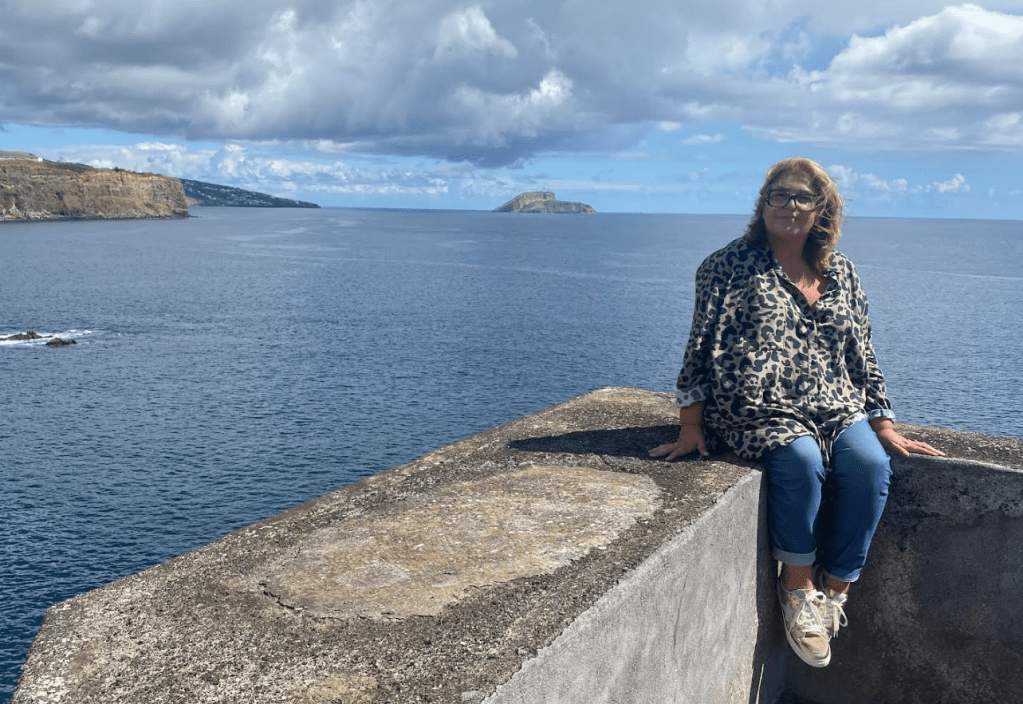
Alexandra Manes publishes regularly in Azorean newspapers. She is originally from the island of Flores and currently makes her home in Angra do Heroísmo, Terceira, Azores.
NOVIDADES will feature occasional opinion pieces from various leading thinkers and writers from the Azores to give the diaspora and those interested in the current Azores a sense of the significant opinions on some of the archipelago’s issues.
Translated to English as a community outreach program from the Portuguese Beyond Borders Institute (PBBI) and the Modern and Classical Languages and Literatures Department (MCLL)
 Novidades - The Islands and the Diaspora