

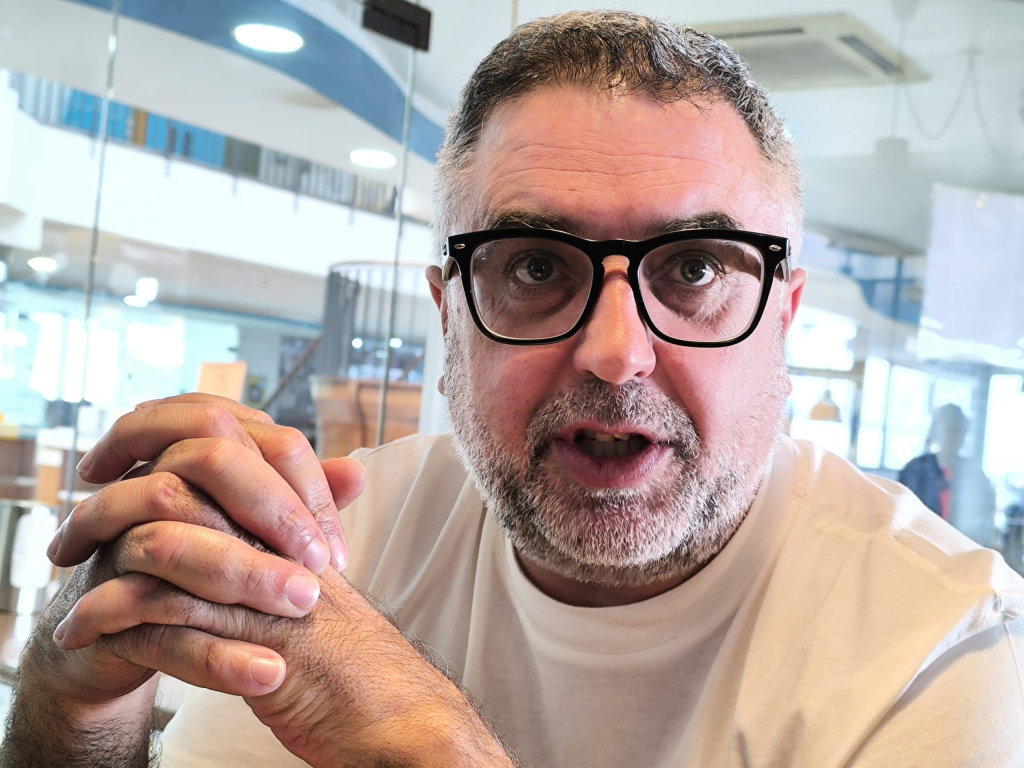
The three Italian Gostner brothers were in the region to hire maintenance technicians for
for SATA Air Açores for a fleet of 14 Dash-8 planes, which could rise to 50.
When he finished school in Ponta Delgada, Álvaro Pereira was in a dilemma: attend university or become an aircraft maintenance technician. He went against his parent’s advice and opted for the latter. Today, he is the director of aircraft maintenance technicians at Skyalps, a company with an airport in Bolzano, in the Italian Alps. He is in charge of the technicians maintaining a fleet of 14 Dash-8 planes, which can number up to half a hundred. It’s evident that Skyalps is interested in flying its Dash-8 400s between the Azores islands, but Álvaro Pereira is cautious. He is making his application for next year’s international public tender for connections between the Azorean isles, dependent on the content of the specifications. However, Skyalps will almost certainly participate in the tender, not least because of the price. In his conversation with the journalists from ‘Correio dos Açores’, he showed that he had learned his lesson. He says it’s possible to fly more cheaply between the islands of the Azores with incentives for Azoreans to travel more between the islands by air, giving the planes more turns. Therefore, at less cost. The three Gostner brothers (all pilots) were with Álvaro Pereira in the Azores, where they hired several aircraft maintenance technicians that he wouldn’t specify. The Gostners fell in love with the region and said, “The Azores are like a diamond in the rough and you have to be careful not to turn it into a mass destination.”
Correio dos Açores – Where was Álvaro Pereira born?
Álvaro Pereira (Technical Director of Aircraft Maintenance) – I was born in Ponta Delgada, in the parish of São Sebastião. I did my schooling here on the island, first at Passarada and then at Domingos Rebelo Secondary School. I was supposed to continue my studies and go to university, but the opportunity arose to do a TMA course, aircraft maintenance technician, at TAP. I graduated at 18 and went to work for SATA, where I stayed for 16 years.
After that, I decided to go to Holland when SATA bought the Bombardier Dash-8s. I went to work for a repair station called Samco in Maastricht. Then I started doing what is called ‘start-ups’; in other words, when a client buys an airplane, I would go for six months to train the client’s technicians to explain what had to be purchased and what needed to be in stock. I then spent two years in Nigeria and Lagos and three years in Russia. I was also in India for two years, always working for Bombardier, doing maintenance and opening a maintenance center in India.
I then went back to Europe, where I was in Malta, working for Medavia. I was also Maintenance Manager, and we set up an ‘authorized service center’ for ‘The Havilland’, which is now the Dash-8 aircraft factory.

Your profession allows you to see the world…
I’ve always had to travel a lot. I’ve had an upward career. After Malta, I went to Skyalps. I already knew the Gostner family. There are three brothers, and they own the company.
It’s a private company that owns a considerable energy group called Friel Green Power. The family, who love airplanes, decided to buy Bolzano Airport in 2019. Even then, I helped buy the first two planes. Since I was in Malta, I have always helped, being a kind of advisor, in this project, especially in purchasing and maintaining planes.
Skyalps was supposed to be a small company that served Bolzano in the Italian Alps. But then we saw an opportunity in the market, especially after some bankruptcies due to the pandemic, to buy planes at a reasonable price and that the business had the chance to grow. We currently have a fleet of 14 Dash-8 planes.
Where do you operate?
We operate scheduled and charter flights all over Europe. Of course, we operate more in the Italian market, but we operate all over Europe, from Austria to Germany, the aforementioned Italy, and the Baltic countries, such as Croatia and Bosnia.
During the years you were away from the Azores, were you able to come here?
I’ve never forgotten the Azores, and I try, whenever possible, to come here for a week every two months. Sometimes it’s not easy, especially in recent years with the purchase of airplanes and the expansion of the business.
Do you plan to buy another type of plane apart from the Dash-8 400?
No. This plane has a special feature: per passenger, it uses the least CO2. We believe that of the market that already exists in Europe, what is lacking are small planes that can serve as a link between small towns and large cities. In Italy and Germany, regional aviation has almost completely disappeared since COVID-19.
Would you advise SATA to fly Dash-8s to Lisbon?
Not at all. It’s very complicated to fly that distance due to fuel limitations. It’s at the limit of the plane. The ideal time for a Dash-8 to fly is 1.5 hours, two hours maximum. And here we have something else: the sea. There’s no alternative for landing, so it’s not the ideal plane for flying these distances.
Has Sky Alps considered taking a stake in Azores Air Lines, which is being privatized?
There isn’t much interest in going public with Azores Air Lines. Our interest lies in the regional public tender in the Azores, where we can form a partnership and see what the regional market is.
So, do you accept a partnership with SATA Air Açores in the regional market?
No, and we have to be careful with what we say not to create expectations. We’re interested in the public tender since it’s a European public tender. We already have planes that do practically the same thing in Italy, but there, it’s called territorial continuity. We’re looking at all the possibilities of expanding the fleet.
The plan is to grow and have a fleet of between 25 and 50 planes. We want to have a footprint throughout Europe, and of course, the tender here is very attractive, not least because of the sums involved.
So, will Sky Alps look at the following public tender for internal travel?
Yes, we will. And I can tell you that the tender will be next year.
What was the purpose of Sky Alps' visit to the Azores? We came here with the intention of holding what is called an 'Open Day', in other words, a day where we are available to talk to aircraft maintenance technicians and mechanics who want to join us. We think that there are experienced technicians and mechanics here. We can offer better conditions than there are here, for example the salary is higher in Italy. Fortunately, we managed to recruit some technicians at this Open Day.Next month we'll be in Poland holding the same kind of event as we do here and in December we'll be in Greece with the same aim. We're trying to go to regions or countries where the Dash-8 has already been used and therefore have people with experience who can help us and be an asset to the group.In addition to the operation in Bolzano, we've opened a new company in Turin, Skyalps, just for aircraft maintenance. We're going to start doing the most complex maintenance on our planes, the so-called 'heavy maintenace', and we need to recruit technicians. We have 75 vacancies and we need numbers to keep growing and buying more planes. With this project, we're opening up the company to new customers. And we also have another project to maintain private jets. Did the Gostner family like the Azores?They loved everything about it, from the golf courses to the climate. Of course, they are very interested in the region and have seen that it has enormous potential for tourism. These are areas in which we are involved, since the group also has hotels and golf courses. It's an area that the group already knows. The Azores have enormous potential for tourism growth.

Do you regret not going to university and becoming an aircraft maintenance technician?I don't regret anything (laughs). I think my parents were sadder at the time because I had the chance to continue my studies. As I love airplanes, it was a good decision for me. I started out as a technician and I'm now Maintenance Manager. It was impossible to grow up here in this way and the fact that I've been all over the world, getting to know other experiences, has given me a great deal of experience that makes all the difference to my career. Have you started a family? I have my partner, but no children. My life doesn't allow me to have children, as I travel a lot. One of the reasons I was able to leave SATA and travel the world was because I didn't have children. If I did, it would be very difficult to have the lifestyle I have.In which of the countries did you have the most trouble adapting?Russia. It was very complicated. Firstly, because there's a huge language barrier and we were in Siberia, in Yakutia. It's a region that can get down to minus 65 degrees. It was a very different experience, I was there for three years. Apart from the language, there was a huge cultural difference. Sometimes it was difficult to explain to them that there are rules and that things are done according to a manual. Is it difficult to reconcile several technicians, of various nationalities and with different experiences, all under the same roof to work in the same way?No, it's easy. For example, we have 10 nationalities in our hangars. There has always been a rule in aviation that English is our language, our manuals are all in English. And then aviation has invented everything there is to invent, the rules are well defined and it's not difficult to bring different people together. Of course, there are always small cultural and language differences, but it's not difficult to reconcile everyone or the whole team.Sky Alps wants to grow to 50 planes. And when you reach this limit?At the moment we're not growing any more because there aren't enough people to work with. The biggest problem is the lack of manpower, particularly pilots and maintenance technicians. There simply aren't enough of them. The aviation market is irregular, it's always going up and down, and we don't know the future. At Sky Alps we have to arrange strategic partnerships with larger companies, because this is what will enable us to open more routes and more destinations. We always have to have a big company working with us so that we can be a feader for the big cities. For example, Bolzano is an operation for four or five planes at most. Returning to the tender in the Azores. Can we say that SATA will have a competitor for the inter-island routes?It's something that's being studied. By this I don't mean yes or no. It's a possibility. We'll see what the specifications are and how we can do it best. SATA and the Azores are close to my heart, but I think something has to change because things are not being managed in the best way. What do you mean by that?In my opinion, the Azoreans deserve a little better. In terms of quality, SATA is undoubtedly a world-class company. Even in terms of quality of maintenance and safety.But I think there are other possibilities on the inter-island routes that could increase the number of passengers and better serve the smaller islands. Encourage people to go and make the internal market grow. There is a way to grow, internally, but to do so, the type of aircraft used has to be the Dash-8. You have to do more rotations so that you can lower the price per passenger. This is the only way to create more business. Of course, there are always specifications and limitations on the number of passengers and the number of flights to each island. But, without a doubt, we have to invest in quality tourism. We can't do inter-island tourism like the low-cost companies. We have to focus on quality so that the locals don't lose their quality of life. I was scared when I came this summer and everything was full of people to go anywhere. There needs to be a greater distribution of people across the nine islands of the Azores.And how can this be achieved?We can achieve it with more flights, with day packages that can serve other islands, especially those with less tourism. You can't centralize everything on two or three islands. There is enormous potential on islands like Flores, Corvo, São Jorge and Graciosa. The Azores are like a diamond in the rough and we have to be careful not to turn it into a mass destination. It has to be a quality destination. There's always the economic aspect and no one is going to come here to lose money. The operation is very complicated and has many limitations, but it could be better.
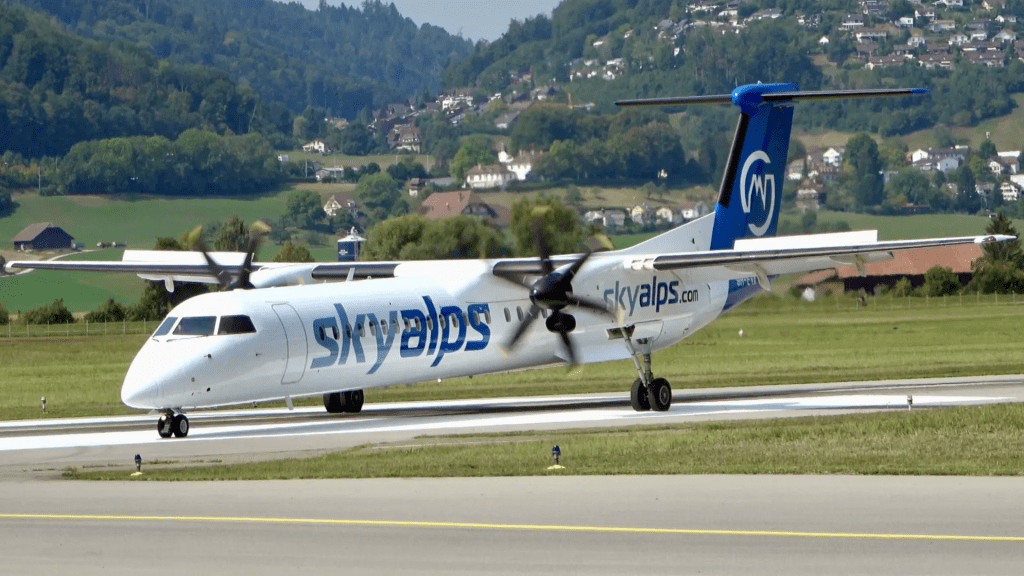
One of Sky Alps' concerns, operating only with Dash-8s, is environmental concern?The Dash-8 is the aircraft with the lowest CO2 emissions per passenger. The planes on the world market at the moment are very old designs. Nothing new has come out yet and, in my opinion, the transition to electric or hydrogen-powered planes is still a long way off. What is available on the market are the Dash-8 400s, which can be used for flights of up to 1.5 hours to two hours. Of course we are concerned about this. The group is called Green Power and has always been focused on renewable energies. It's focused on trying to ensure that the next generation can have a world like ours. As the company comes from the Alps and nature, it has always been our aim to minimize CO2 as much as possible.We have other projects, in relation to the Dash-8, to make the plane more efficient. We want the plane to consume less fuel by installing winglets. There is the possibility of starting to produce synthetic fuel, which is called SAFA, but it's not viable yet. It's too expensive.Your brothers didn't want to go into your field?No. They always stayed in the Azores and started their families. One is a teacher and the other is a nurse. I'm the only one in aviation and I can say that the three of us are the pride of our parents.Is it in your plans to return to the Azores permanently?It will be very difficult!Frederico Figueiredo/JP–Correio dos Açores

In Correio dos Açores-Natalino Viverios, director
 Novidades - The Islands and the Diaspora