


João Fontiela, a researcher at the Institute of Earth Sciences (University of Évora), recalled the last volcanic eruption that Terceira experienced during a lecture he gave on Thursday in Angra do Heroísmo.
The seismologist described the events of April 17, 1761. “The eruption began between the Santa Bárbara area and the central part of the island,” he said.
In the spring of 1760, there began to be a marked reduction in fumarolic activity in Furnas do Enxofre. From November of that year, he described how earthquakes began to be felt all over the island.
A robust seismic event of undetermined intensity occurred on April 14, 1761, marking “an increase in the frequency and intensity of earthquakes, accompanied by volcanic tremors.”
On the morning of the 17th, the first eruption occurred between Pico Gordo and Serra de Santa Bárbara, lasting 10 to 12 days. The second eruption began four days later, “of the Hawaiian type with strombolian episodes and ash falling all over the island.”
The researcher from the Earth Sciences Institute said this second eruption, at what is now known as Pico do Fogo, lasted for eight days.
“When we go along the bush road towards Biscoitos, we find, to the right and to the left, fields of rock cut by the road, which are from this eruption,” he said.
According to the seismologist, there have been 26 eruptions since the settlement of the Azores, “half subaerial and half submarine.” Seven eruptions occurred in the 20th century, but only one progressed to subaerial, the Capelinhos volcano in Faial.
The submarine eruption off Serreta is the most recent in the archipelago, lasting from 1998 to 2000.
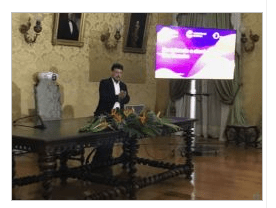
João Fontiela explained that “the Azores have a very complex structure,” being “on the edge of three plates, the Eurasian, the American and the Nubian.”
“The Central Group, in particular, is delimited by a platform defined by a depth of 2,000 meters. This means that the Central Group area has a high rate of magmatic extrusion,” the seismologist described.
The Terceira rift “has a unique characteristic,” which is an alternation of depressions and elevations. “This unique structure crosses Graciosa, Terceira, and São Miguel,” explained the researcher.
In this scenario, João Fontiela considered Terceira to play a fundamental role in the geodynamics of the Azores and act as a pivot.
“In the western part of the island we have one behavior and in the eastern part we have another behavior and all these tensions generated by these behaviors accumulate in Terceira,” he summarized.
“This, for me, makes Terceira a fascinating island to study. This pivot that works in the geodynamics of the Azores,” he said.
in Diário Insular-José Lourenço, director.
if you want to see the entire conference in Portuguese, here it is on VITEC- Azores TV
Translated to English as a community outreach program from the Portuguese Beyond Borders Institute (PBBI) and the Modern and Classical Languages and Literatures Department (MCLL) as part of Bruma Publication and ADMA (Azores-Diaspora Media Alliance) at California State University, Fresno, PBBI thanks Luso Financial for sponsoring NOVIDADES.

 Novidades - The Islands and the Diaspora