

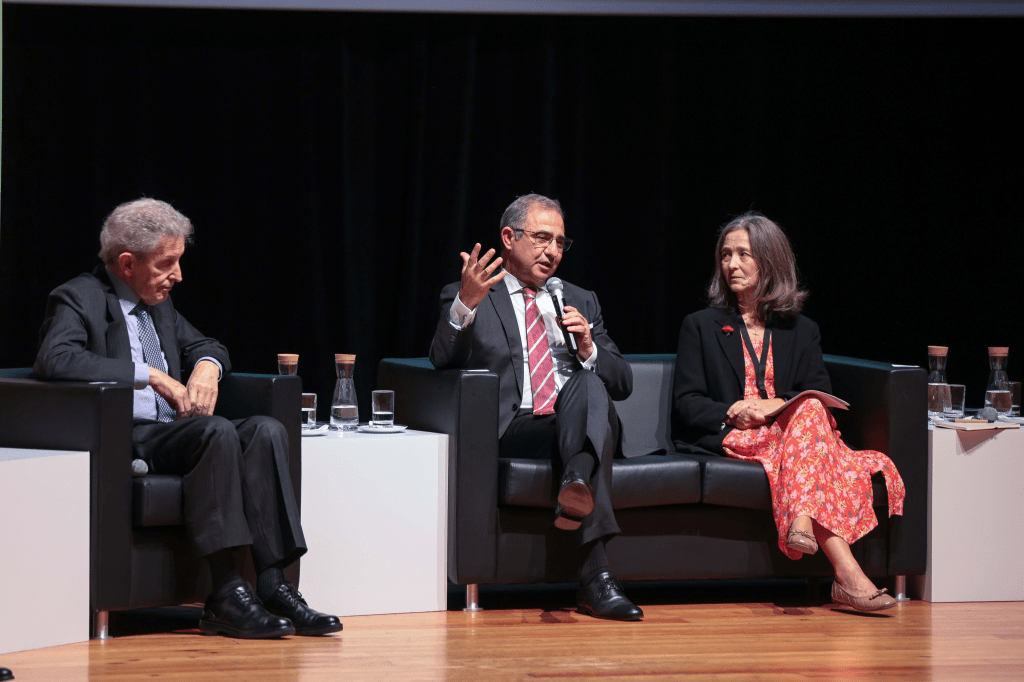
The President of the Government of the Azores, José Manuel Bolieiro, was present on Friday at the solemn closing session of the congress dedicated to the theme “Democratization, Autonomy and Decentralization.” The congress was held at the Aula Magna of the University of the Azores on the island of São Miguel.
The event featured a round table that brought together the leading figures in island autonomous politics from both the Azores and Madeira, including the current and former Presidents of the Regional Governments: João Bosco Mota Amaral, Carlos César, Vasco Cordeiro, and Alberto João Jardim. The debate was moderated by Maria Inácia Rezola, President of the National Commission for the Commemoration of the 50th Anniversary of April 25, providing a space for reflection on the evolution and challenges of democracy and autonomy in the island regions.
The leader of the Azorean executive highlighted the value of the democratic revolution of April 1974, which, by guaranteeing peace and ending the cycle of colonial war, profoundly changed the country’s course.
For José Manuel Bolieiro, this transformation should inspire the democrats who idealized and built this path in the past and today’s democrats, who still face threats from regimes that have little in common with democratic principles. He recalled Portugal’s situation before the revolution as an isolated country without a culture of participation and distant from the modern world, stressing that “it was democracy that paved the way for development, progress, and inclusion.”

However, he argued that the decentralization process must continue to be deepened since Portuguese democracy still has some reservations about autonomy and decentralization.
For the President of the Government of the Azores, the political and administrative autonomy of the Autonomous Regions of the Azores and Madeira is a valuable achievement of the democratic revolution, built on the pride of insularity and regional identity. However, he stressed, “This autonomy is not a gift, but a daily conquest that needs to be constantly renewed.”
“Our democracy, in its mature state, still has reservations about the autonomous process, about the decentralization process,” stressed José Manuel Bolieiro. He also emphasized the importance of Portugal’s Atlantic position, reinforced by the presence of the Azores and Madeira, which give the country global relevance in the Atlantic. Thanks to the new economies and the international visibility of the Autonomous Regions, the President of the Government of the Azores argued that Portugal should be “ambitious” in investing in its Atlantic centrality, taking advantage of the island’s potential.

Translated to English as a community outreach program from the Portuguese Beyond Borders Institute (PBBI) and the Modern and Classical Languages and Literatures Department (MCLL) as part of Bruma Publication and ADMA (Azores-Diaspora Media Alliance) at California State University, Fresno, PBBI thanks Luso Financial for sponsoring NOVIDADES.

 Novidades - The Islands and the Diaspora