

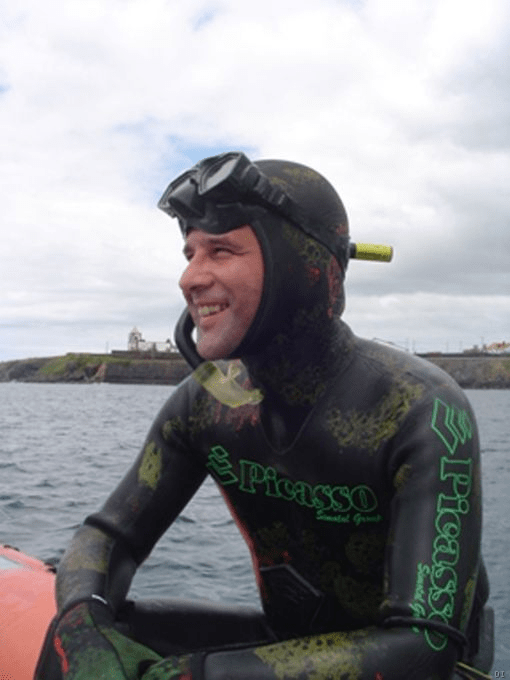
The creation of 30% marine protected areas in the Exclusive Economic Zone of the Azores has been approved by the Azorean Parliament. Do you maintain that, in essence, the new law does not protect what is essential?
That’s my position, unfortunately. I’m very sorry, but the fact is that this is pouring sand into people’s eyes. There has been a great deal of publicity, a series of congratulatory demonstrations, and self-propaganda from the Regional Government, which is perhaps natural, but this is a handful of nothing. All this noise and self-congratulation will result in nothing; it won’t solve any of the severe problems we have in the Azores, such as the depletion of living marine resources. Most of these marine protected areas do not cover highly productive regions. It’s deep sea and pelagic environments. Nothing has been done where it has been urgent for many years, along the coast and on seamounts, apart from the Condor Bank, which has already been protected for many years and shows the effectiveness and positive outcome of protecting a marine area very well.
Do you think there hasn’t been the courage to act in coastal areas?
I don’t know. Honestly, it’s something that amazes me. Another thing that surprises me a lot is that it’s not just this government’s responsibility; it’s because there has to be this close connection between the Oceano Azul Foundation and Blue Azores, which are not scientific organizations. These have their merits in many ways, particularly in disseminating beautiful images that captivate people. But that’s not science. That’s because the University of the Azores has a vast body of scientific output, which has been discussed for decades and presented all the solutions long ago. That bothers me as a citizen. I’m very sorry that this is another missed opportunity and, above all, another waste of time because nothing is being solved, and what is essential to protect is not being protected. Moreover, it doesn’t protect the fishing industry in any way – and I think the fishermen are being cheated in this whole process. For the time being, it won’t solve the current fishing problems. It’s also misleading people into making a severe mistake, thinking it will solve them when it won’t. Fishing will continue to have high catches. Fishing will continue to have increasingly limited catches, and things will
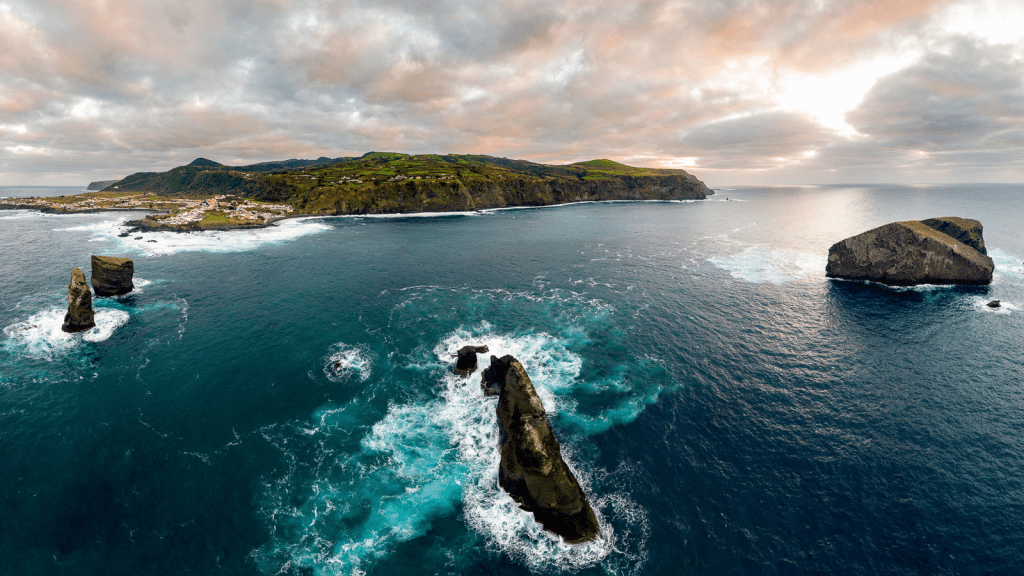
How do you feel about the University of the Azores’s exclusion from this process?
I find it bizarre, to say the least. I imagine myself in the position of someone in political power, something I’ve always refused. If I were in such a position, having the knowledge of the University of the Azores at my disposal, why wouldn’t I use that knowledge? On top of that, many of the government leaders, both in the PS governments and in today’s coalition, are members of academia, particularly in the field of the sea. It’s bizarre. I don’t know what this deification of the Oceano Azul Foundation and Blue Azores is based on. What is the need? To make posters and pretty pictures is fine. Prepare: Most people who come to the Azores to dive and see those things that appear in those photographs aren’t going to see them unless they go to a particular place.
If there is no will to create coastal reserves, what kind of scenario will we have in a decade?
If there is nothing, we will continue to worsen what we already have, which is already very bad. You don’t have to think about a decade; almost everything is already terrible, and it’s not just São Miguel and Terceira. We can already see this decline and decay on all the other islands, including the more remote ones, such as Flores. We are witnessing the dragging out of a lack of intelligent decision-making that continues over time and space, without recovering what can be recovered. There can be no recovery without integral coastal reserves, where nobody fishes anything, which doesn’t have to be vast areas. It also affects another important public sector, which is much publicized: observation and diving tourism. A diver who pays for a trip here will see very little. If they know what state it’s in, they won’t come. There is no way of thinking in the medium and long term, and this problem cuts across our democracies. More thought is given to electoral cycles rather than reflecting on what transcends the legislature. If this had been done 20 years ago, we would be talking differently now. I am very sorry and deeply saddened to see, over these decades, the decline that has taken place, the warnings and warnings that we have all given, and the inaction to do what was urgently needed.

A Restructuring Plan for Fisheries, a PS proposal, was approved as part of this diploma. Is it justified?
I’ll be candid, I don’t know how people are still thinking about restructuring fisheries when, at the moment, in our situation, I hope I’m wrong, but fisheries in the Azores are doomed to extinction. I don’t know the plan, but this area, too, over all these years, has had no medium-long term project. It hasn’t had the protection of the profession or the process of guaranteeing the minimum sustainability of extractive fishing. At the moment, what I imagine is a kind of early retirement for many fishermen. Otherwise, I don’t know how they’ll be able to continue their activity.
in Diário Insular-José Lourenço, director
Translated to English as a community outreach program from the Portuguese Beyond Borders Institute (PBBI) and the Modern and Classical Languages and Literatures Department (MCLL) as part of Bruma Publication and ADMA (Azores-Diaspora Media Alliance) at California State University, Fresno, PBBI thanks Luso Financial for sponsoring NOVIDADES.

 Novidades - The Islands and the Diaspora