

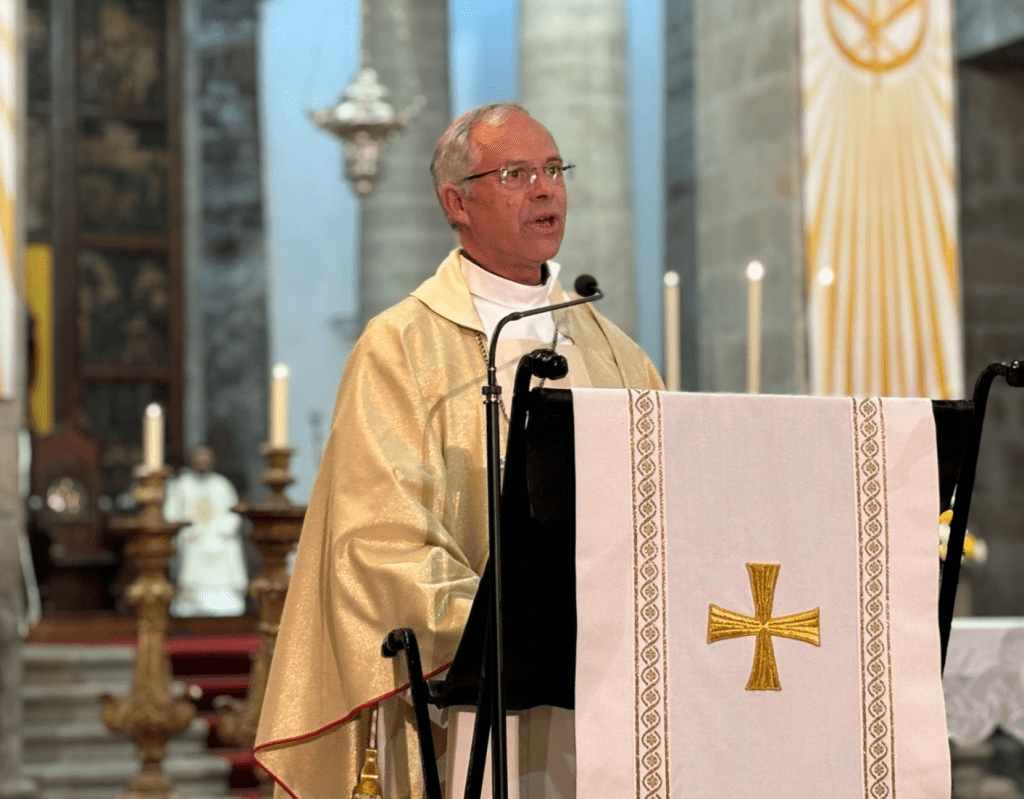
The diocese of Angra “has always been a lighthouse in the middle of the Atlantic, and we want it to continue to shine through life itself,” says the bishop of Angra on the day that the diocese marks 490 years since its creation and officially begins a new pastoral year, marked by the celebration of the Jubilee of Hope, giving continuity to the Pastoral Itinerary defined for the 2023-2025 biennium.
“490 years is a long time in the history of a diocese that has been made and continues to be made particularly remarkably. Within the Church, so much has been done for the instruction and education of people, for social welfare, and so celebrating 490 years is about giving thanks to God for the people who have served the Church over time and who, in serving the Church, have served the Azores. It is also about preparing for the future,” said the prelate in a conversation with Sítio Igreja Açores, which can be heard at midday on the radio stations Antena 1 Açores and Rádio Clube de Angra.
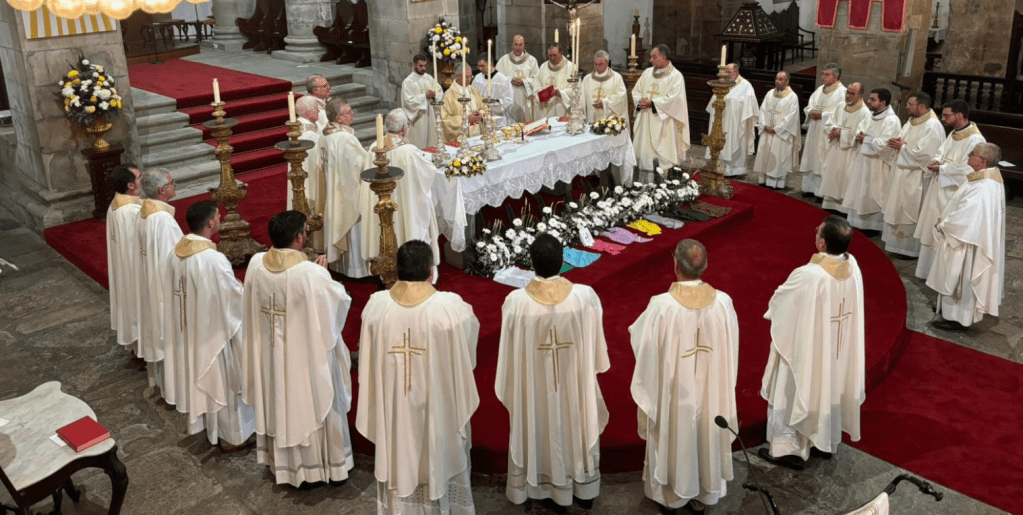
The program outlined for the pastoral year, which is strongly marked by the Holy Year of the Universal Church, which the Pope called the Jubilee of Hope, was presented at the Episcopal Seminary of Angra. The pastoral year began at 4pm at the Seminary and then at the Cathedral at 6pm, with a live broadcast on https://www.facebook.com/igrejaacores, celebrating this anniversary of the island church.
“The pastoral project is one of continuity, nature doesn’t come in leaps and bounds, and neither does a diocese suddenly,” said Archbishop Armando Esteves Domingues, stating that it is a continuation of the pastoral itinerary that began last year, based on a motto – Everyone, everyone, walk in hope – already a clear invitation to all of us to walk as a people with Christ and in this second year very much focused on the Jubilee of Hope’.
“This is what the Jubilee is all about: celebrating Christ and every 25 years the Church does it in a different way. He is our joy as Christians and that’s why we have this project, which we’re going to live very much on the basis of initiatives in Jubilee Churches,” the prelate continued.
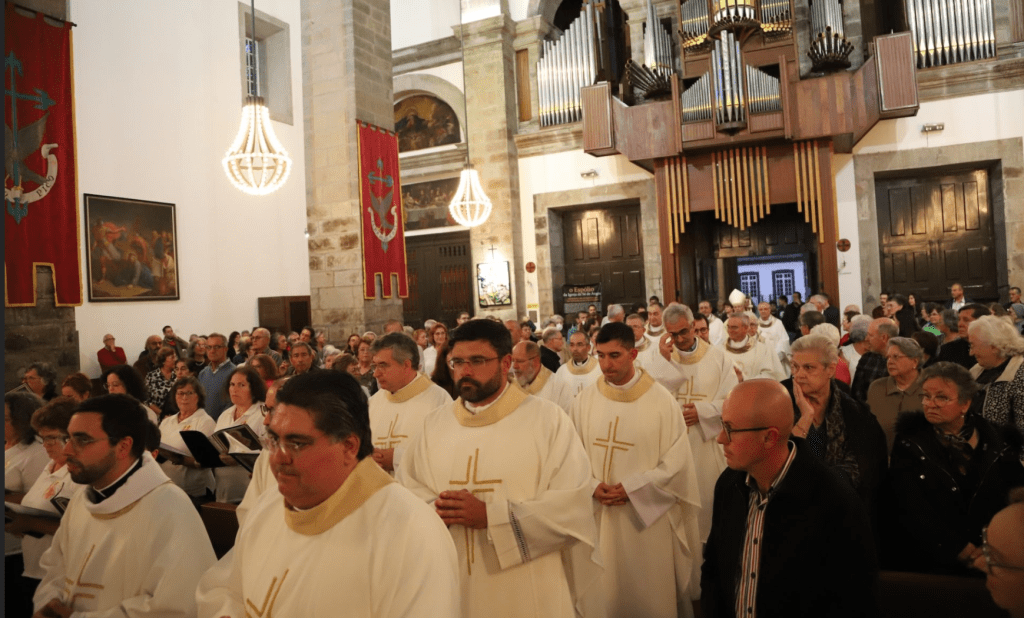
The diocese will have nine Jubilee Churches—one per island—and on three—São Miguel, Pico, and São Jorge—the Jubilee Churches will be the diocesan shrines of Senhor Santo Cristo, Bom Jesus, and Santo Cristo da Caldeira, respectively.
“On each island we will have a church where pilgrimages will converge (one of the most obvious signs of the jubilee) where Christians will be able to pray, celebrate the sacrament of reconciliation and obtain this indulgence which is the expression of God’s mercy,” he explains.
“This life is the new life that allows the renewal of the diocese. When we convert, when everyone renews themselves and manages to move forward, it’s an opportunity for grace. But we also very much want to open up to the world,” said the Bishop of Angra, who is presiding over the Diocesan Day celebrations for the second year in a row.
“I wish we could free ourselves from the chains that bind us and be hope for all those who suffer,” concluded the bishop of Angra.
The diocese of Angra was created by Pope Paul III through the Bull Aequum Reputamus on November 3, 1534, making it autonomous from the diocese of Funchal, of which it was a suffragan.
Since then, the island diocese has been governed by 40 bishops – the 40th bishop of Angra is Bishop Armando Esteves Domingues – only two of whom are from the Azores. The diocese is territorially divided into 17 ouvidorias; only São Miguel (8) and Terceira (2) have more than one ouvidoria.
The parishes of the Azores were first subject to the jurisdiction of the Order of Christ, exercised by the Vicar nullius of Tomar.
The first Catholic settlers were instructed by the Franciscans who arrived on Terceira Island in 1456, where they built a chapel and, in 1470, erected the Convent of São Francisco de Angra. In 1461, the Ermida de São Salvador was founded at the behest of Álvaro Martins Homem, founder of Angra. This chapel was the origin of the Cathedral of Angra do Heroísmo.
After discovering the Azores islands and their subsequent settlement, the ecclesiastical government of the archipelago went through three distinct phases.
The first phase goes from the discovery population to the creation of the diocese of Funchal, which in 1514 had jurisdiction over all the Atlantic islands, the coast of Africa, India, and all the Portuguese discoveries, making it the largest diocese ever to exist in the world.
In this way, we enter the second phase of the canonical jurisdiction of the Azores, which is now under the purview of the new Diocese of Funchal.
The third phase of the canonical jurisdiction of the Azores, which has lasted until the present day, began with the foundation of the Diocese of Angra.
Pope Paul III, by the Bull Gratiae divinae proemium, dated the same day as the creation of the Diocese, confirms the appointment of the first Bishop of Angra in the person of D. Agostinho Ribeiro (1534-1540).
The Church in the Azores has always been a factor of cohesion between the islands and has been responsible for many social works, from education to culture and assistance to the most disadvantaged. It always guarantees an effective presence in times of disaster.

From a Press Release by Igreja Açores. Photos courtesy of the Diocese of Angra.
Translated to English as a community outreach program from the Portuguese Beyond Borders Institute (PBBI) and the Modern and Classical Languages and Literatures Department (MCLL) as part of Bruma Publication and ADMA (Azores-Diaspora Media Alliance) at California State University, Fresno, PBBI thanks Luso Financial for sponsoring NOVIDADES.

 Novidades - The Islands and the Diaspora