

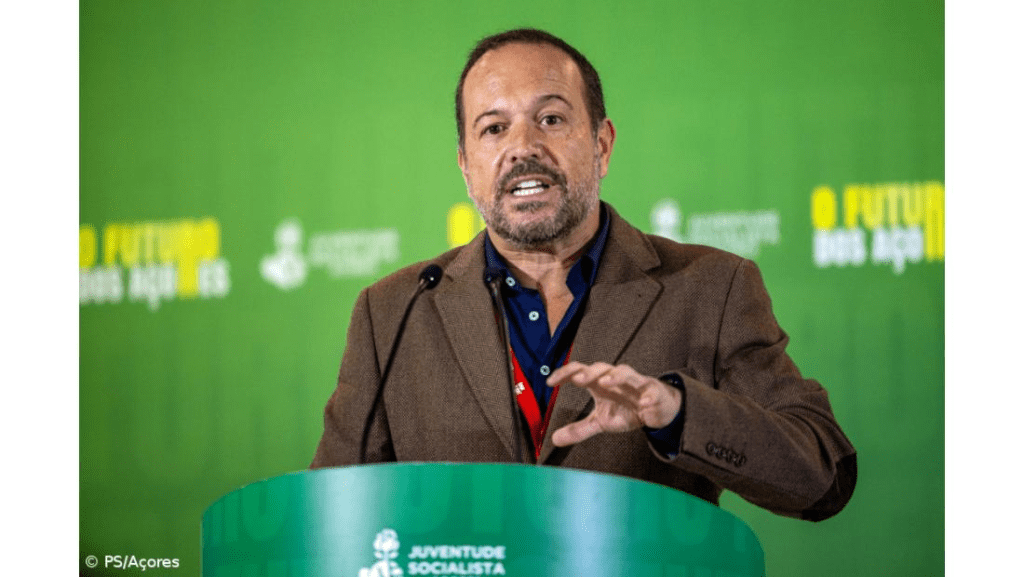
Francisco César said the party will not give up on this negotiation “until the last moment” and “is still waiting for a phone call.” If that call doesn’t come, it’s a “signal that has been given.”
The leader of the largest opposition party in the Azores spoke at the opening of the structure’s parliamentary days, which precede the consideration of the 2025 Plan and Budget in the Regional Legislative Assembly of the Azores, in the last week of this month.
In September, after an audience with the Regional Government President, Social Democrat José Manuel Bolieiro, as part of the consultation process on the draft Regional Plan and Budget for 2025, the PS presented a package of 11 measures to make the document viable.
César reiterated that he will present proposals for amendments to materialize the 11 points and add others in sectoral terms, with the aim of “alleviating problems” in the document.
According to the Socialist, “it costs much less to listen to Chega, who says he’ll approve it without difficulty.”
“If you want a viable budget, access to nurseries has to be universal, free and no one can be excluded,” he said.
César wants “no increase in debt” in 2025, noting that while the PS/Azores “is accused of leaving a debt of around 2.4 billion euros” in 24 years, the previous regional administration, in the space of three and a half years of right-wing management, “increased it by one billion euros.”
The PS wants to reduce the region’s debt to suppliers and is willing to “talk and negotiate about how the Regional Government can effectively meet these commitments if it is willing.”
Contrary to what the Regional Government claims, César added, there was net debt in 2024, “breaking the promise they made.”
The Socialists had hoped that in the archipelago, “everything would actually be much better” and that they would be able to “effectively keep up with the pace of the country, which is growing, has budget surpluses, the capacity to deal with problems”, following a “good legacy left by the PS governments.”
The representative challenged the idea of the bad legacy left by the socialist governments in 24 years: “If there hadn’t been the good conditions of the socialist legacy,” he said, the government of the Azores “wouldn’t have carried out the measures it is proud to have presented today.”
Francisco César subscribes to the need to revise the Autonomous Regions’ Finance Law, but “not in the way that has been said, that the Regional Government’s revenues have actually been lower.”
In about four years, with the right wing in power on the nine islands, he added, national and tax transfers have increased, as has the “highest ever amount of EU funds, between the Recovery and Resilience Plan and the Azores Operational Program”.
“There has been an increase of 400 million euros more per year than the socialist governments had in the same previous period,” he specified.
in Açoriano Oriental, Paula Gouveia, director
Translated to English as a community outreach program from the Portuguese Beyond Borders Institute (PBBI) and the Modern and Classical Languages and Literatures Department (MCLL) as part of Bruma Publication and ADMA (Azores-Diaspora Media Alliance) at California State University, Fresno, PBBI thanks Luso Financial for sponsoring NOVIDADES.

 Novidades - The Islands and the Diaspora