

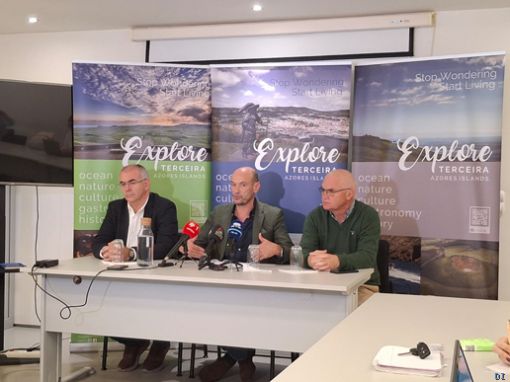
Marcos Couto, president of the Angra do Heroísmo Chamber of Commerce and Industry (CCIAH), expressed concern about the Azores’ financial sustainability and proposed a robust privatization plan for regional public companies.
“This extremely complex and adverse context requires, for the most part, a reformist impulse that includes, for example, the creation and implementation of a robust regional privatization plan, which includes companies in the public business sector, with Azores Airlines at the forefront,” he said at a press conference yesterday.
In addition to the airline Azores Airlines, part of the SATA group, which the Regional Government is already planning to privatize, the businessman believes that the remaining companies in the group should be privatized: SATA Handling, responsible for ground support services, and SATA Air Açores, which provides air connections between the archipelago’s islands.
Marcos Couto also proposed the privatization of Atlânticoline, Portos dos Açores, and the regional slaughterhouses.
“It’s not up to governments to own airlines, hotels, spas, factories… That’s not the role of the state. The role of the state is much more geared towards education and health and these are the essential areas where the state should be, in everything else it is taking space away from private initiative,” he stressed.
According to the business association president for the islands of Terceira, Graciosa, and São Jorge, regional public companies in the Azores are used “as a political weapon to create jobs,” reflected in the region’s accounts.
“SATA Air Açores has six planes and 750 employees, which means we have an average of one hundred and many employees per plane. The average for a non-low-cost airline is around 40 employees per plane, while the average for a low-cost airline is around 30 employees per plane,” he said.
The president of the CCIAH read out a communiqué, which will be transformed into a letter sent to the president of the regional government, José Manuel Bolieiro. The communiqué said that the biggest concerns of the businessmen relate to the “financial sustainability of the region.” It argued that the problem “can only be solved if there is an increase in revenue and a significant reduction in expenditure.”
“The difficult situation facing the region is clearly evident in the Regional Government’s difficulties in fulfilling its commitments to companies, social institutions and associations, which calls for a paradigm shift, less welfare-based and increasingly based on companies and the creation of wealth through them,” he stressed.
In presenting contributions to changing the socio-economic situation in the Azores, Marcos Couto recalled measures previously proposed by the business association, such as implementing a tourist sustainability tax aimed at financing, for example, the “creation of a regional water storage network.”
He also insisted on opening a regional dialogue on genetically modified organisms “to increase agricultural productivity and strengthen food self-sufficiency in the Azores.” He proposed changes to the maritime freight transport model.
The businessman also defended the decentralization of powers to the municipal councils, the creation of an upper house in the Azorean Parliament, and a greater appreciation of the role of the island councils.
He also considered it urgent to reform the regional public administration, ensuring a reduction in the weight of civil servants and the modernization of services using artificial intelligence.
“The CCIAH has been at the forefront of discussing problems and presenting solutions. Time always proves us right,” he stressed.
Translated to English as a community outreach program from the Portuguese Beyond Borders Institute (PBBI) and the Modern and Classical Languages and Literatures Department (MCLL) as part of Bruma Publication and ADMA (Azores-Diaspora Media Alliance) at California State University, Fresno, PBBI thanks Luso Financial for sponsoring NOVIDADES.

 Novidades - The Islands and the Diaspora