

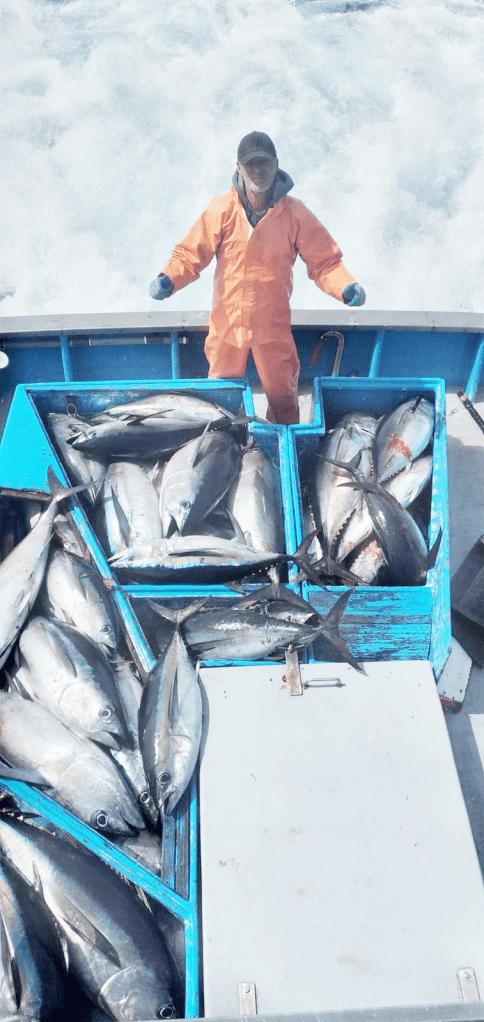
Today, November 16, marks National Maritime Day. In this context, Correio dos Açores spoke to someone who works and lives off the sea as the primary source of survival in their daily lives. Silvino Santos lives on the island of Santa Maria and has been a fisherman for around forty years. He is the master of the fishing boat “Salto e Vara” and one of the key players in this area on the “yellow island.”
Good coexistence between the sector and the maritime-tourism sector
The fishing sector, especially in the summer, and the diving and tourism companies represent two major employment activities and two slices of the local economy. Asked about the good relationship between the two sectors within the common field of the Azorean Sea, Silvino Santos says without hesitation that there is mutual respect and inter-help between the two businesses. “They let us know when they see a good school of tuna, just as we let them know when we see species that are of interest to them for diving, such as the whale shark,” explains the fisherman. He says there is room for these two sectors to work; even if they have different objectives, there are always specific common issues. In the case of this fisherman, he rejects the stigma that there is a rivalry between maritime tourism and fishing as a profession.
Correlation between the sustainability of the oceans and economic livelihood
Economic activities that work at sea and live off the species that live there are affected by the issue of sustainability. Silvino says that when he started working as a fisherman, there was “plenty of fish,” and he often had the luxury of “choosing the type of fish” that would be caught on a given day. He points out the enormous importance of the dynamics of sustainability and the preservation of the seas, as well as the various campaigns and measures to protect marine biodiversity. Referring to the ever-increasing scarcity of fish throughout his years in the profession, on the other hand, he says that fishermen cannot be forgotten because “you can’t ban everything, because you have to think that fishermen have to earn their living, they have to put food on the table”. Silvino Santos rejects certain methods of catching fish, which “destroy the seabed,” and which in the short term may be profitable, but in the long term create huge problems for maritime biodiversity, which will obviously harm fishermen and this sector of the economy.
The master of the boat, “Salto e Vara,” supports measures to save the oceans and guarantee the sustainable growth of species and their natural existence in their habitats, as these measures will then benefit fishermen but always guarantee their livelihoods in the present. With this in mind, a question was asked about fishing seasons and quotas in the region. Silvino Santos says that he has “a very personal opinion on the subject,” which focuses on the “poor management of quotas” by the authorities and a certain lack of knowledge about them. He says that it is important to have this imposition, safeguarding the species’ existence, but that often “it doesn’t make sense” how the respective catch quotas are managed.
The future of fishing in Santa Maria
The conversation ended with the opinion of the experienced fisherman from Santa Maria on the future of fishing on his home island. “Lately I’ve seen more and more young people entering the profession. It’s very important for the future of fishing that we have these young people,” he said enthusiastically. Silvino Santos shared his opinion on the need for training for fishermen, which needs to be more common among younger fishermen and is still somewhat taboo among older fishermen: “We need to invest in training these fishermen, especially in terms of safety, with training such as the STCW course,” adding that the members of his crew have the respective “on-board safety course.”
José Henrique Andrade is a journalist for the Correio dos Açores.
Translated to English as a community outreach program from the Portuguese Beyond Borders Institute (PBBI) and the Modern and Classical Languages and Literatures Department (MCLL) as part of Bruma Publication and ADMA (Azores-Diaspora Media Alliance) at California State University, Fresno, PBBI thanks Luso Financial for sponsoring NOVIDADES.

 Novidades - The Islands and the Diaspora