

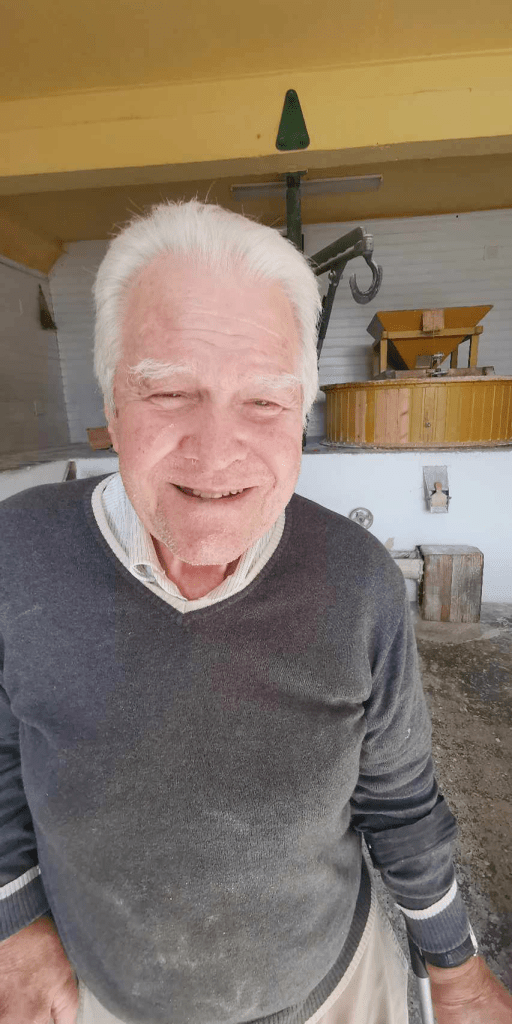
An old mill still operates in Vila das Capelas, the only one still operating on the island of São Miguel, Azores.
João Viveiros is the owner, and he has a verbal sense of humor. When we asked him how old he was, he replied, “I’m 86 years old. Sitting down, I’m young; standing up, I’m old.”
João Viveiros began by explaining that when he left school in the 4th grade, at the age of 11, he immediately went to work at the mill owned by his father, João de Oliveira.
However, he wasn’t always there because he first tried his hand at other trades. His father even had a grocery store in Santo António, but it wasn’t what he wanted. He was also a farmer, riding in a cart to transport corn and other products that his father produced.
In the meantime, his father fell ill, and João Viveiros took up milling, a fundamental process in the food industry, especially in producing flour and other grain derivatives. “As well as corn, I milled wheat and broad beans”. Broad beans? “The broad beans (fava) were ground to feed pigs,” he explained.
Corn comes from abroad.
Corn and wheat flour are essentially used to make bread, but long gone are the days when corn was produced on the island. “This corn now comes from abroad because the corn we have here on the island is to feed the cows.”
In fact, few mills are still operating in the region, and on the island, most are abandoned or have been redeveloped into local accommodations.
The number of cows that feed on basto corn increased at a certain point in our agricultural history.
In the past, millers would stop by people’s houses to collect corn, and the following week, they would leave the flour corresponding to the corn they had collected.
However, there were also people who bought flour from the millers in quarters, which was a wooden portion of flour.
“The government talks about agriculture, as if it were important, but for them agriculture is the milk from cows, which is valued more than corn, wheat or broad beans,” he laments.
Ironically, João Viveiros almost emulates singer-songwriter Mário Mata when he says, “There is nothing left for anyone, there are no workers, there are no peasants, there is nothing left.” All he had to do was add, “Let’s go, Manel. There’s nothing here for anyone.”

João Viveiros is known as João of the Mill
The mill had two other workers besides João Viveiros. “Back then we worked from morning until midnight, it’s not like now.”
The Capelas mill is located at Rua da Praça, no. 6, and João Viveiros is better known as João da Moagem.
The mill used to run on coal, which eventually broke down, and then on diesel, but now it’s electric. “The diesel engine still works, but I don’t have the strength for it anymore, and the service isn’t what it used to be.” With the help of one of his sons, João Viveiros, he grinds flour every eight days.
His main customers are bakeries and ordinary people. People usually come here to get it. It can be used to bake bread or cakes, but it can also be used to fry fish.
João Viveiros confesses that he’s there all day, but one of his sons helps him. “I can’t carry the sacks of flour anymore, let alone climb the stairs.

A bag of flour costs 24 euros.
After all this time, he says there are many differences. “People were much more friendly with each other and it’s not like now, when friendships are more favored through cell phones. When I started working with my father, people helped each other, now it’s every man for himself and God for all.”
Time at the Mill is spent chatting with friends or serving customers who come to buy flour.
A sack of flour at Moagem das Capelas “costs 24 euros,” and a sack of corn, imported from the mainland, is cheaper because otherwise I wouldn’t earn anything,” he said.
Married and the father of three, João Viveiros was born in Santo António but has lived in Vila das Capelas since his marriage 61 years ago.
He remembers his father’s grocery store, which sold a bit of everything loose. “In those days there were no pharmacies,” but there was a kind of paracetamol. “Butter and lard were weighed on greaseproof paper, salt, flour, rice, beans and coffee were also weighed. Olive oil was poured into a bottle brought from home and measured.”
The mill, about a century old, is regularly visited by tourists, who are delighted that it is still in operation. The miller João knows that none of his children will give up their jobs to stay with Moagem das Capelas, not even the one who helps his father, because “this has no future for anyone. As long as I can, I’ll be here. Otherwise I’ll close the door”.
Mr. João Viveiros started carrying 70 kg bags when he was very young, and nowadays, he can’t stand for long because his back hurts.
However, he is at the mill from 9 a.m. to 5 p.m. during the week, which he can’t do without a friendly chat with friends, acquaintances, or visitors.
Photos and more information in Portuguese at:
https://www.aspessoasfazemoslugares.com/historias/rc2a8ym5ab5ajjpn7m9psmrm5kcznd
Translated to English as a community outreach program from the Portuguese Beyond Borders Institute (PBBI) and the Modern and Classical Languages and Literatures Department (MCLL) as part of Bruma Publication and ADMA (Azores-Diaspora Media Alliance) at California State University, Fresno, PBBI thanks Luso Financial for sponsoring NOVIDADES.

 Novidades - The Islands and the Diaspora