

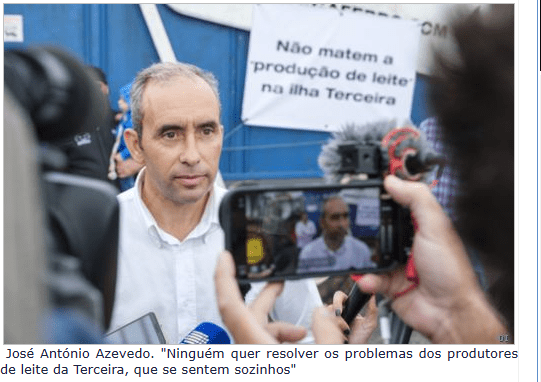
More than 100 farmers attended a meeting on Monday at the headquarters of the Agricultural Association, which emerged with possible forms of protest against the current price of milk paid to producers on Terceira Island: Terceira farmers are prepared to blockade Lajes airport and the commercial port of Praia da Vitória.
The president of the Agricultural Association of Terceira Island (AAIT), José António Azevedo, says that “drastic measures” may be necessary given the “deplorable situation” affecting dairy farms.
“All the producers are telling us that they are having great difficulty meeting the monthly costs of their farms. Milk has been falling for nearly 18 months. These drops have left the islands of Terceira and Graciosa with the lowest prices in Europe,” he says.
Currently, the gap between the price of milk paid to producers on Terceira and that charged by Lactogal on the mainland says José António Azevedo, is 10 cents. “We’re also five cents behind the prices in São Miguel,” he laments.
The AAIT advocates a minimum rise of three cents by the end of the year and that, by 2025, progressive increases should bring prices closer to those in mainland Portugal.
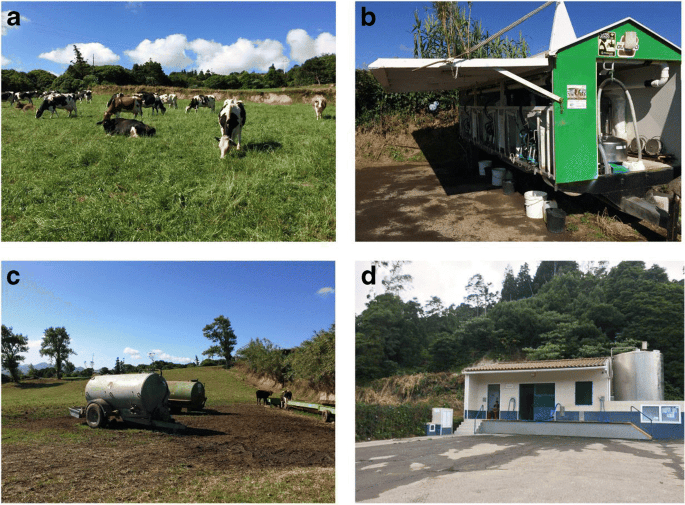
If there are no signs of change, the deadline for protests is the end of this month. “At the meeting, various forms of struggle emerged. One would be to block the entrance to the milk tanks at PRONICOL and the highway nearby. We also clearly advocated blocking the port and the airport if either the regional government or the industry on Terceira island didn’t consider the deplorable situation that Terceira’s milk producers are living in now,” explains José António Azevedo.
“I know that it could hamper Terceira’s economy and inconvenience visitors and air travelers, but we don’t see any other way to draw attention to our situation, given that everyone wants to live well with everyone else and no one wants to solve the problems of Terceira’s milk producers, who feel alone,” he said.
José António Azevedo guarantees that the producers will first “exhaust the avenues of dialogue.”
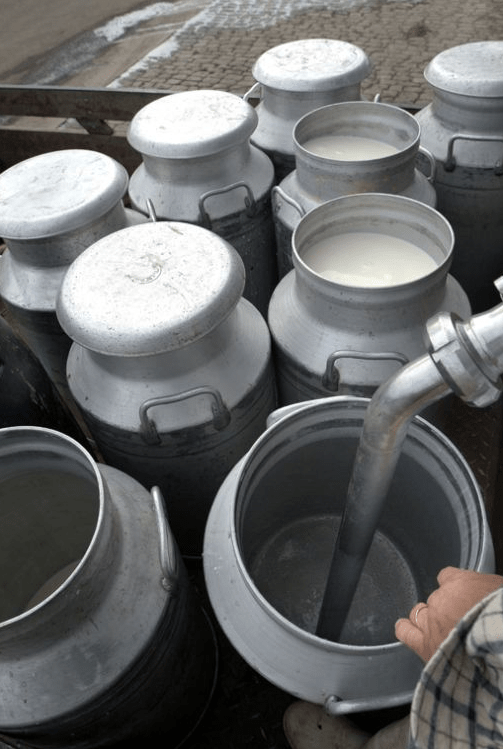
In addition to the price of milk charged by the industry, the consequences of a “parched summer, with less fodder production and all the costs that have also increased due to inflation,” are leading to the collapse of farms, warns José António Azevedo.
“There is total discouragement on the part of milk producers on Terceira Island. We’re seeing some who have already abandoned production, others who are going into meat production and young people who were going to enter the sector are no longer entering,” he describes.
The farms are so decapitalized that, as the AAIT leader assures us, the investment measures launched in 2025 under the Common Agricultural Policy (CAP) may be out of reach. “They won’t be able to take advantage of them and make the investments to modernize their farms. Once again, we’re going to be left behind due to the poor prices paid and the inefficiency of the industry on Terceira Island,” he warns.
AAIT demands efficiency and transparency from PRONICOL. “The cards have to be put on the table. Where is the problem, on Terceira Island or at Lactogal in terms of payment or return for products processed on Terceira Island? Because the quality of the products is there and it’s there because of the quality of the milk,” he says.
On the part of the Regional Government, the AAIT defends the application of “45 euros to the dairy cow, bearing in mind that the price of milk paid on Terceira Island is the same or lower than in some of the Cohesion Islands”, but the priority is that “the aid from the Republic, which has been promised to the Region’s producers more than ever, is paid soon.”
The president of the agricultural association believes that the region must pressure the Republic’s government. “Above all, there needs to be strong lobbying by the regional government and all of the region’s elected representatives in the Republic, together with the Azores Agricultural Federation, so that this aid comes to the region as soon as possible and a payment schedule is created so that producers can count on it in their budgets,” he said.
However, the primary struggle for Terceira’s farmers remains the milk price paid to producers.
In Diário Insular-José Lourenço, director
Translated to English as a community outreach program from the Portuguese Beyond Borders Institute (PBBI) and the Modern and Classical Languages and Literatures Department (MCLL) as part of Bruma Publication and ADMA (Azores-Diaspora Media Alliance) at California State University, Fresno, PBBI thanks Luso Financial for sponsoring NOVIDADE.

 Novidades - The Islands and the Diaspora