


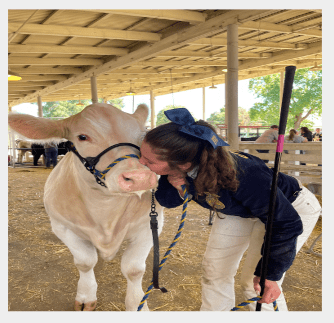
My name is Arlene Chaparro, and I interviewed Vivian Borba. We started by introducing ourselves and talking a bit about ourselves. Then I asked her what her full name was and if she had any history behind her name. She replied: “Yes, my name comes from a woman my mother spoke with in Salinas, and my middle name comes from my father’s sister.” Vivian was born on September 24, 2003, and her sign is Libra; she liked to add that because she is big on birth signs. She was raised in Lodi, near Stockton, and now she lives in Fresno because she studies at Fresno State. I asked her what her earliest childhood memories were, and she said: “All my life, I was raised in a dairy, so I remember the soles of my feet were dirty because I played with my cousins; oh! One was when my sister and I broke the main water pipe. My mother was very angry with us,” she said. She also added that she was a little queen and went to all the Festas and watched the bullfights. She said that after the Festas she was so tired because she and her cousins ran around in the heat, and then their heads started to hurt because the sun was so hot.

Her family migrated to the United States in 1972 for the American dream and decided to settle in Stockton, California. So I asked her if her grandparents or parents told her what it was like to settle in a new country. Vivian said: “I never asked because I know it can be complicated since my father only spoke Portuguese and had to learn to speak English in the United States. He’s an immigrant, but not an immigrant. He was born here but raised in the Azores and was used to everything outside; it must have been new to him.
Vivian is part of the third generation born in the United States. It is important for her family to be involved in the Portuguese community. Her mother didn’t grow up with the culture, but she saw how her husband got involved in the Portuguese community.

Vivian says her mother liked having them participate in the Festas and took her and her sister to many Festas because the family enjoyed them. Vivian’s father was a big part of the Portuguese community because he knew his father loved going to
everything.
Vivian’s identity was expressed through the language, the food, and the traditions. Because her father spoke adult Portuguese, she laughed at their conversations. She ate a lot of Portuguese food, like languiça and bacalhau. She grew up Catholic but didn’t go through everything because she followed her sister. However, she still studies Catholicism. The main cultural tradition she maintains is the Lint Tradition, which states that when you give up something for a few weeks, you can finally have what you gave up on Easter Day. And, of course, not eating meat on Friday. She said, “I ate meat every Friday this year, I’m sorry! But it was so hard. “

Another tradition she wants to keep alive is the ceramic rooster, kept in the house as a sign of good luck.
When I asked Vivan if she had ever been to the Azores, she replied, “I haven’t. It’s something we’ve planned but we haven’t had the chance to go yet. I want to go with my father because it will bring back memories and he can tell me his
stories. I also want to go because I want to visit my grandfather’s island.” Some experiences she’s had in the Portuguese community are related to her life in a dairy. Because the Portuguese are big on agriculture, there is a strong sense of community. She’s been on a lot of fishing trips with her father.
She says the Festas were the fun part because they had many activities. She recalls enjoying the “Bazaar or quermesse” as a child. Her parents and grandparents would buy these tickets, and the children had to unwrap and reveal a prize. Some prizes they would show, then show it to their mother, and then you’d never see them again.
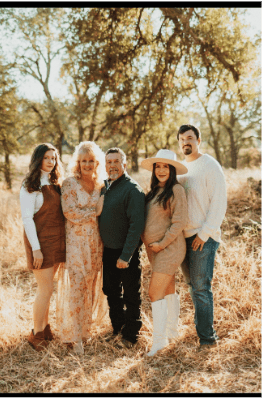
I was surprised when she said that she was afraid of bulls because I know many Portuguese people, and to hear that from someone who was brought up in a dairy surprised me.
Vivan adds that being Portuguese has made her tough skin because Portuguese can be very critical, which taught her not to care. It made her hardworking because she says that the women of the Portuguese community are strong, whether you like it or not. Being Portuguese-American for Vivan means being close to her grandfather, and she feels that if she can be in this community, she can feel closer to him. She adds that if she learned the language, she could feel even closer to him and her father.
She enjoys having her father share all the memories and stories about her grandparents.
To her, the Portuguese community continues to be strong. It’s the same as when she was a child–with many of the same traditions.
I added that I’ve never eaten Portuguese food and want to try it. As I told her, my family and I love the Portuguese community.
We go to the bullfights in Tipton every year, but we’ve never tried the food.
Arlene Chaparro was a Portuguese Language and Culture Class student in the Spring of 2023. This project is part of the Central California Portuguese-American Oral History project at Fresno State. With our students and the Medica Communication and Journalism team, we recorded over 100 oral history interviews–our goal is to reach 200 by the end of the 2028-29 academic year)
These stories will be registered in our archive at the Fresno State Library. They continue to be uploaded, a process that takes time and funding.
https://library.fresnostate.edu/find/pbbi-collection

 Novidades - The Islands and the Diaspora