

“After a life dedicated to promoting the cult of the image of the Lord Santo Cristo dos Milagres, she died at the age of 79, with a reputation for holiness, on May 16, 1738 and to this day our people have shown deep devotion, faith and respect for this Clarissa Nun.”
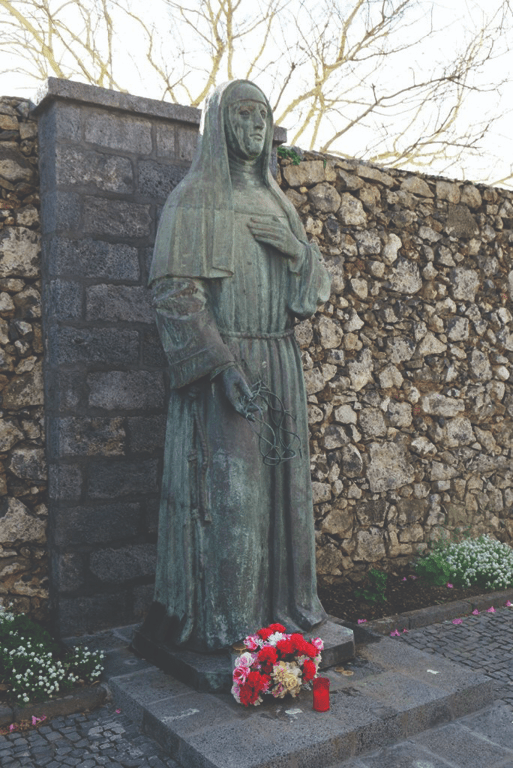
Today, Monday, in São Miguel island and throughout the Azores, we celebrate another anniversary of the birth of Mother Teresa of the Annunciation: in fact, in the parish of Ribeira Seca, in Ribeira Grande, she saw the light of the world on November 25, 1658. She was a nun of the Order of Santa Clara who is considered the leading promoter of the devotion to the Holy Christ of Miracles and, since then, the most significant religious festival in the Azores. She died with a reputation for holiness, having already been officially declared Venerable, a title that has since faded.
November 19 was 344 years since Teresa of Annunciation began her novitiate at the Convent of Esperança. From the moment she entered the convent, and on the advice of her sister Joana de Santo António, Teresa da Anunciada adopted an attitude of deep devotion and surrender to the image of “Ecce Homo,” with whom she established an intimate relationship and whom she called “My Lord” and “My Nobleman.”
Mother Teresa of the Annunciation spared no effort to enhance the image of the “Ecce Homo.” However, she was hindered by a convent abbess and her allies; she managed to get a decent chapel erected for the Venerable Image, as well as having the image adorned with all the insignia befitting a King.
Teresa da Anunciada’s influence and relationship with the kings of Portugal was significant. So it was that when Pedro II, known as the Peaceful, was ruling our country, and by the charter of September 2, 1700, the king granted her a stanza of 12,000 réis to keep an oil lamp constantly burning in front of the altar of the Holy Christ. On the other hand, there is a cloak in the Image’s treasury that was offered by King João V, the magnanimous, through his wife, Maria Ana of Austria, because the King had expressed the Lord’s wish to have a cloak made of the same brocade as his royal mantle. Furthermore, at the request of the Nun of the Holy Christ, the king removed the sugar tax from all Azoreans living on all the islands of the archipelago.
The cult and devotion to Senhor Santo Cristo dos Milagres quickly spread to the other islands of the Azores archipelago. Today, the festivities in honor of Senhor Santo Cristo dos Milagres, who is venerated by the people of all the islands, are held in Vila do Porto, on the islands of Santa Maria and Graciosa.
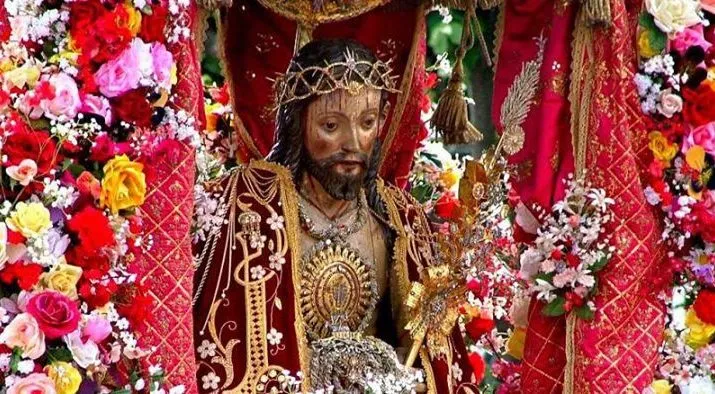
On the other hand, in the past, a picture of the Senhor Santo Cristo dos Milagres was the traveling companion of every emigrant from São Miguel. As a result of this emigration, the cult of and devotion to the Senhor Santo Cristo dos Milagres has led to grandiose festivals and processions being held in some cities on the American continent. Examples are the cities of Montreal, Toronto, Brampton, Cambridge, London, Kingston, and Leamington in Canada, as well as Fall River and Cambridge in Massachusetts, among others in the state of Rhode Island and in California. A parish church dedicated to the Lord Holy Christ was even built in Fall River. In the city of Hamilton, Bermuda, there is also a solemn procession in honor of the Lord Saint Christ of Miracles.
As you can see, thanks to Mother Teresa of the Annunciation, the festivities in honor of the Venerable Image are now global and not just confined to Ponta Delgada.
From an early age, Teresa showed a great interest in religious things, following her mother, who was said to be a seer in Ribeira Grande. Through the influence of her sister, who managed to obtain the necessary licenses, at the age of 23, she entered the Convent of Nossa Senhora da Esperança, where she began her novitiate and received the novice’s veil on June 20, 1682.
From then on, she dedicated herself to the cult of the image, and in 1700, the first procession of Lord Santo Cristo was held using the image of Ecce Homo, from the Convent of Esperança, through the city and passing all the existing convents.
The cult finally gained great popular expression when, in 1713, at the height of a seismic crisis, the image fell during a strong earthquake during a procession. It was considered miraculous that it hadn’t broken and that the seismic crisis had ceased. After this incident, the image was given the epithet of the Miracles, and the procession of Senhor Santo Cristo dos Milagres became one of the most significant events in São Miguel’s religious calendar.
After a life dedicated to promoting the cult of the image of Senhor Santo Cristo dos Milagres, she died on May 16, 1738, at the age of 79, with a reputation for holiness. To this day, our people have shown deep devotion, faith, and respect for this Clarissa Nun.
By: António Pedro Costa, in Correio dos Açores-Natalino Viveiros, director

Translated to English as a community outreach program from the Portuguese Beyond Borders Institute (PBBI) and the Modern and Classical Languages and Literatures Department (MCLL) as part of Bruma Publication and ADMA (Azores-Diaspora Media Alliance) at California State University, Fresno, PBBI thanks Luso Financial for sponsoring NOVIDADE.


 Novidades - The Islands and the Diaspora