

For several years now, we’ve become accustomed to a recurring story, around the 1st of May, in which the media reports that the retail chain known as Pingo Doce (the one whose owner doesn’t pay taxes in Portugal) is going to organize another big promotion, cutting the prices of its products in half. Promotions have become normal in our daily lives. We accept that it’s normal for something that costs one price today to cost much less tomorrow simply because someone decides so from the head office.
Doesn’t it make sense to ask ourselves: if this promotional cut exists, why isn’t it applied all year round? It’s one of those things that the more liberal-minded don’t want to be asked too often, lest the devil weave them and people question the status quo.
And I’m talking about promotions today, but a very particular kind of promotion. A promotion that some enlightened minds will want to see as a means of publicizing and value. Don’t be fooled! The promotion I’m writing about today is clear and demonstrates
of the total lack of interest that the current Regional Government of the Azores has in culture.
José Manuel Bolieiro has learned nothing from the mistakes of the past. Anointed by the renewed by the renewed popular vote, he has forgotten that he was wrong about many things during his first three years in power. One of them, which has not gone down in history, was the change in the name of the Regional Directorate for Culture and the thousand-and-one twists and turns he took until he got back to where it was, together with Education. At the time, the coalition claimed to be renaming it.
“Cultural Affairs” was an act of ennoblement for that sector because it was management, and that was how it would be taken seriously.
If the name was important then, it should be important now. On November 15, the decree presenting the new organization of the Regional Secretariat for Education, Culture and Sport was published.
Secretariat for Education, Culture and Sport. Having analyzed the document with a legal magnifying glass and everything
legal magnifying glass, the truth is that we find very few differences from the previous ones. The main disaster is the extinction of the Regional Fund for Cultural Action, which I don’t blame those currently in charge of the sector, although they could have tried to make up for that mistake.
The major culture change is mainly found in the names of its sectors. In the days when that department functioned minimally well, the regional directorate was divided between two service directorates: one dedicated to the artistic side, working with cultural agents and managing the services that represent Culture in the archipelago; the other was dedicated to cultural heritage, its preservation, inventorying and protection. With this new organization, those responsible for the portfolio announced their strategy for the Azores. Cultural heritage has disappeared. So has cultural action. What remained was development, which we can understand, and the Cultural Promotion Division. Where heritage strategies were once discussed, they will now promote issues, which seems to indicate some ignorance on the part of those responsible.
The feeling is that we’re facing one of the biggest sell-offs in culture in living memory. António Ferro, once the other gentleman’s propaganda minister, couldn’t have done better. When we look at the changes in competencies, we see that very little has changed. However, we find a symptomatic omission since the region no longer has the power to draw up draft regulations and other legal acts relating to the sector, making its role as a managing body obsolete.
But when we think about the names and the importance Bolieiro attached to changing them, we see that they are trying to demonstrate that culture is for sale and that this sale is being promoted.
There seems to be a desire to turn that department into a space for promoting shows, with a grandiose and megalomaniacal cultural season that will compete with those striving to do something in the region. Still, it will be mandated to make itself felt in the ideological causes of its leadership.
The palace celebration of November 25th has already been announced for next year, which is certainly not innocent. It is a symptom we must consider when diagnosing the serious illness that has struck us.
Every year, cultural disasters multiply. Cultural agents, as if resigned, already complain very little. The regional directorate employees have come to accept the fate handed to them by the succession of management. As well as disappearing in name, cultural heritage also disappears in office. The competition for the head of the cultural heritage division has been open since January 2024, with no response on the subject. That’s something we can’t remember from the past. Perhaps it should be sent to the office, but I imagine Bolieiro already knows about it…
What remains of our cultural heritage seems to have been given to the Center for Mobile, Intangible, and Archaeological Heritage Center, where competencies are pooled at the behest of a coordinating position, which will carry very little weight in the internal structure and which is a specialized technician with a degree in Theology. After a priest in the regional director’s chair, we have a religious professional as the coordinator.
Culture, without a capital “C,” never ceases to amaze us. If it was assumed that Sofia Ribeiro wanted nothing to do with that sector and that Sandra Garcia would try to exploit her personal taste for promotion, now there’s no doubt. The days of Culture with “C” are a thing of the past. Cuts and promotions like that, not even at Pingo Doce!
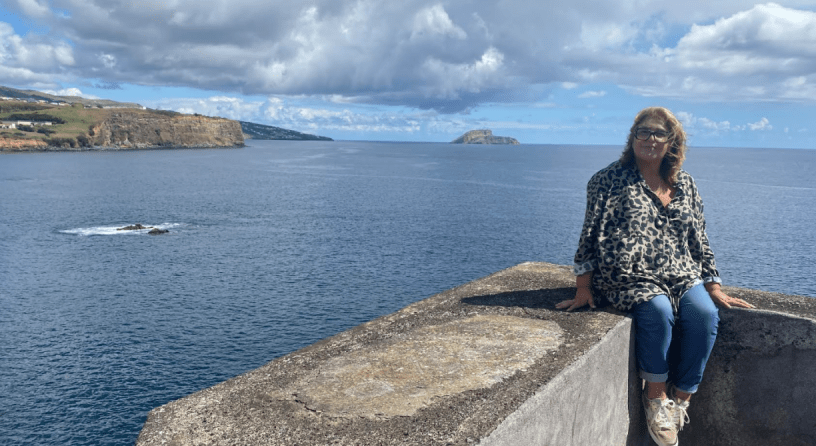
Alexandra Manes is from Flores Island but lives in Terceira Island, Azores. She is a regular contributing writer for several Azorean newspapers.
NOVIDADES will feature occasional opinion pieces from various leading thinkers and writers from the Azores to give the diaspora and those interested in the current Azores a sense of the significant opinions on some of the archipelago’s issues.
Translated to English as a community outreach program from the Portuguese Beyond Borders Institute (PBBI) and the Modern and Classical Languages and Literatures Department (MCLL)
 Novidades - The Islands and the Diaspora