

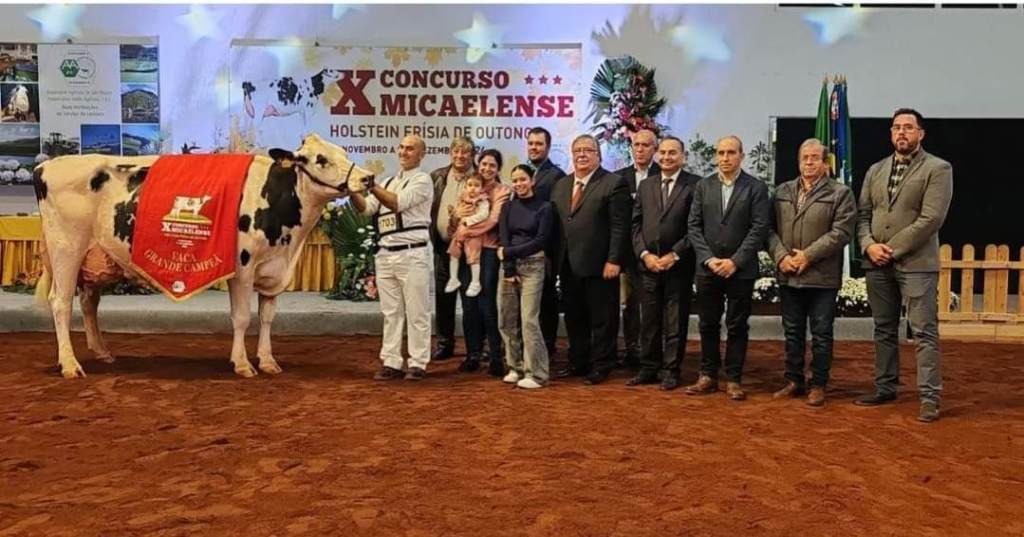
The 10th Holstein Friesian Autumn Contest has ended at the São Miguel Exhibition Park in Santana. The winning cow is called ‘Maravilha’ and is owned by António José Ferreira Pacheco, a producer from the parish of Furnas. This is the second year running that ‘Maravilha’ has been ‘Grand Champion’ in competition with different judges, and this year she was also the Adult Champion cow.
The President of the São Miguel Agricultural Association, Jorge Rita, considered the results of the X Holstein Friesian Autumn Contest, which took place from November 29 to December 1 at the São Miguel Exhibition Park in Santana, “extremely positive”.
“We’re talking about the best national competition, given its size, the passion shown by the producers, the involvement of the people, the quality of the organization and the conditions of the pavilion,” he stressed.
Jorge Rita, who was speaking after handing out the trophies to the winning cows, heifers, and heifers, highlighted the “great participation” of the producers and the “excellent dynamics of the competition, with the public filling the pavilion, especially on Saturday, the day when the winning cows were determined.”
“People didn’t come to see something else. They came specifically to see the competition. This is extremely positive. Our society and farmers have been significantly involved,” he said.
“We’re talking about two competitions in one year, which are not easy to do. It’s extremely difficult. And we always manage to overcome the difficulties with the work of the producers, who are very resistant and resilient,” he explained.
Jorge Rita stressed “the extraordinary quality of the animals” in the competition, “the diversification of the prizes, knowing that there are some more dominant farms.”
But, he continued, “in addition to the traditional producers, there are new producers who are starting to appear in the competition with genetically very good animals and who are also winning prizes.”
In the opinion of the President of the Agricultural Association, this is proof that “more and more producers are investing in good genetics. And some young people encourage their parents to participate due to the animal preparation courses that are very popular with our young people. And there are also exchanges with other very good countries in this area, which encourage producers to participate in these competitions,” he added.
In his opinion, “a large part of this new wave of producers is also beginning to assert itself” in competitions “with the extraordinary quality of their animals.”
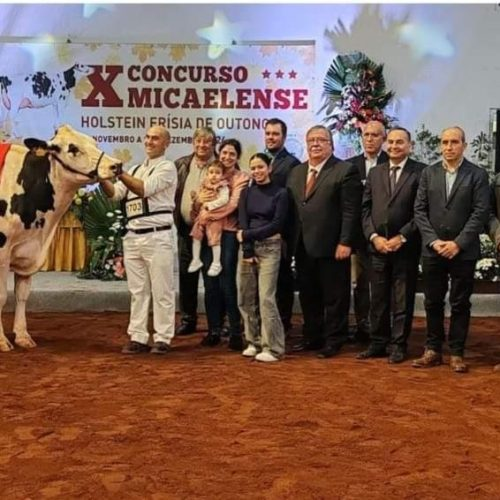
Jorge Rita doesn’t hide his “enormous pride in the level of excellence that the competition has achieved” and, in conclusion, he issued a warning: “There must be total involvement around this sector, especially from those in the milk sector, from production to processing, to marketing, to the regional government and to society itself.
“Society is increasingly aware of the importance of our sector for the region. Even those who are in sectors of activity that are emerging in the region, such as tourism, know that if agriculture begins to have many economic and social problems on the various islands, territorial cohesion disappears and the great work done by farmers in maintaining the great beauty of our landscapes and our environment ceases to exist. And nobody wants this to happen.”
“What I want to say is that strong agriculture, growing agriculture, in all its dynamics, in the milk and meat sectors, and in agricultural diversification, will always be very important for the tourists who visit us, because of what we enhance, both in terms of the gastronomic offer and in terms of the natural beauty,” he added.
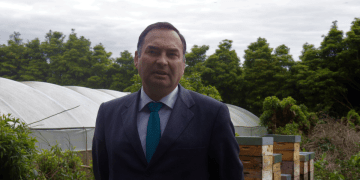
António Ventura highlights the quality of the competition
The Secretary for Agriculture and Food, António Ventura, said the competition “is a very prestigious event for the Azores.” “This competition is gaining not only regional projection, which it had already achieved, but also national and international projection,” he stressed.
There is coordination here with other geographical locations. The judge himself is from Canada, and this is a competition that is already known internationally. There is a connection here with technicians from other countries, and through this competition, the Azores are becoming known as a region that produces excellent milk. Milk is increasingly rich in more fat and more protein. It is a milk made with a cross between what is called Atlanticity, that is, between volcanic soils and the sea air of the Atlantic. And so we have a difference: it’s a pity that this excellence is not sufficiently valued as it should be,” he said.
António Ventura praised the competition’s organization, which, in his opinion, “has been magnificent.” As he pointed out, “it’s an exemplary and wonderful organization.”
“I know,” he continued, ”that other countries are closely following what is being done in São Miguel through multimedia, so that they can try to do better.”
“And if this happens in São Miguel, in an island competition, to try to do better, this means that good things are being done in the region,” he added.
‘Maravilha’ was the ‘Grand Champion’
The ‘Grand Champion’ cow of the X Micaelense Holstein Friesian Autumn Contest is called ‘Maravilha’ and is owned by António José Ferreira Pacheco, a producer from the parish of Furnas.
This is the second year in a row that ‘Maravilha’ has been ‘Grand Champion’ in a competition with different judges, and this year she was also the Adult Champion cow.
António José Ferreira Pacheco couldn’t hide his satisfaction at the decision by Canadian judge Ian Crosbie: “This is a wonderful feeling, an incredible feeling,” said the producer.
The producer considered it ‘extremely difficult’ to reach this level. “It’s a constant struggle and the work of a lifetime,” he added.
António Pacheco believes “perfectly in investing in new technologies. It’s possible to have robots on farms, modern equipment and computerized management,” he said.
The producer gave a “very special” thanks to his family, who are often sacrificed for the sake of the cows.”
“Sometimes there’s no time to spend with the family because things have to be done with the cows. And unfortunately, we have a lot of trouble finding labor these days,” he said.
Judge surprised by the quality of the cows in the competition
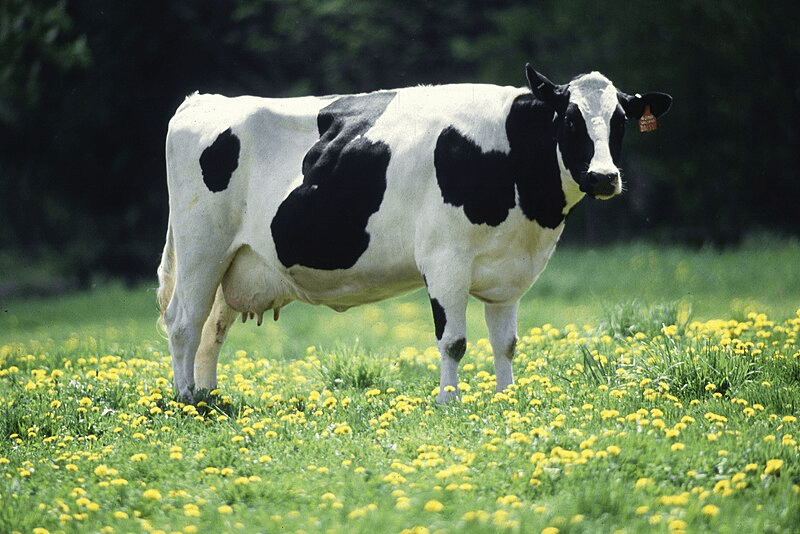
Judge Ian Crosbie, who has judged several competitions in Canada, was surprised by the genetic quality of the cows in the competition. He called the competition “fantastic,” with “tremendous” animals in all classes. “They are high quality animals. And I’m impressed with the six animals that made it to the final,” he said.
When asked by journalists if the animals competing in São Miguel could compete in shows in Canada and get good marks, Ian Crosbie had no doubts: “The animals that made it to the final, essentially the champions, can go to Canada to compete with the best animals in Canada and make it to the top,” he said.
The criteria adopted by the judge were, “essentially, functionality, mobility, width of chest, a lot of milk character, good udders and good legs.”
Ian Crosbie explained that these criteria ensure the cows’ “more longevity and are more profitable for the producer.”
The judge considered the experience in São Miguel “phenomenal,” “a surprise from the quality of the animals to the breathtaking landscapes. It was a unique experience,” he said.
Crosbie also praised Portuguese and Azorean cuisine. He said, “Italy is reputed to have the best cuisine, but since he tasted Portuguese and Azorean food, he puts it above any other cuisine in the world.”
In Correio dos Açores-Natalino Viveiros, director
Translated to English as a community outreach program from the Portuguese Beyond Borders Institute (PBBI) and the Modern and Classical Languages and Literatures Department (MCLL) as part of Bruma Publication and ADMA (Azores-Diaspora Media Alliance) at California State University, Fresno, PBBI thanks Luso Financial for sponsoring NOVIDADES.

 Novidades - The Islands and the Diaspora