

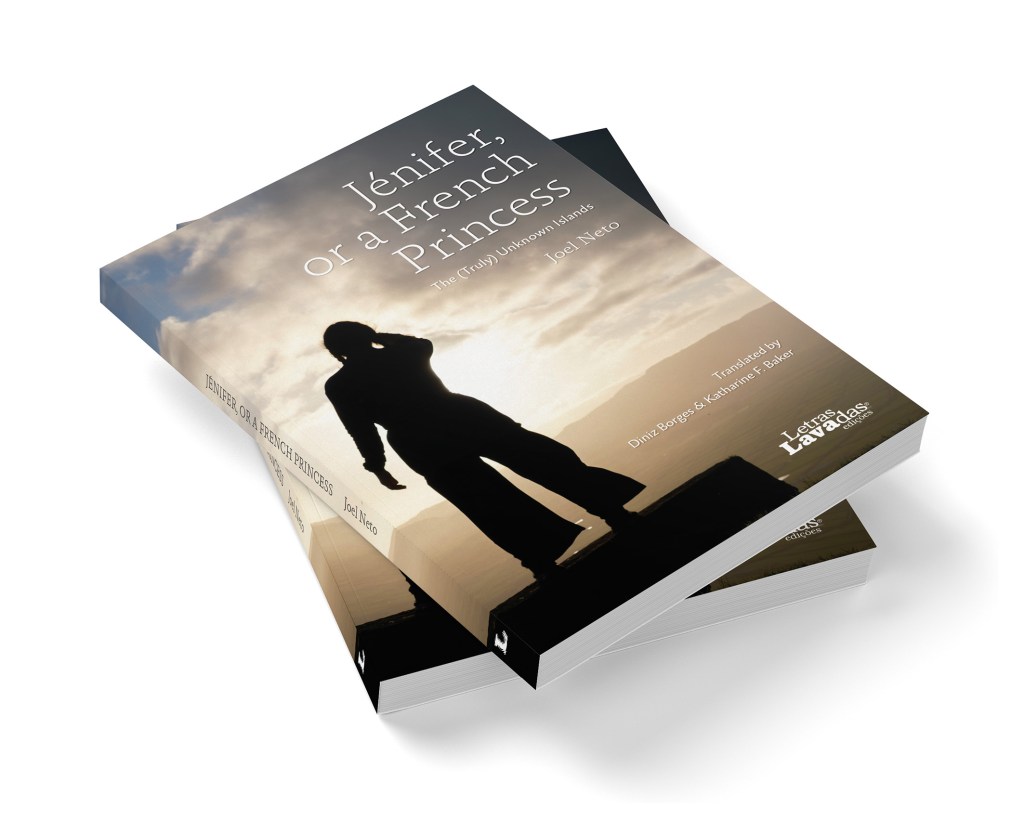
Young Jénifer was unexpectedly in the spotlight despite being a dreamer in the Azores and, with less impact, in the capital of this sad country that continues producing poor people and emigrants.
Some liked it, and others did not like Joel Neto’s book, which appeared in print under the title “Jénifer, ou a princesa de França —As ilhas (realmente) desconhecidas” (Translated to English and published by Bruma Publications/Letras Lavadas as Jénifer or a French Princess-The Truly Unknown Islands); this is what usually happens when you read a book, visit a painting or photography exhibition, watch a movie, or attend a concert. In short, it’s natural, and there’s nothing strange about a diversity of opinions; it’s healthy and helps to enrich the public debate.
In the case of “Jénifer, ou a princesa de França – As ilhas (realmente) desconhecidas” , differing opinions have generated some controversy in the regional public arena. The contours are known, but I have nothing to say about them.
This text is not intended to fuel any polemic, like throwing fuel on the fire. I am no longer old enough or have the patience for such sterile disputes, and, on the other hand, it is not intended to be a literary review, nor could it be, as I am not qualified to do so. I only read “Jénifer, or the Princess of France – The (Really) Unknown Islands” during the first few days of September. Although I wasn’t stimulated by the controversy it generated, I can’t deny that it was also a motivation, although it would get there sooner or later. I have a long list of books I’m waiting to read, and this one has surpassed some of them due to the controversy its publication generated, which undoubtedly helped popularize it.
You may like Joel Neto’s literary constructions and narratives more or less. Still, anyone in the habit of reading recognizes the value of his aesthetic and is not indifferent to it. I haven’t read all of Joel’s work. Still, I have read all of his books published since he returned to the Azores, and despite what separates us politically, I recognize his valuable contribution to Azorean literature, as I have had the opportunity to make it public in the past.
I read and reread it, but I could not understand some of the negative reactions to the book. The story is simply the observation of a reality that affects a considerable number of Azoreans without directly accusing this or that party formation, this or another regional government; in fact, Joel’s “sin,” if it exists, is anchored in generalizations, when he blames politicians for a situation that shames us and that regional autonomy has not solved. Not all political parties and protagonists bear direct responsibility for the dramatic but little-known portrait that Joel Neto seeks to make known as a soap opera, which has caused such an uproar.

The situation of poverty, exclusion, the social housing estates that house the marginalized that political power hides from the gaze of the middle class, and the illustrated postcards that sell the Azores as a destination. Illiteracy, dropping out of school, early pregnancies, and, in recent years, the exponential growth in the consumption of and addiction to new psychotropic drugs are not the direct responsibility of the current government, even though some of its members are militants and leaders of one of the parties that governed the Azores for 20 years. On the other hand, if we want to take a holistic view of the problem, it is important to look at the history and ancestral origins of poverty and exclusion in the Azores. The settlement model, the anachronistic land tenure system, Portuguese fascism, and, only afterward, the autonomous regime, which has proved incapable of resolving this and other structural issues in Azorean society, such as the excessive external subjection of our economy and the historically mistaken insistence on promoting just one economic activity to the detriment of the necessary balance between the different sectors of the regional economy. But let’s return to the responsibilities for the autonomous period’s incapacity or conscious political choice. As I have already said, the responsibility does not lie with the current government, which has been in power for less than three years. However, the region will be even poorer at the end of this political cycle, which is expected and hoped to be short. Its social and economic indicators will be plummeting. The serious problems that afflict us are not solved through welfare and charity; it is not by pouring public money into the private sector that the economic activity of the second sector is strengthened; moreover, with the scale of support for the private sector, it is legitimate to say that: the Region is a “shareholder” in most regional private companies; this must be why liberals and others like them want to get rid of the weight of the public sector in the economy.
With the April Revolution and the establishment of the autonomous system, social and economic indicators in the Azores have improved considerably; that much is indisputable. I’m not going to compare the data from the early 1970s with the current social and economic indicators, but today, we live better, much better, in the Azores. Significant progress has been made in health, education, infrastructure, and accessibility. Still, we have not resolved some structural issues that characterize Azorean society.
I’ve already mentioned that some of the current executive branch leaders belong to a party that governed for twenty years, but what is now the largest party in the fluffy opposition governed for twenty-four. Therefore, it is legitimate to infer that in these forty-seven years of constitutional autonomy, the PSD and PS are entirely responsible for thousands of Azoreans’ dramatic social and economic situation.
No magic wand exists to solve the problems that Joel Neto’s portrait exposes in the short time that the current government has been in power. The measures to solve the problem, if they are to be solved, should have been taken a long time ago.

Joel Neto’s narrative is set in 2020, perhaps extending into 2021. The allusions to the serious public health problem that affected us at the time allow the reader to infer this conclusion, i.e., the novel narrates the experiences of a marginalized community in the transition phase from the last PS government to the hybrid solution of the current government. Other reasons I am completely unaware of may be behind the controversy surrounding the book and its author. Still, I can’t find any in the pages of “Jénifer, ou a princesa de França – As ilhas (realmente) desconhecidas (Translated to English and published by Bruma Publications/Letras Lavadas as Jénifer or a French Princess-The Truly Unknown Islands) ” that can justify the controversy that has arisen.
Ignoring and hiding poverty and exclusion by sending people to the outskirts of the city and allocating a few crumbs from the public purse as if they were handouts is not a solution.
I don’t have any miracle solutions, but multidisciplinary intervention, parenting education, training and education, access to work with rights (without precariousness and with decent wages), an end to the widespread misuse of “occupational programs” and turning them into what they really are: real jobs, might be a good start. It is more expensive and more difficult to live in the Azores, and the costs of insularity that the political discourse has abandoned are why salary supplements and tax breaks were created at the beginning of the century. The costs of living on the island are permanent; what has gone up in smoke is the political discourse that supported the creation of specific support that urgently needs to be updated. It’s not everything, but it is a priority.
Aníbal C. Pires, poet, education and political activist.
You can order the translated book through Bruma Publications from PBBI-Fresno State.
 Novidades - The Islands and the Diaspora