

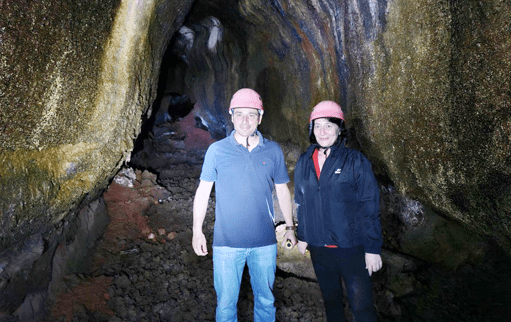
The Regional Secretary for the Environment and Climate Action, Alonso Miguel, announced yesterday the discovery of a new volcanic cavity on the island of Pico, called “Gruta de Santana,” which is around 170 meters long. The discovery followed electrification work by EDA – Eletricidade dos Açores, in Santana, parish of Santo António, municipality of São Roque do Pico.
During a visit to the site, accompanied by the Regional Director for the Environment and Climate Action, Ana Rodrigues, the Regional Secretary explained that “following a contact made by EDA to the Pico Island Environment and Climate Action Service, a team of technicians and nature watchers went to the site.”
“Various pieces of information were collected and a cartographic sketch of the cave’s layout was drawn up, in order to understand its location on the ground and ensure that the work to be carried out would not cause any additional disturbance to this volcanic cavity,” he said.
The cavity now discovered is around 170 meters long, with a height of between 70 centimeters and five meters and a width of between two and five meters. It has a structurally well-preserved geological heritage, with only small collapses in the walls and several important geological structures, such as stalactites, gas bubbles, side benches, small overlapping tubes, lava balls, and grooved walls.
“In addition, the biological presence of colonies of bacteria, arachnids, roots and the bones of small animals has been identified, and this set of characteristics underscores the scientific and natural value of the cave, which requires special attention for its preservation,” he said.
Due to the location of the access to the cave on one of the highway’s lanes, Alonso Miguel explained that “in conjunction with the Regional Secretariat for the Environment and Climate Action, EDA has built a structure to guarantee safe and regulated access to the volcanic cavity.”
Alonso Miguel stressed that “of the 340 or so known natural volcanic cavities in the Azores, not all are visitable or open to the public. The island of Pico has by far the largest number of caves, with 145 identified, a figure that will be updated at the end of this year with this new discovery.”
The Regional Secretary recognized the scientific interest of preserving some of these formations, which led to the classification of four volcanic cavities in the Azores as Natural Monuments: Algar do Carvão, in Terceira; Furna do Enxofre, in Graciosa; Gruta das Torres, in Pico, and Gruta do Carvão, in São Miguel.
“The discovery of the Santana Cave is further evidence of the geological and biological wealth of the archipelago, a unique heritage that deserves to be studied, protected and valued,” concluded Alonso Miguel.
Translated to English as a community outreach program from the Portuguese Beyond Borders Institute (PBBI) and the Modern and Classical Languages and Literatures Department (MCLL) as part of Bruma Publication and ADMA (Azores-Diaspora Media Alliance) at California State University, Fresno, PBBI thanks Luso Financial for sponsoring NOVIDADES.

 Novidades - The Islands and the Diaspora