

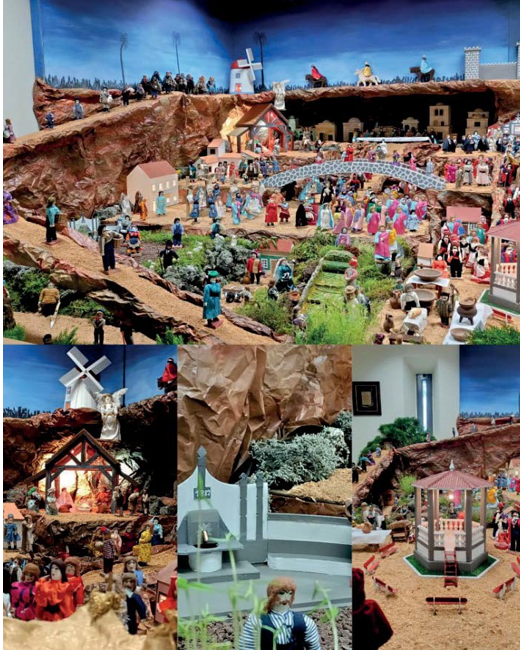
There is a Nativity Scene made of cloth dolls in the parish of Pico da Pedra that is more than half a hundred years old and can be visited these days.
In fact, the traditional cloth crib is on display at the Casa do Povo do Pico da Pedra from Monday to Friday, from 9am to 12.30pm and from 1pm to 5.30pm.
This Nativity Scene was all made by the late Maria da Estrela Sousa, who was born on March 27, 1925, in the parish of Rabo de Peixe, and died in Pico da Pedra, where she had lived for several decades on May 14, 2009.
Estrela started making cloth nativity scenes after she married when she already had two young children.
She then lived in the Pinhal da Paz, which her husband, João Pedro de Sousa, helped to preserve and protect for twenty-two years.
According to the picopedrenses Gilberto Bernardo and Paulo Rosa Cabral, it was there that Mrs. Estrela made the first dolls for her crib by the light of an oil lamp on long Ad- windy nights. When she moved to Pico da Pedra, she already had a considerable collection to build a nativity scene that took up half of her bedroom.
From year to year, he increased the number of scenes in his beloved crib, which was then installed in the largest room of his house at 15 Avenida da Paz.
352 handmade dolls
The priceless work includes 352 dolls, molded and beautifully dressed in cloth, made patiently by hand, which feature in a nativity scene that contemplates some of the main scenes from the Bible: from the birth of Christ, to his flight to Egypt to the slaughter of the children in Bethlehem, to the Last Supper and the Crucifixion of Christ, including the Resurrection of Lazarus, Solomon’s sentence and the Wedding Feast in Canaan. In addition to these Biblical pictures, you can also enjoy scenes that illustrate traditions, customs, and aspects of the daily life of our people: a pig slaughter, a procession, pilgrims, revelers, a folklore group, fishermen, washerwomen…
That’s how, for many years, at Christmas, Estrela opened her doors to everyone who wanted to see her nativity scene, which she kept up until February 2nd.
During that time, she won several crib competitions at county and parish level.
She won the admiration of many locals and Picopedrenses who, on June 16, 1993, in a solemn session at the parish council headquarters, elected her an Honorary Citizen in homage to her art and in recognition of her contribution to the good name of the parish.
But time is not forgiving, and the advancing age of this virtuous craftswoman, coupled with the illness and misfortune of losing her devoted husband in 1995. who patiently helped her put the crib together, made her unable to continue her laborious task.
She worked hard to ensure that the crib remained in what is now her parish and is now on display at the Casa do Povo do Pico da Pedra.
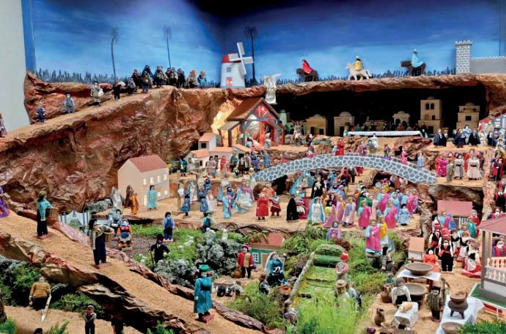
And so it is that in these piles of bran – populated by ragged figures, excrescences collected throughout a modest life, born between hands resigned to silence – goes the whole world of secretly lived forces.
Here lies the colorfulness of his restlessness, the impetuosity of his deep religiosity, the picturesqueness of his torrent naivety, the innocence of his unrestrained creative impetus, and the pulse of his emotions represented in the admirable variety of his work.
A testimony to the faith of those who, in their own world, created the most original way of paying homage to the one who is the Lord of all the stars and of all Creation, conclude the researchers Paula Rosa Cabral and Gilberto Bernardo.
In Diário dos Açoores, Osvaldo Cabral-director
Translated to English as a community outreach program from the Portuguese Beyond Borders Institute (PBBI) and the Modern and Classical Languages and Literatures Department (MCLL) as part of Bruma Publication and ADMA (Azores-Diaspora Media Alliance) at California State University, Fresno, PBBI thanks Luso Financial for sponsoring NOVIDADES.

 Novidades - The Islands and the Diaspora