

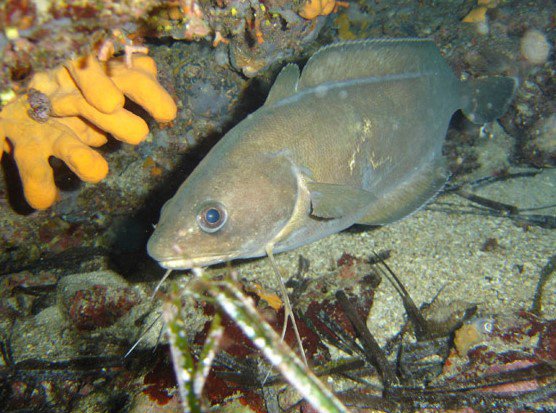
Forkbeard (abrótea) fishing is banned in the Azores until the end of the year because it has reached the quota limit.
In fact, in a letter published by the regional authorities, it was announced that the regional fishing fleet has reached its annual catch limit for forkbeards (Phycis phycis).
This measure will be in force from 00:00 on December 17 until 24:00 on December 31, 2024.
Quota issue discussed at Regional Fisheries Council
Meanwhile, the Regional Fisheries and Aquaculture Council (CRPA) was held in the town of Rabo de Peixe, attended by more than 50 councilors, including the Azorean Fisheries Federation (FPA), its members, the Azorean Fishing Cooperative, the Fishermen’s Unions and other interested parties.
About the agenda item on TACs (total allowable catches) and regional quotas, the management of stocks was discussed, namely of the species red seabream, beryx spp., swordfish, see, forkbeard, blackmouth, pitcher, among others of economic interest, reports the Fisheries Federation in a note sent to our newspaper.
On this point, we highlight some of the changes agreed during the CRPA, including the annual catch limits per vessel and the vessel limits per trip.
The possibility of implementing new minimum sizes for some species and adjusting existing minimum sizes was discussed. Still, there was no final decision due to insufficient scientific data.
Concerning the bigeye tuna harvest for 2025, important criteria were discussed to improve quota management and avoid, as in recent years, the early end of the quota. As bigeye tuna is a species with a low TAC and a resource shared between mainland Portugal and the Autonomous Regions, the fisheries sector has joined forces to ensure a co-management plan and discuss the possibility of increasing the quota, establishing daily catch limits for open-mouthed vessels, maximum limits per vessel, among other relevant criteria for good management of this important fishery.
Throughout the meetings, there was also talk of offshore and coastal marine protected areas, which again caused concern among fishing organizations because there was no consensus. The Regional Secretariat for the Sea and Fisheries said the participatory process for coastal marine protected areas would resume in 2025. Councillors were also given a provisional document on the sector’s restructuring plan, but still without guarantees of fair support for the scrapping of vessels.

Concerning the Monitoring and Inspection Systems or MONICAP, more equipment is to be installed, and by 2030, all vessels must be equipped with a monitoring system, as required by the European Commission’s new Fisheries Control Regulation. Other points of great importance to the sector were taken into account on the agenda of the Regional Fisheries Council, particularly fishing support infrastructures, investments in vessels, training, and professional categories, and the system of incentives for the Collective, as well as the registration of associations.
During the CRPA, as proposed by the FPA, there was the opportunity to present two projects in the field of green and digital transition and security in fisheries. One of the projects was a platform for managing fish auctions and fisheries, presented by shipowner Nuno Rosa, which allows shipowners and fishermen to know in real time what is being unloaded at any auction, compare fish sales in their history, enter their expenses and calculate their income and, above all, know how to value their fish, fishing less and better. Another of the projects was “Fish-X,” presented by Nicholas Blanc from Sciaena, a pilot study with small-scale fisheries in three areas of European Union waters (Atlantic, Adriatic, and North Sea), whose main objective is to monitor fisheries and use data to identify fishing hotspots.
“It was two days of intense work, which resulted in the drafting of several FPA recommendations for the fisheries sector and possible measures to improve the future of the sector,” concludes the Fisheries Federation’s statement
.

Azores-style fried fish with forkbeard (abrótea frita)
Translated to English as a community outreach program from the Portuguese Beyond Borders Institute (PBBI) and the Modern and Classical Languages and Literatures Department (MCLL) as part of Bruma Publication and ADMA (Azores-Diaspora Media Alliance) at California State University, Fresno, PBBI thanks Luso Financial for sponsoring NOVIDADES.

 Novidades - The Islands and the Diaspora