

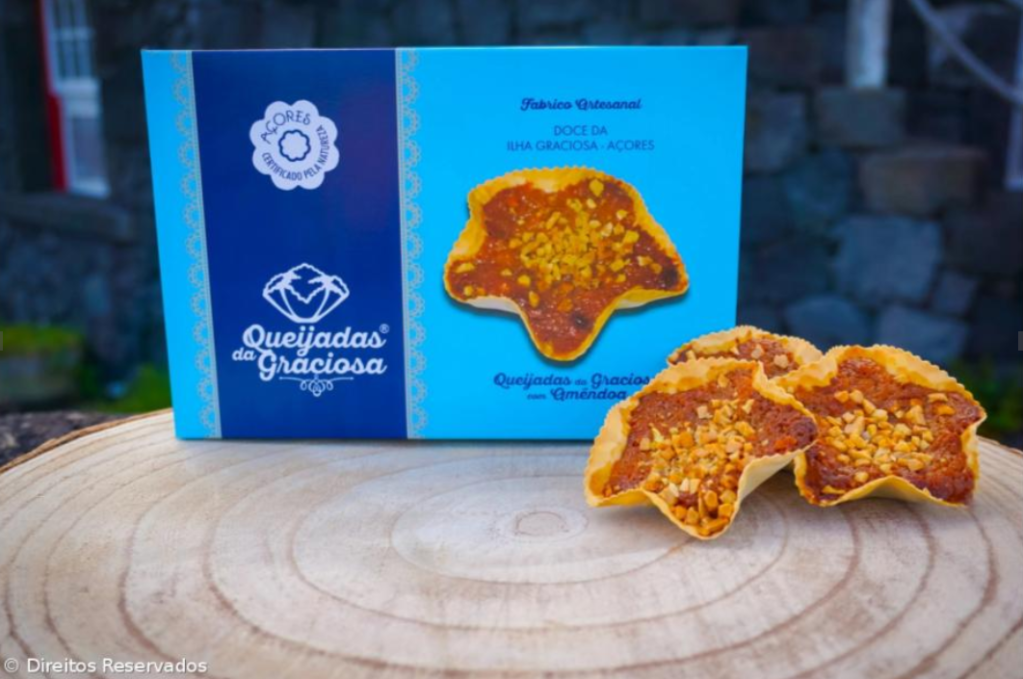
The queijadas, now a symbol of the white island, originated in an ancestral recipe that was once in danger of being forgotten.
The idea of an inheritance typically refers to something material, something that can be valued and entered into spreadsheets. What you inherit often doesn’t fit into mathematical formulas and can have incalculable value. Sara Félix knows this well, as she is the heir to a legacy in the form of a sweet, the fruit of a dream that she now graciously assumes as her own.
What has become her everyday recipe remains untouched, as genuine as the one her mother, Maria de Jesus, taught her. The queijadas she replicates today were made in her childhood kitchen even before Sara Félix was born. “My mother used to make them for my brothers’ birthday parties, who are older than me, and for my parties too,” she recalls.
It wasn’t only in her home that this sweet was a must. Before it had an island name, they called it ‘Covilhete de Leite,’ made in many other houses for parties. Sara Félix believes its origins date back over a century, although she can’t say for sure. As time passed, it faded into the background at parties and family gatherings and disappeared from many dishes but never from those in her home. Maria de Jesus made sure to keep making them, and friends and family made sure to keep asking for them.
This circle of admirers widened at some point, and their preparation demanded more time and attention. “It was around 40-something years ago that it all began, in a small separate kitchen that my mother decided to build. It started as a very small thing and grew from there,” says Sara Félix. Whether it was in her plans or not, this is how Maria de Jesus ended up being responsible for giving a new lease of life to what would become the typical sweet of her island, currently registered under the name Queijada da Graciosa and the first product to bear the Azores Brand symbol.
With this new prestige given to an ancestral recipe also came a new shape, the one we recognize today, distinguishing it from other typical queijadas.
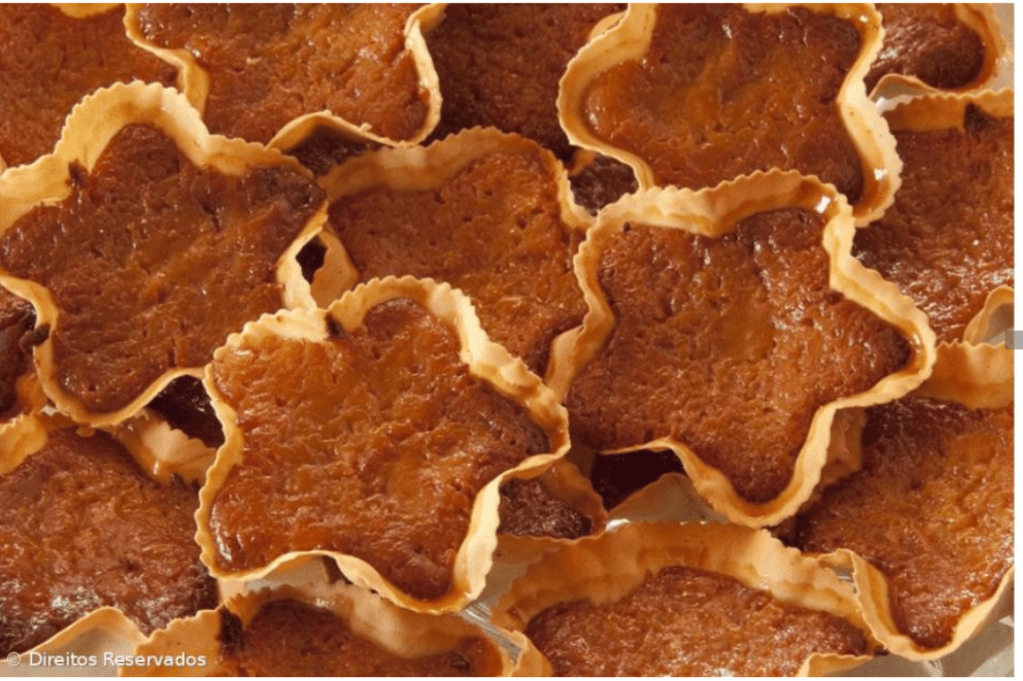
Sara Félix confesses that she doesn’t know the story’s outline that gave the queijada this five-pointed shape, perhaps a star or even a flower, depending on the path chosen by the imagination. “I was very little when my father made the shapes, and I don’t remember any more details. They used to be round, but I don’t remember that. I always remember them like this, as they are today,” she says.
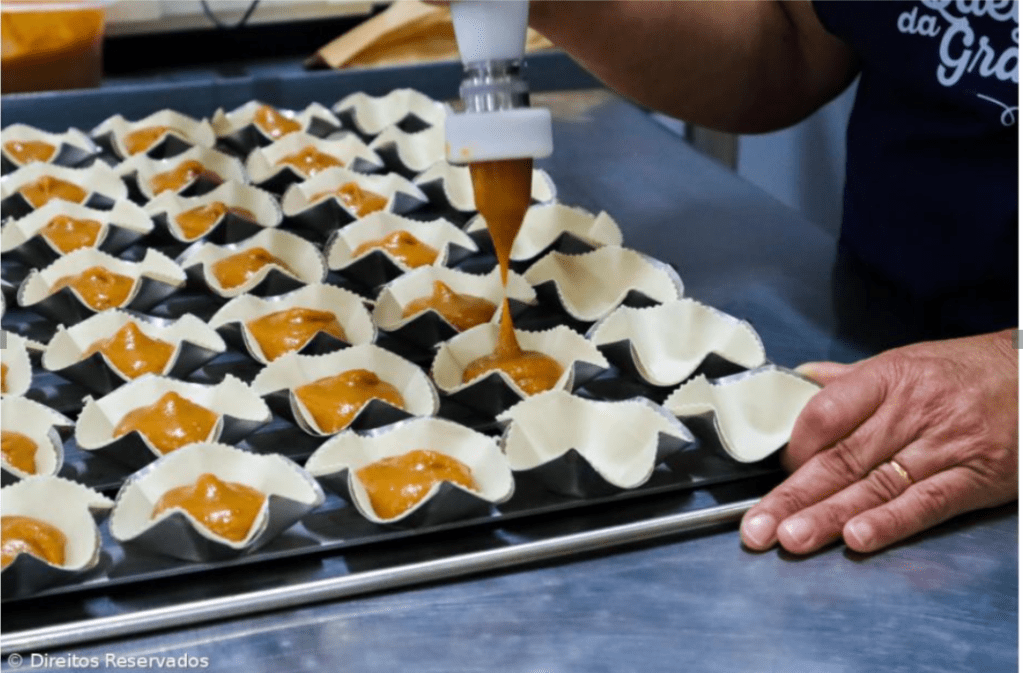
Although demand is high, the factory remains relatively small: “The last big expansion we did was 26 years ago, so it’s been a long time,” says Sara Félix, who says she only has six people to help out. “In the low season, we can manage. As we already have a certain rhythm and everything is organized, we can manage,” she explains.
Currently, the white island’s queijada is sold in large supermarkets and is on all the Azores, Madeira and mainland Portugal islands. Sara Félix adds that it also has a special place further afield: “We have demand from many places, but a lot from emigrants, the nostalgia market,” she stresses. She adds that tourism has also come to help. “It’s good for everything. The more people there are around, the more you sell,” she says.
Apart from the daily challenges, Sara Félix confesses that she can’t point to any major difficulties in the business. “Everything is done,” she sums up bluntly, adding that even during the pandemic, she has found ways to grow. “As everything was at a standstill, I took the time to experiment. I wanted to do something different, to sweeten people’s lives, and that’s how I launched Queijadas da Graciosa with almonds around Christmas time.”
In addition to this variation, there is another version which, although not as common, is for Sara Félix as old as the original. “My mother has always made Queijada de Coco for as long as I can remember,” she says. She confesses that the new year ahead smells like something new, a couple of them to be exact, but they’re not ready to come out of the oven yet.
“I’ll think about it next year, not this year,” he says patiently. “I have two ideas but they’re not certain yet. It’s not just up to me to approve them, it’s a decision that will be made together with my brothers and my father.”
This is how Queijada da Graciosa remains as familiar and genuine as it was initially. Thanks to the commitment to preserving an ancestral recipe, the once ‘Covilhetes de Leite’ have left home and are no longer sweets just for festive days.
Today, they represent an entire island, are one of the symbols of a whole archipelago, and continue the greater mission of uniting a family around a dream left by a mother and wife who, although physically absent, is present in this sweet heritage whose value is beyond calculation.
From Marca Açores in Açoriano Oriental, Paula Gouveia, director
Translated to English as a community outreach program from the Portuguese Beyond Borders Institute (PBBI) and the Modern and Classical Languages and Literatures Department (MCLL) as part of Bruma Publication and ADMA (Azores-Diaspora Media Alliance) at California State University, Fresno, PBBI thanks Luso Financial for sponsoring NOVIDADES.

 Novidades - The Islands and the Diaspora