

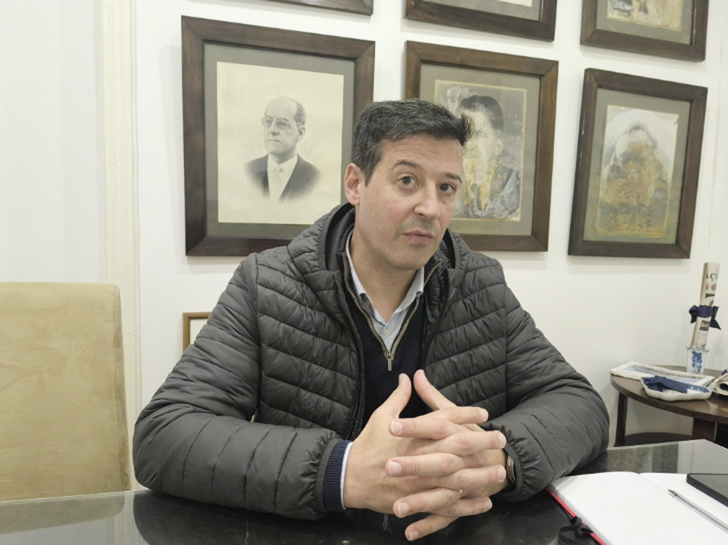
Correio dos Açores – You say that public contracts are failing and that the state in the region cannot systematically default. What do you mean? Has this been happening?
Pedro Marques (businessman) – Yes. For many years now – this is not new – in public contracts, particularly in payments, companies’ relations with the government and local authorities have not always been easy.
The law on commitments has brought a lot of order to municipalities, and fortunately, things have improved. Overnight, we went from a situation where there were no guarantees to a situation where there were total guarantees, and that’s important.
Concerning the Government of the Azores, I feel that there were significant payment delays, and then a path was taken to recover these payments before COVID-19. During the COVID-19 period, things went very well; they were excellent. In the post-COVID period, they got significantly worse and now tend to improve again.
Contrary to what people think, companies don’t have the margins to constantly finance themselves because they don’t get paid on time. This can’t happen, and it shouldn’t happen, not systematically. It can happen occasionally.
What I’m asking for is a political commitment for the future in which the PS, the PSD, the CDS, the Liberal Initiative, Chega, the Left Bloc, and all the political forces understand, once and for all, that they can’t ask for entrepreneurship when payment deadlines don’t work. You can’t make contracts, and things aren’t fulfilled, particularly regarding payments.
And in companies, are there delays in paying wages?
Companies are weakened and fall behind with suppliers and wages, and then it snowballs. In this context, everything becomes complicated even if companies compete and get support lines. The other day, someone said, “I have many millions in factoring, and it’s still not enough”. You can’t; factoring is supposed to be a short-term, one-off line. It cannot be used to sit on a company’s balance sheet. It is, by definition, a short-term line that has to increase and decrease in the period in which it has to exist. It can be used for a one-off problem, such as an increase in turnover that needs to be taken care of.
Is the cash flow support not enough to support these companies?
If public contracts are systematically not fulfilled in good time, how can a cash support line work? The fact that companies have funding doesn’t excuse them from not getting paid. It will go wrong sooner or later.
I’m calling for the political forces and the regional and local authorities to understand, once and for all, that they can’t make investments unless they have guaranteed funding sources. This cannot happen for everyone’s sake.
There’s no point in running around with banners of entrepreneurship and new companies because they will go wrong, especially those that depend on public contracts.
What do you consider to be policy 2.0?
I called it 2.0 so that the younger generations would understand. I hope the new politicians will come with a desire to do things differently because society has evolved, things have evolved, the world is different today, and people’s and society’s needs are different. When I call for 2.0, it’s for a change in how things are done. When I say 2.0, I call for us to stop thinking systematically about re-elections. When are we going to start thinking about the country and the region? When? Are we going to waste any more time?
Is it a mistake to give in to populist decision-making to get re-elected and have no money for the essentials? Is that what you’re saying?
That’s exactly what I’m saying. Then, the already-signed contracts can’t be fulfilled. We all make mistakes, but they can’t be systematic enough to put everyone and everything into debt.
Should councils invest more in work and less in parties?
(…) Suppose I throw money at people, or at festivals, or at what is called culture. In that case, this is very short money that doesn’t solve anyone’s problems, creates absenteeism, and creates the false feeling in people’s minds that leisure is a way of life when suffering is part of our lives.
It advocates for less leisure, less waste, and more work.
I think it’s sad that nowadays we don’t talk about work. Values such as work, honor, and words have fallen out of our vocabulary. They’re not taught, they’re not passed down between generations, they’re not part of our everyday lexicon. The only thing people do is have a disagreement at work, they take sick leave, they get upset, the work is tiring, and they don’t show up the next day. Is that how we’re going to increase our productivity?
Unnecessary sick leave, absenteeism, and low demands at work?
This is very dangerous. If we’re going to pass students on from year to year just because their parents are going to shout at the teachers or the class leaders or the board of governors because their children have to get the grades they need, we’re going to lose demand and meritocracy. How are we going to be a better people?
Are we regressing socially in terms of values, or are we evolving? I think we are regressing. This is dangerous because it reduces an economy’s productivity. We’re passing on the wrong values to the next generation.
At one time, they advertised well-being, leisure, vacations, traveling, and relaxing at home as good. When it isn’t, life is mostly about work. It seems that work is now only for free time, and leisure is the main way of living. This is wrong, and companies suffer a lot from it.
Aren’t you generalizing?
I’m generalizing, but this is becoming increasingly serious in companies. Let’s do an exercise here: idleness becomes the way of life and not work, so companies have a hard time; some fall by the wayside and can’t adapt. Those that do adapt, if they’re distressed, what are they going to do? They look everywhere, and the solution is immigration. Let’s bring in immigrants, right? People don’t realize the results of this option.
In my opinion, immigration is good, necessary, and useful. The Azorean population is becoming increasingly educated, and there is a shortage of people for other types of professions. Construction, hotels, restaurants, fisheries, and agriculture all benefit from it.
All is well and good, but to what extent? Because then there will be a point at which these immigrants, who come with the ability to work and the need to work and put in the extra hours, will pass on the right values to their children, and what will happen in the following generations? When there’s a generation of Azoreans who haven’t been taught the right values, and the next generation of immigrants are graduates who want to work, who will the companies employ?
I question whether we are aware of where we are heading in this social state or not. We still think that someone else is going to solve our problems and we, in the Azores, are all going to travel, we’re all going to go on vacation. When we have an argument at work, we take time off, we have an argument at work, and I don’t show up the next day. What do you think will happen to people who work like this when immigrants are available to work and with training?
The region’s collectives (business associations, associative movements, trade union movements…) don’t have to be on opposing sides. And I don’t see the will for both sides to come together to solve serious problems. On one side, all they talk about is increasing salaries.
I say this to shock you: I advise anyone who wants to be an entrepreneur today not to do it, to run away from being an entrepreneur, to do something else. Or if you want to be an entrepreneur, let your company depend only on computers and machines because the day it depends on people, you’re stuck with a labor code that, at the moment, is horrible.
I know that in the United States, we’re in the opposite direction, and I’m not advocating that. But we can’t be in the state our country is in. Our Labor Code urgently needs to be revised. We can’t have the same Labor Code protecting a good worker and protecting a bad worker. That’s not fair. This is the big problem. The Labor Code lumps good workers and bad workers together.
Where does the Labor Code defend companies? Where does it protect companies? Where does it safeguard jobs? Because jobs mean protecting the employer and the worker.
When I talk about this, I’m always talking about companies and serious, honest people.
Is tourism still growing in the Azores?
Still, our base is low, and that’s a good thing. We have to have a driver in our economic growth. Whether it’s tourism, agriculture, industry, commerce, services, or whatever, there has to be someone pulling the wagon at some point.
Let’s look at the Azores’ economic model. Can it be based on just one pillar, two, or three? What are the main pillars of the Azorean economy? For me, the first is the public treasury. It’s the biggest employer in the region. It employs a lot of people, and through subsidies, it feeds a number of others. Through the region’s budget, it generates a lot of savings.
The second is companies and the real economy. Which sectors? I’ll tell you:
We have the government, and then, in the business sector, we have tourism, commerce, agriculture, and fisheries.
Do you put trade before agriculture and fisheries?
I put commerce ahead because, if you look, the biggest employers in this region are the department stores. When we have a supported economy, where most sectors import and sell, we are not creating wealth. We have to develop industries that export. Tourism exports and brings money to the region.
Where do we have to go? We have to move towards sectors that essentially export. We have to reactivate our regional industry and encourage industries that work abroad so that we can balance our flow and our balance of trade. If we only have a low incorporation capacity and only incorporate labor and a few local products, we are impoverishing ourselves and not enriching ourselves.
If most of the things we incorporate – as is the case with civil construction – come from abroad… what wealth is there? Construction is only doing well and should only be doing well if the country or the region is doing well economically. And how can we get out of this trap of this “low value” spiral?
It’s not easy. I don’t have all the answers, either. What I don’t see is anyone worried about it. I see everyone worried about the summer party programs and re-elections. This scares me as a citizen and, as a businessman, worries me a lot. This means that the region will become poorer sooner or later. And that doesn’t guarantee a future.
Now that tourism is a breath of fresh air, we can take advantage of it to make strategic investments. These won’t pay off in the short term but will pay off in the long term, and we have to invest there.
We have to change the way the University and its research and development area evolve. We have to change this paradigm radically. There can’t just be research. There is merit in research, but the merit has to be “research has been done and now it has been applied in practice.” In my opinion, there has to be a component for research and a bigger component for the success of this research in practice.
Is it the creation of start-ups?
It could be a way forward, but the government has to comply with the contracts afterward because if it doesn’t, people will jump in, and then what? How do you pay salaries, how do you pay commitments, suppliers, how do you pay for investments, how do you pay the rent for the place you’re in?
We end up in a vicious circle that leads to impoverishment, and we can’t get out of it.
There is a limit to tourism…
A sector can’t grow infinitely. And what is the post-tourism plan? We must take the time to organize, restructure, and reinvent ourselves when the region and the country are growing, not when we’re already in a difficult situation.
You’re explaining to me why great talents leave the Azores?
Where are the opportunities? This isn’t just a problem for the Azores; it’s for the country. Our country has the highest number of graduates, and the economy has adapted? Are we still in the traditional sectors, and will the conventional sectors absorb this talent? These people have degrees in biology, physical chemistry, engineering (…). Do we have companies and jobs for these people? We don’t. So, the economy has fallen behind. Our country first developed and built up its infrastructure. That’s true. But when Cavaco Silva was Prime Minister, we should have stopped with quantity, switched, and gone from quantity to quality. That’s when we started investing in universities and training, but the economic sector didn’t keep up. It remained formatted, supported by the State Budget.
Our entrepreneurs can’t always be waiting for subsidies to solve their problems. They can’t always expect the government to solve their problems.
You emphasize public road passenger transport and new demands in this area…
I still shudder when I pass the narrow roads of our islands and see those huge buses passing by empty of passengers. For example, in the ‘Marques’ company, we have a huge fleet that, at eight in the morning, transports more than 150 people back and forth every day.
Why is that? Because I don’t have public transport capable of getting workers to the various points on the island where I need them to be. But I’m fine with that because the construction industry has mobile points. But what about restaurants, bars, hotels, all the businesses that are based around tourism, which have shifts that work almost 24 hours a day, bakeries, a whole range of the companies that are based on tourism, and we still have transport from 8am to 5pm? Does this make sense? Wake up, mayors. What are you doing to change this?
Less partying, more problem-solving. Does having a bumpy industrial zone with highway access make sense just because the mayors don’t get along and wash their hands like Pilate?
The entrepreneurs are also to blame. Because they’re afraid, they’re muzzled. I want to believe that our country and society have evolved, and we don’t live in an autocratic state.
We don’t live in an autocratic state. Fortunately, democracy exists, and I can speak freely. I may not be right, and I may not be right about everything. But woe betide me if I fail to discuss the issues that must be addressed. I won’t forgive myself that day.
What is the current state of implementation of the PRR? Is there any reason to be worried?
Let’s look at the RRP from the point of view of a construction worker. In the last two and a half years, around 800 to 900 million euros of work has been launched from public tenders and direct adjustments. These are figures from AICOPA. Normally, just to give people an idea, 100 to 150 million euros a year were launched and, in the best years, sometimes as much as 200 million euros. What we have here is called PRR. We’ve gone from a reality of 300 to 400 million euros in two and a half years to 800 to 900 million euros.
I’m convinced that the PRR will be fulfilled, for the most part, in terms of value. The only thing is that the work needs to be launched and carried out. That’s what has been done, and I take my hat off to the politicians because they understood the urgency of getting the PRR off the ground and putting the country and the region first.
For example, I’m worried when I see talk of the 2030 Operational Program. People have to think about what they are saying. Why? Let’s look at a construction entrepreneur. I’m faced with two projects, one from the RRP and another. Which decision am I going to make? The one that’s more economically advantageous for me. That’s logical. You can’t even demand that entrepreneurs think differently.
Launching the 2030 Operational Program now would be a mistake. It will run over the PRR, causing the loss of these frameworks and funds. So far, the government and local authorities are doing well because they prioritize the PRR.
I know that PO 2030 is important and urgent, but we must understand the reality. You can’t look at reality and see what’s in front of you, or you can ignore it and pretend it’s not in front of you and make the wrong decisions. Making decisions based on intuition or on part of the information without seeing the whole is part of populism.
The appeal I make, as a construction entrepreneur, is not to make any mistakes. I think it’s logical, it makes sense, let’s wait a bit longer before launching PO 2030. A project takes a year, a year, a half, and two years. Those not completed by this year’s summer can’t be finished until 2026. So, if that’s the case, priority has to be given to launching everything possible in the PRR because there won’t be time to carry it out. And if we launch PO 2030 now, they’ll run over it.
João Paz is journalist for the Correio dos Açores, Natalino Vieiros-director
Translated to English as a community outreach program from the Portuguese Beyond Borders Institute (PBBI) and the Modern and Classical Languages and Literatures Department (MCLL) as part of Bruma Publication and ADMA (Azores-Diaspora Media Alliance) at California State University, Fresno, PBBI thanks Luso Financial for sponsoring NOVIDADES.

 Novidades - The Islands and the Diaspora