

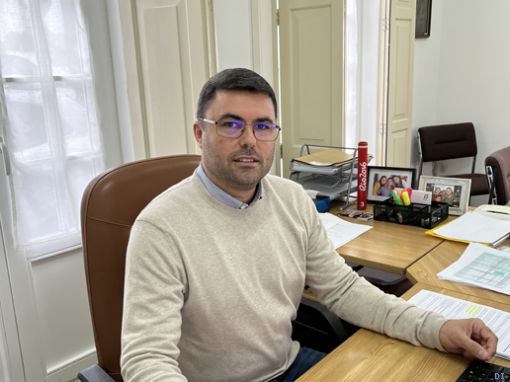
What motivated you to accept the position of Regional Sports Director?
Anyone who knows me knows I like challenges, work, and building. Wherever I’ve been, I’ve always been keen to leave something beneficial to all parties.
I could not resist accepting this mission, which requires much responsibility and competence. I aim to contribute to the development of the regional sports movement and the promotion of physical activity.
You’ve been in the office for just over a week. What was the reality you encountered?
I’ve been with the Regional Directorate for Sport as director of services since November last year, so I have some knowledge of the work carried out under the guidance of the previous director, Luís Carlos Couto.
We’re in a phase of simplifying procedures and reducing bureaucracy to speed up processes and provide quicker responses to meet the needs of sports associations.
On the other hand, we are following up on the processes as most sports seasons in different modalities are underway.
My appointment coincided with the payments that had been suspended due to the implementation of the budget.
UP TO DATE PAYMENTS
Are all payments to clubs and associations up to date?
All the clubs with national competitions that signed program contracts for the 2024/2025 season have already received all the funds last week.
As we have a negative balance from last year, we are now reviewing the budget to move forward with the applications that are currently considered.
We will soon be able to sign the new program contracts and make the respective payments to the clubs.
We don’t have all the processes completed for the sports associations because there are cases where some procedures or documents are still missing. Only two or three sports have completed their processes.
Once these processes and the sports development plans have been completed, we will begin the summits with the associations to define the support granted in 2025.
Still, we have the so-called “Azores Word ” to support us. Are there any delays in these payments?
This process was already completed when I took office, so everything will be settled.

CLOSER PROXIMITY
As well as working professionally in the sports sector, first at Angra do Heroísmo City Council and, more recently, in the Regional Government, you also come from the associative movement. One of the recurring criticisms is that there is no proximity and dialog between the public authorities and sports associations. Do you intend to change this reality?
I promote dialogue because I believe it’s the best way to resolve any situation that may arise.
Since I started working as regional director for sports, I’ve received many requests for various situations, but it’s not always possible to deal with everyone as quickly as I’d like.
The post of Director of Services that I held is still vacant, so I’m filling in until the position is filled.
I’ve always been an advocate of proximity, and in this mission, I have ahead of me, I must never forget what our role is in the sporting development of the region. If we distance ourselves too much from the reality on the ground and from the difficulties, there may come a time when it no longer makes sense to be in our position.
I come from the associative movement, having been linked to a club and an association. I hope I will never distance myself from reality so that all decisions and policies align with all sports agents’ expectations.
Azorean Sport and Beyond is going through a crisis of leaders. There is a proposal in the Azorean parliament to create a Statute for Sports Managers, which has been criticized for not meeting expectations. What is your position on this matter?
As an association leader, I have received this proposal, but I don’t know where it stands.
We believe that giving sports managers more tools is necessary, so we plan to promote training courses. We discussed the matter with the secretary this week.
We intend to launch a training program soon, as we have done, so that leaders can have more tools. Many of their difficulties involve not knowing where to secure funding. Sometimes, the application processes become complex because of a lack of knowledge about the procedures.
Later this year, we should start the program to acquire skills and tools for managers.

HIGH PERFORMANCE
Azorean sport is experiencing a period in which several athletes from different disciplines have been present at major international competitions representing Portugal. Is there any possibility of increasing support for these athletes?
The region has seen remarkable growth because an increasing number of athletes are fighting for top positions in national competitions, and some are already starting to appear regularly in major international competitions.
A first step has been created at the regional level: Young Talent B and Young Talent A are maintained. Currently, more than 60 athletes are covered by the High Performance Statute.
As far as we know, support for Young Talent has been satisfactory, although there are some situations where the available money is not always fully used.
We have an increasing number of High-Performance athletes, a status awarded by the Portuguese Institute of Sport and Youth, for whom the support is more significant because they are at a higher level than Young Talent.
Also, as part of my role as Director of Services, I participated in a meeting with the Regional Directorate for Education and Administration to create a model that can consider both the school and sporting aspects of athletes. The aim is to generate complementarity between sporting and school activities and avoid young people having to opt for one of them.
I can give as an example the case of João Pereira, who had to be absent from school for several days to participate in Argentina’s karate world championships. When he returned to the island, he had to make a huge effort to resume school activities.
It’s important to create tools so that young people in competitions or internships and away from their island of residence can follow classes by digital means or otherwise and have access to materials that allow them to keep in touch with curricular activities.
We need to find solutions that can minimize the conflicts between sports practice and the school activities of our young athletes.
There is an openness to working and finding solutions, and I believe that progress in this direction will soon be possible.
In Diário Insular, José Lourenço-director
Translated to English as a community outreach program from the Portuguese Beyond Borders Institute (PBBI) and the Modern and Classical Languages and Literatures Department (MCLL) as part of Bruma Publication and ADMA (Azores-Diaspora Media Alliance) at California State University, Fresno, PBBI thanks Luso Financial for sponsoring NOVIDADES.

 Novidades - The Islands and the Diaspora