

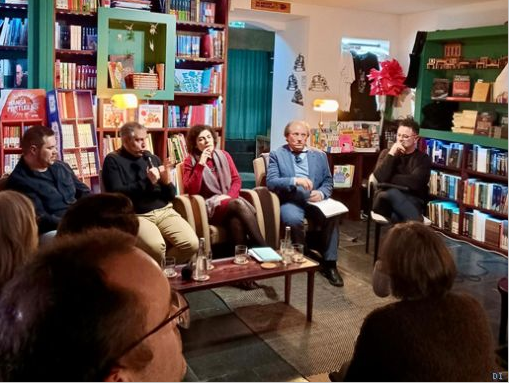
The coordinator of the recently created Observatory on Poverty and Human Development in the Azores, José Henrique Ornelas, argues that the region should invest in full compulsory schooling.
“The Azores should be an exception. On the mainland, a law says children shouldn’t leave school until the ninth grade. Secondary school is not so clear. In the Azores, it has to be more radical,” he said in a debate last Friday, International Education Day, at the ‘Lar Doce Livro’ bookstore in Angra do Heroísmo.
“One of the fundamental measures I would like to propose to the (regional) government is a collective decision to contribute to the issue of education and poverty. It was to make compulsory education compulsory for all children. Eighteen years. Absolutely no one should leave school until they’ve reached that target. If you don’t get the 12th grade by the time you’re 18, that’s fine, but let’s all work towards it,” stressed José Henrique Ornelas, who felt that this step would be essential from the perspective of ‘learning and worldview.’
Another goal, said the retired professor at the Higher Institute of Applied Psychology, is to double the number of graduates in the Azores.
The Poverty and Human Development Observatory is the first of four structures to be established by SEDES (Association for Economic and Social Development) in the Azores. The other areas of action will be Health, Innovation, and Citizenship.
José Henrique Ornelas, also founder of AEIPS-Associação para o Estudo e Integração Psicossocial (Association for the Study and Psychosocial Integration), argued that the problems in the fields of education and poverty have already been diagnosed in the archipelago and that it is time to act. “We need to put scientific evidence into practice in these areas. This is not inevitable. Poverty in the Azores and education issues can be changed and we have already done practical test work, through Community Intervention Partnerships,” he said.
The professor recalled a project developed in São Miguel, which overturned the myth that, in education, everything takes a long time. “We carried out experiments and interventions that showed that school situations can be resolved much more quickly than we thought. In terms of school retention, in Água de Pau we managed to reduce it by 40% in one school year,” he said.
The debate was held in partnership with SEDES Açores and the Angra Radio Club, which will soon broadcast it.
“Education is the heart of society, if it doesn’t work, society will all malfunction,” said Vítor Fraga, president of SEDES in the region, at the event.

Market and Economy
Francisco Simões, psychologist and associate researcher at ISCTE-IUL, also participated in the debate. He expressed reservations about presenting school as a way of “solving” poverty.
“For some years now, the public discourse has been making this direct, unique and unidirectional connection that school is the solution. This discourse then has nuances. For example, school is going to solve skills levels, so it will generate more jobs. This is not true. On the other hand, the labor market and the economy have to generate jobs,” he said.
This gap, the researcher stressed, is even greater on the peripheries. “This is very well proven by studies in the fields of sociology and economics, which compare regions and show that, in the peripheries, even if there is an increase in qualification levels, this is not enough to increase people’s income levels and the level of employment,” he said.
Francisco Simões pointed out that school is “one of the most important factors in promoting upward social mobility”. Still, they maintained that “this obligation to solve all the problems” cannot be placed on it.
“What I feel is that in political discourse, because there is no overall vision, it is said that the School will solve…” he lamented.
José Henrique Ornelas agreed that creating a “regional plan” in this area is necessary. “We have to have everyone: the state, the school, the government, the local authorities and the whole of civil society, each one of us, each parent, working towards this goal. That’s the only way we can solve it,” he said.

“Urgent” work
The discussion included the views of teachers. Arminda Magalhães, a Jerónimo Emiliano de Andrade Secondary School teacher, argued it is still worth studying.
“If we look at the most recent indicators, we realize that there is a relationship between levels of schooling and then the quality of life that our children, young people and also our adults have,” she explained.
She cited figures on unemployment in 2023 published by the National Statistics Institute (INE). “Eighty-eight percent (of people in this situation) don’t have a secondary education, 46% don’t have more than a basic education,” he said, pointing out that these are national figures.
She added that the regions with the highest at-risk-of-poverty rate, among which the Azores stand out, “are also those with the highest rate of early school leavers from education and training.”
The teacher recalled that schooling is also reflected, on average, in salary values. “This makes our work in the classroom, the work of all those who work in schools, those who make and build public education policies, urgent. As a whole, we have to be able to disconnect these poverty indicators from education,” said Arminda Magalhães.
Paulo Matos, a Portuguese Theater, Citizenship, and Development teacher, said we must reflect on the school and how to involve families. “We often hear that going to the soccer match is more important than attending class, for example. There are several scenarios where the school is devalued by the students and their parents, who often don’t show up when they are called to the school to deal with behavioral or achievement situations. This devaluation is a catch in the mouth. If there is no appreciation, there is no commitment. If there’s no commitment and no success, there’s also a lack of belief that the school can counteract all the indices that affect us,” he said.
For José Henrique Ornelas, what’s on the surface doesn’t always show the real attention of families. In the project he developed in São Miguel, he worked with more than a thousand families over five years. “They surprised us. The poor families from the social housing estates came with written texts… ‘Can I read my text?’ So they wouldn’t be fooled into saying how worried they were about their children how much they wanted their children to go to university. We managed to create an environment of security, liberation, and empowerment for the families,s and they expressed their dreams, instead of being defensive,” he said.
in Diário Insular-José Lourenço-director
Translated to English as a community outreach program from the Portuguese Beyond Borders Institute (PBBI) and the Modern and Classical Languages and Literatures Department (MCLL) as part of Bruma Publication and ADMA (Azores-Diaspora Media Alliance) at California State University, Fresno, PBBI thanks Luso Financial for sponsoring NOVIDADES.

 Novidades - The Islands and the Diaspora