

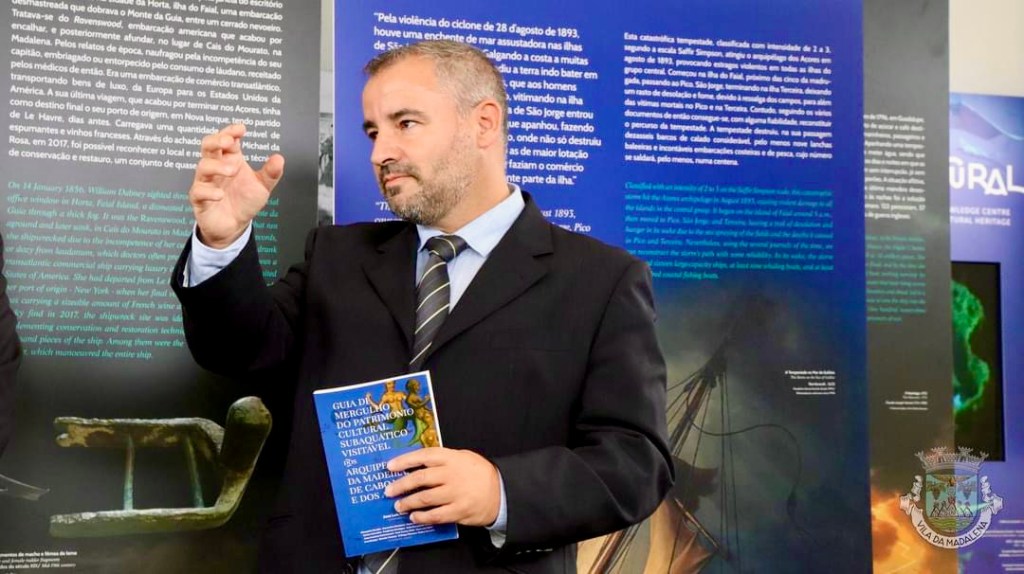
Alexandre Monteiro began his career as an underwater archaeologist when he discovered a shipwreck with cannons off the island of Terceira shortly after obtaining his diving certificate. The creation of a database documenting thousands of shipwrecks and the discovery of a Portuguese ship in Australia, whose owner was from Pico, are some of the achievements of the archaeologist and researcher. “We know that there are 250 ships with treasures off the Portuguese coast and that between 150 and 170 of them are in the Azores,” says the archaeologist.
Correio dos Açores – What path did you follow to become an underwater archaeologist?
Alexandre Monteiro (underwater archaeologist) – At the time, I was teaching biology and natural sciences and working for the Regional Directorate of Education. I was also an amateur diver. Practically the day after I took my diving course, I found a shipwreck with cannons and went to see the Director of the Angra Museum.
After this event, I stayed on to advise the Azores when treasure hunters were harassing the region. Then, I worked as an archaeologist—not yet trained in archaeology—hired by the Portuguese Institute of Archaeology, where we worked from the Port of Pipas.
Sometime later, I ” legitimized” my profession: I did a degree in Archaeology and then took postgraduate courses. I have a postgraduate degree in scientific diving, am a diving instructor, and am a commercial and professional diver.
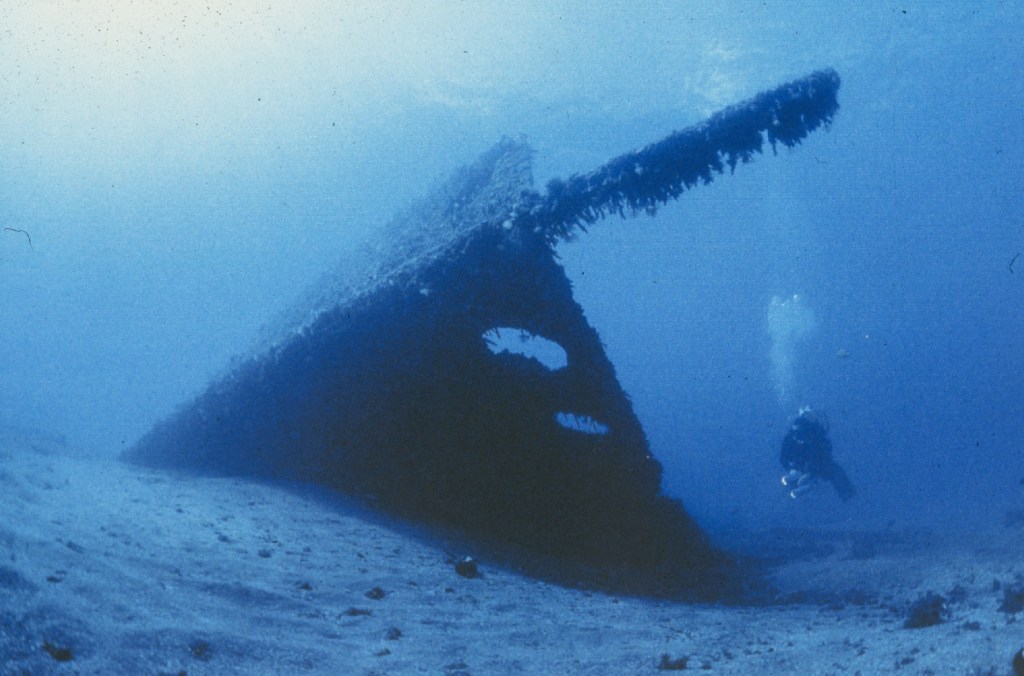
He says that around 250 ships must contain treasures in the Portuguese Sea. Do you think the Azores are a “mine” regarding underwater archaeology?
The Azores Sea is part of the Portuguese Sea. Due to the characteristics of the region in terms of the North Atlantic trade winds, all the sailing ships that returned from the colonies and the Orient – we’re talking about the Portuguese and Spanish cases – that came from the “New World” when they returned to Europe, had to pass through the Azores. Historically, this has led to many storms causing shipwrecks in the archipelago and many fleets of the powers involved in this trade at the time (namely the English and the French). At these stops in the Azores, these fleets came laden with gold, silver, and Chinese porcelain. It was a climate conducive to conflict between nations, so there were combats and battles, and some of these ships went down.
Of the 7,000 to 9,000 shipwrecks I have documented in Portuguese waters, around 250 carried cargo that today we call “treasure.” In other words, a treasure hunter can find and quickly sell everything at auction—such as gold, silver, and Chinese porcelain—because the rest is of no interest to them.
If we’re talking exclusively about the ships that carried this type of cargo, we have around 250 proven shipwrecks in Portuguese waters, the vast majority of which are in the Azores.
This results from the Azores’ transatlantic importance, specifically during the Age of Discovery, right?
The Discoveries are a short slice of human maritime history. For 300 years, large quantities of precious metals were transported on board ships. In the case of the Azores, everything other than basalt was transported to the islands by ship. In this case, these precious materials that we now call treasures were transported in a small tranche of humanity’s maritime history between 1500 and 1850.
How do you organize and conduct this underwater historical and archaeological research?
The potential is one thing, but realized potential is another. We know there are 250 treasure ships off the Portuguese coast, between 150 and 170 of which are in the Azores. It’s one thing to see that they’ve been lost in the Azores, but it’s another to know where they are and where we will find them.
For example, I can tell you that in 1589, a fleet of Spanish ships came with these riches from the “New World” and arrived in Terceira – others had been sunk in a hurricane in the Caribbean. A fleet of ‘Cumberland’ privateers came via the English crown and sailed around the Azores islands. These privateers intercepted one of these Spanish ships on the island of Terceira. A battle took place, resulting in the sinking of a Spanish ship loaded with treasure, more precisely between São Mateus da Calheta and Fanal on Monte Brasil.
I know where that loss took place, I know that the point of the masts outside is no lower than 40 meters, and if I wanted to or the Region wanted to investigate, I believe it would be relatively easy to cover the 40-meter bathymetric in those two kilometers that exist between Calheta de São Mateus and Ponta do Fanal in Monte Brasil.
On shipwrecks, you often need to invest time in each one. I’ve been organizing a database of shipwrecks in the Azores for 30 years. I started with 20 and now have around 1000. I often make a small footnote in which I talk about a ship lost on a particular island, but after investing more time in research, we discover many more stories.
I’ve been doing something I call “a shipwreck a day,” where I take every day of the year and talk about a shipwreck each day. For example, one of these shipwrecks in January was that of an Italian brig in Prainha do Galeão, on the island of Pico. I had very little information about this event, so I spent two days researching and speaking to Italian friends, and suddenly, I even had a picture painted in 1864 of this Italian brig.
If we want to turn a particular shipwreck from this database into archaeological reality, we can do so. The database is just a starting point for where these ships were sunk.

Given the immensity of the Portuguese sea, is there a need for greater incentives for this area of research?
No one needs an archaeologist; everyone needs a doctor and a mechanic, but archaeology and history are fundamentally matters of identity.
The government of Portugal and the respective autonomous regions live a little around this concept that “Portugal is the sea” and that we are a people that had its apogee with the Discoveries movement. That’s true; we were a small nation, a very peripheral and poor kingdom, and we managed to break this isolation. The Portuguese managed to work miracles regarding scientific innovation and even bring different worlds into contact – in what was the first globalization.
If we want to continue to capitalize on Portugal’s essentially maritime nature, underwater archaeology needs to be encouraged. For example, in the Azores, the cities of Horta, Angra do Heroísmo, and even Vila Franca do Campo have a very strong maritime component.
The great advantage we have with underwater archaeology is that we can take concrete examples of ships lost on a certain day, month, or year and tell the story through them. For example, the Orange Cycle in São Miguel caused an incredible number of shipwrecks in the 19th century; in the case of Horta, it was whaling; in the case of Terceira, it was supporting the ships of the Discoveries and the “New World” that came from Spain. So, it’s possible to use all these examples of boats that were lost to tell the story of Portugal and the Azores.
What was your greatest find? What stands out in your years of activity?
Regarding concrete finds, it may have been the ‘Angra D.’ The ‘Angra D’ was a ship we saw in Angra Bay, a very small bay with more than 120 shipwrecks registered there.
We found a ship while conducting an environmental impact assessment study before the Angra Marina was built. I remember vividly that we were digging in that sand, and a metallic echo came from a metal detector. Suddenly some very small boards began to appear, they looked like fruit crates. And then, as we excavated, larger pieces of wood appeared and, in the end, we had a complete shipwreck, more than 33 meters long by 12 meters wide at its widest: they were the remains of a Spanish silver galleon from the late 16th century, which had been lost 50 meters off the coast in Angra do Heroísmo, and which had been lost for the last 400 years.
Concerning other projects, I would say that perhaps the discovery, in 2004, of a Portuguese ship in Australia, called the “Correio da Ásia,” which was lost in 1816 on its way from Lisbon to Macau, with a brutal cargo of silver coins: 66,000 silver coins, the total weight of which was equivalent to more than 3 tons of silver.
The museum in Western Australia invited me to do archival research and then to do the excavation. I went to Australia to excavate the ship and discovered that it was owned by an Azorean named José Nunes da Silveira. This man was born very poor in 1754 in Madalena do Pico and later became one of the richest men in Portugal, trading all over the world in the more than 30 ships he had acquired.
It was extremely curious to start my underwater archaeology career in the Azores, and suddenly, the ship I’m excavating in Australia is owned by this man from Pico, who was one of the biggest traders in the kingdom of Portugal at the time.

José Henrique Andrade is a journalist at the newspaper Correio dos Açores-Natalino Viveiros, director.
Translated to English as a community outreach program from the Portuguese Beyond Borders Institute (PBBI) and the Modern and Classical Languages and Literatures Department (MCLL) as part of Bruma Publication and ADMA (Azores-Diaspora Media Alliance) at California State University, Fresno, PBBI thanks Luso Financial for sponsoring NOVIDADES.

 Novidades - The Islands and the Diaspora