

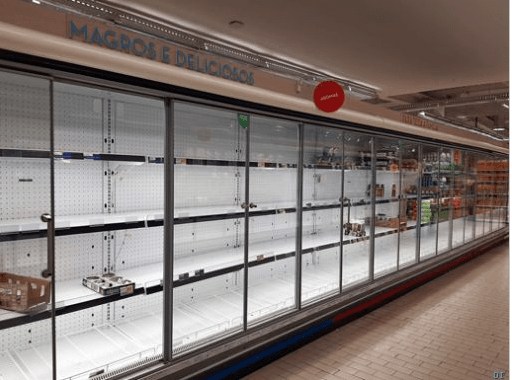
The Diário Insular newspaper has learned from various sources that empty shelves in several stores on Terceira Island indicate a disruption in the maritime supply of goods.
Regular “shopping” customers at various stores have contacted our newspaper and provided photographs of empty shelves or shelves close to them. The problem has been going on for several days but has worsened in the last 48 hours due to the impossibility of restocking some imported products.
According to DI (Diário Insular Newspaper), sources linked to maritime transport told DI that a ship that was supposed to transport containers to Terceira broke down, and the products remained on the mainland, which collided with the near shortage of stocks on the island.
DI spoke to several stores. In some cases, the stores were waiting; in others, they had already started receiving products yesterday.
“In fact, stocks are low, and we’re all relying on the regularity of maritime transportation. But we always have our hearts set on waiting for things like this to happen. This time it happened…” a local department store employee, who requested anonymity, told DI. He said the situation would likely be regularized by the end of this week.

DYSFUNCTIONAL
The island of Terceira consumes, for example, around ten thousand tons of potatoes and around seven thousand tons of onions a year. The rate at which local production covers these products is residual. According to Hugo Veríssimo, from Pomar da Ilha, Terceira produces potatoes three weeks a year, while onion production is almost insignificant.
In general, local production of vegetables and fruit is not enough to meet consumption needs for one month a year, according to Hugo Veríssimo.
There are exceptions. Local bananas produce enough for seven months of consumption, as does lettuce. These are good examples cited by Hugo Veríssimo.
One of the problems detected has to do not only with low local production but also with the fact that several products that have entered the diet of the island’s population are not even produced in our lands but are imported in their entirety.
FUTURE
The person in charge of Pomar da Ilha told DI that there are good expectations regarding the production of lemons.
With the orchards already planted, Hugo Veríssimo hopes that in two to three years’ time, Terceira will be able to supply only locally produced lemons. Pomar da Ilha alone has planted fifteen bushels (around fifteen thousand square meters), which, when they come into production, should provide an important boost to the local market.
The Regional Government has declared its interest in local production to reverse the import dynamic. However, given the quantity and variety of imported products, the effects on the consumer end still seem small.
In Diário Insular-José Lourenço-director
Translated to English as a community outreach program from the Portuguese Beyond Borders Institute (PBBI) and the Modern and Classical Languages and Literatures Department (MCLL) as part of Bruma Publication and ADMA (Azores-Diaspora Media Alliance) at California State University, Fresno, PBBI thanks Luso Financial for sponsoring NOVIDADES.

 Novidades - The Islands and the Diaspora