

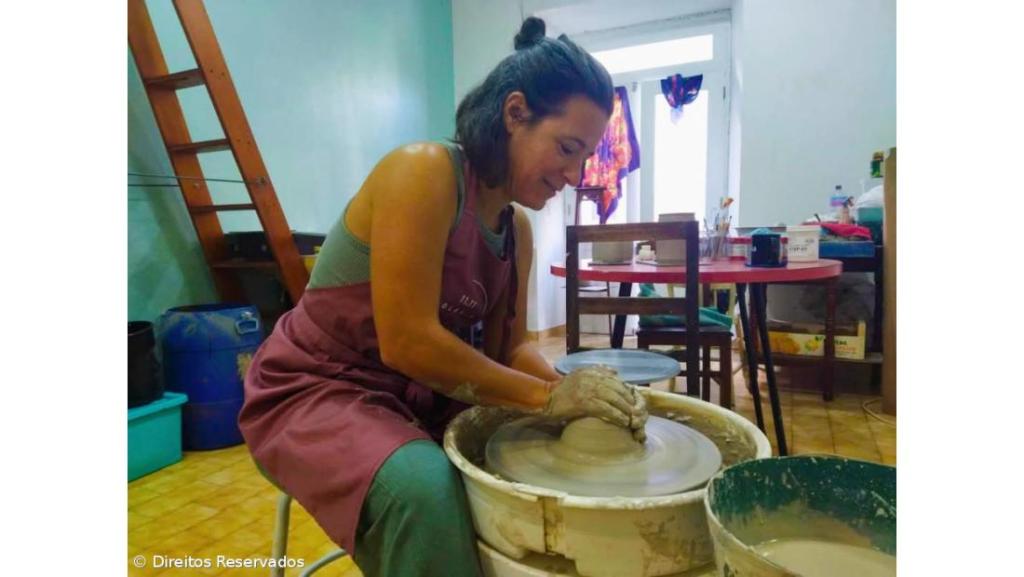
Tânia Bairos grew up in an environment where the memory of pottery was present through the figure of her great-grandfather, a well-known potter from the island of Santa Maria. However, it wasn’t until 2020, when she started working with clay, that the connection to pottery became more evident.
“As soon as I touched clay, I realized that it was something I couldn’t stop doing,” says Tânia Bairos in an interview with Açoriano Oriental, adding that ”I realized that it helped me a lot to manage my day-to-day life issues related to the profession, and personal and family situations as well.”
The experience with clay played an even more important role when Tânia Bairos had to take a break from her medical career due to burnout. Pottery thus became a refuge and a form of recovery.
“I tried to recover and realized that clay had even more weight in my life (…) This impact that pottery had on me was very positive,” says the family doctor.
In homage to her great-grandfather Jacinto Travassos, known as “Jacinto Caieu,” Tânia Bairos created the “Caieu” line of pieces such as vases and jugs. “This line was conceived precisely because of this family memory, but also a collective one,” she says.
Tânia Bairos recalls that she grew up when handicrafts were not as highly valued as they are today, which influenced how she viewed her great-grandfather’s profession.
“There was this knowledge of my maternal great-grandfather’s profession, but I wasn’t fully aware that this art had had such an impact on our island, nor such value on a personal and family level,” she admits.
The doctor and artisan are part of SÓ atelier, a space she shares with other artisans. It is located in an iconic building in Vila do Porto, “where the so-called Lisboa warehouses used to be, “with a very positive energy.
This atelier aims to give visibility to the handicraft work done on the island of Santa Maria. “We’re four friends and four artisans (…) We’ve managed to tackle various areas, but also work together to boost the island’s culture, supporting local artists and artisans,” she explains.
The artisan highlights the importance of rescuing and valuing Santa Maria clay, which is renowned for its high quality.
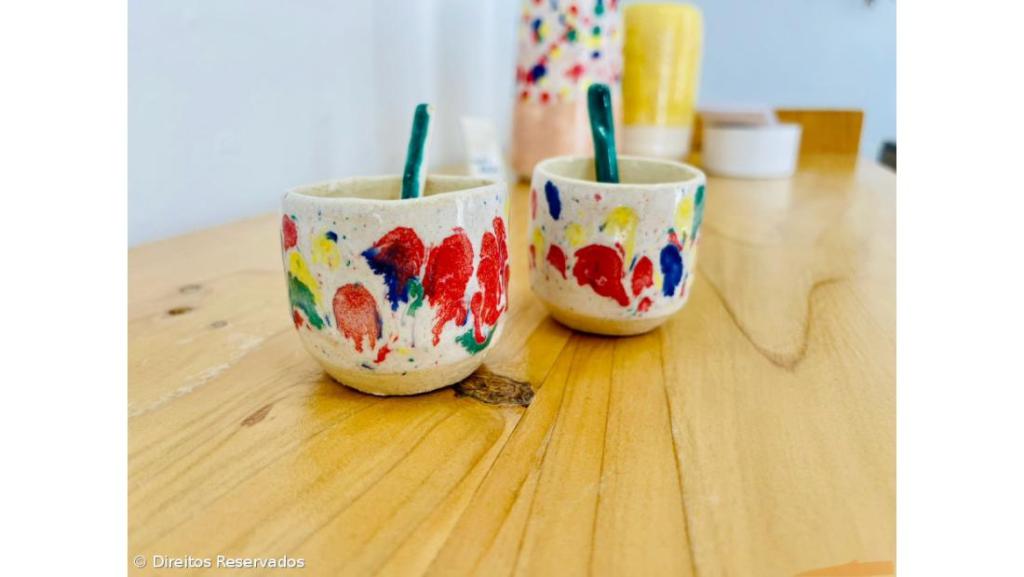
“Santa Maria was known for a long time for the quality of its clay. For many years, we have produced ceramics, tiles, and bricks. We exported clay to all the islands. It was a clay documented as the best in the region. It has a superior quality,” says Tânia Bairos, who regrets that it is not being used regularly in Santa Maria, which she considers ‘a huge shame’.
In Tânia Bairos’s opinion, we need to “start making not only local artists but the community in general aware of the value of this exceptional-quality raw material from our island.”
The artisan’s aim “is to work with our clay on a daily basis,” giving the pieces a “new perspective and a new design, although always based on what was done in the past.”
For example: “One of the lines I have is similar in shape to our salgas – utilitarian pieces where we used to put food to keep it fresh when there was no refrigeration.”
Tânia Bairos argues that “we should look at what is endogenous and cultural, trying to see how we can continue and spread this rich cultural heritage.”
The artisan reveals that together with the Santa Maria Museum, an exhibition dedicated to Santa Maria clay is planned for the end of the year.
Looking to the future, Tânia Bairos intends to return to practicing medicine, reconciling this vocation with pottery – her great passion.
Carlota Pimentel is a journalist for Açoriano Oriental, and Paula Gouveia is the director.
Translated to English as a community outreach program from the Portuguese Beyond Borders Institute (PBBI) and the Modern and Classical Languages and Literatures Department (MCLL) as part of Bruma Publication and ADMA (Azores-Diaspora Media Alliance) at California State University, Fresno, PBBI thanks Luso Financial for sponsoring NOVIDADES.

 Novidades - The Islands and the Diaspora