

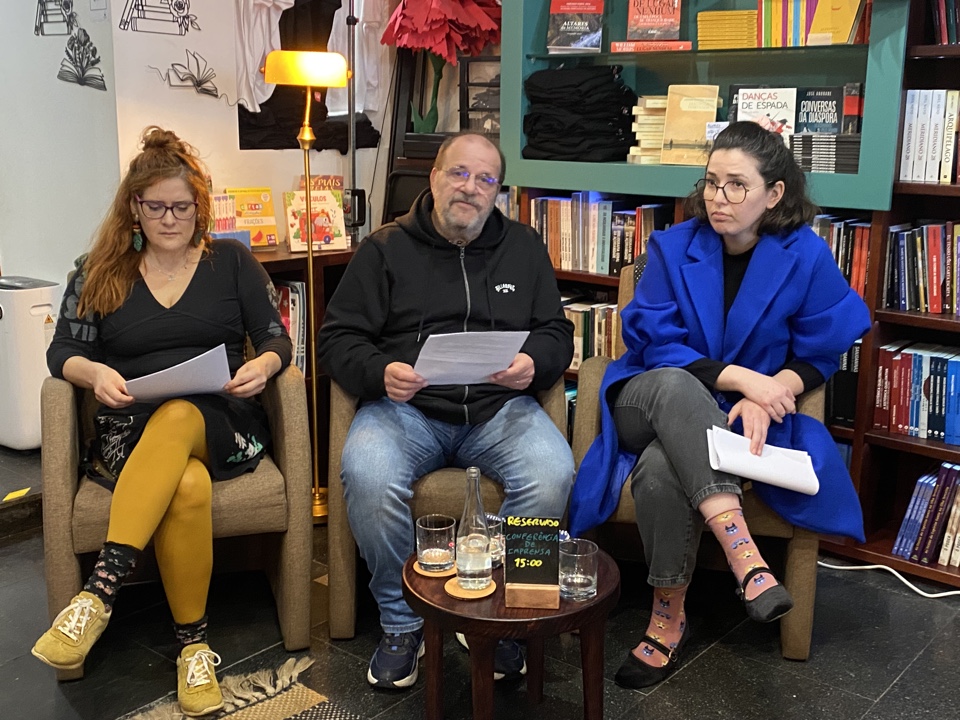
The Manifesto Against the Legalization of Lancing the Bull (sorte das varas- described in Spanish bullfighting as the first phase of a bullfight during which the picador weakens the bull with his lance) in the Azores, which has so far received more than two hundred signatures, was presented today in Angra do Heroísmo by Aníbal Pires, Bianca Mendes, and Laura Brasil.
Aníbal Pires began by explaining that the Manifesto in question came about spontaneously, with no connection to any organization, and that its only interest is the defense of the Azores. As such, he added: “The signatories of the manifesto are doing so individually and are a representation of the social, cultural, political, economic and geographical diversity of the Azores, and many of the signatories are aficionados, which speaks volumes about the scope, but also about the unity on an issue that, if it came to pass, would harm the entire region, especially Terceira Island.”
Before proceeding to present the text of the Manifesto, some clarifications were made through a summary of recent political history, in which Aníbal Pires recalled the unsuccessful attempts to legalize the Sorte de Varas, proving that from a constitutional point of view, there were reasons, not entirely related to autonomous powers, to justify the declaration of unconstitutionality by the Constitutional Court’s ruling on Regional Legislative Decree no. 32/2002, on the “Adaptation to the Region of Law no. 92/95, of September 12, amended by Law no. 19/2002, of July 31”, in 2002.
To this end, he quoted excerpts from the ruling above “(…) Nor has the existence of a deep-rooted tradition, through prolonged and uninterrupted practice, been objectively demonstrated. In fact, the regional legislator invokes “five centuries of history of the Azoreans’ relationship with bulls” and the ancestry of the Sanjoaninas festivities, but only estimates the period for which bullfights with the “luck of the sticks” have been held uninterruptedly at twelve years. (…)” and (…) Since the practice of ‘sorte de varas’ in the Autonomous Region of the Azores does not reach this level of antiquity and continuity, as is recognized by the regional legislator, it is impossible to invoke a special configuration of this matter in the Region. For all these reasons, even if it is understood that the nature and purpose of the general prohibition anchored in the protection of animals does not a priori exclude the normative treatment of this matter by an Autonomous Region, it cannot be concluded that there is a special configuration that justifies the prohibition of such practices in the Autonomous Region of the Azores being guided by criteria different from those that apply to the whole of the country. (…)”.
Aníbal Pires also referred to the two subsequent attempts that took place in 2009 and 2015, which, although unsuccessful, did not dissuade those interested in bullfighting from insisting on its legalization and that, faced with the possibility of a new attempt, “this and other citizen movements” erupted, highlighting the petition that has more than two thousand signatures, already submitted to the Regional Legislative Assembly of the Azores, stating that “The manifesto and the petition do not compete with each other, they complement each other and have different scopes.”
Although this civic movement does not have an organic structure or support, it was pointed out that its work does not end with the public presentation of the Manifesto, that it remains open to more signatures, and, above all, that it remains alert.
Angra do Heroísmo, February 6, 2025
MCLSVA Civic Movement
Translated to English as a community outreach program from the Portuguese Beyond Borders Institute (PBBI) and the Modern and Classical Languages and Literatures Department (MCLL) as part of Bruma Publication and ADMA (Azores-Diaspora Media Alliance) at California State University, Fresno, PBBI thanks Luso Financial for sponsoring NOVIDADES.
 Novidades - The Islands and the Diaspora