

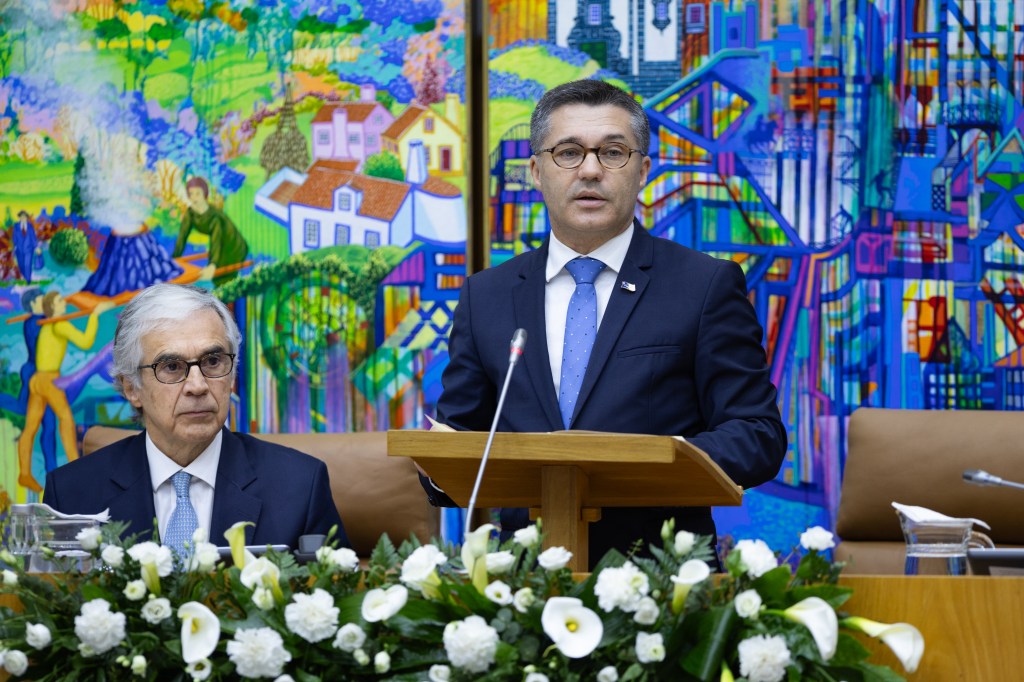
On an official visit to the Azores, the President of the Assembly of the Republic of Portugal, José Pedro Aguiar-Branco, argues that “political agents must talk and find solutions at the national and regional level” regarding shared sea management.
In a speech to the Azores Legislative Assembly yesterday morning, he said that this dialogue must be built “involving partners from civil society, economic agents and, of course, our armed forces.”
“Increasingly, we need a broad and holistic view of the sea, which includes the geopolitical perspective, but also the economy and energy, scientific research and ecological conservation. We must not be afraid to invest in our sea. The world is changing and the Azores represent, in this changing world, the guarantee of our Atlantic Front, our place at the center of Atlantic relations,” said José Pedro Aguiar-Branco.
The president of the national parliament referred to yesterday’s signing of a new memorandum between the regional government, the Oceano Azul Foundation and the Waitt Institute, which he described as an “excellent initiative”.
“Azoreans are well aware that the sea does not isolate us. It connects us to the world, it opens up the horizon to us (…) They know that the seas hide promises of the future for us. All we have to do is dare to sail,” he said.
José Pedro Aguiar-Branco also touched on the subject of Autonomy from a broader perspective. “The authors of the Constitution drew a delicate balance. They established that Portugal is a unitary state, but enshrined the regional autonomy of Madeira and the Azores. And this bold and risky solution didn’t just benefit the autonomous regions. It was a gain for Portugal as a whole, for the mainland and the autonomous regions. A gain in efficiency, in proximity between voters and elected representatives and in the ability to solve the concrete challenges of these regions,” he said.
“I believe in Autonomy. And I come here to say that it must be respected and valued. Autonomy is not a finished project, it’s not a settled matter, it has to be worked on, built, and put at the service of solving people’s problems,” he reiterated.

“Main dispute”
The management of the sea was also featured in the speech by the President of the Regional Legislative Assembly, Luís Garcia, who pointed to the issue as the “main dispute” between the Republic and the Region.
“This has incomprehensibly led to the Republic legislating in disregard of the principle of ‘shared management’ of the sea adjacent to the Region, established in our Statute, with the restrictive and almost colonialist complacency of the Constitutional Court,” he said.
The President of the Azorean Parliament called for a revision of the Constitution. “After several unsuccessful attempts to resolve this dispute with the Republic over the management of the sea, we believe that the best way to do this is through a Constitutional Review,” he stressed.
From Luís Garcia’s point of view, “the scientific knowledge of the University of the Azores about the sea, the approval by this Assembly, in 2023, of a resolution recommending a moratorium against deep sea mining and the creation of the network of marine protected areas, in 2024, should dispel any doubts about the national advantage in giving the Azores a more active role in the management and planning of maritime space”.
He stressed that “this leadership by the Azores in the sustainability and protection of the sea should make Portugal proud and inspire us all”.
Luís Garcia recalled that Autonomy, established in 1976, is on its way to 50 years and argued that the system should be further developed. “Twenty years after the last constitutional revision, which made significant progress, the time has come for a new assessment and advances. It’s time, without prejudice or mistrust, to revisit old autonomous aspirations, to reconfigure the political and governmental system, reinforcing its parliamentary character, to deepen competencies and clarify concepts, namely the aforementioned shared management of the sea”, he advocated.
In this field, he stressed that the Azorean Parliament had done its “homework”. “We are therefore prepared and aspire to a deepening of Autonomy through a constitutional revision, which we want,” said the President of the Legislative Assembly of the Azores.
Luís Garcia also defended the “urgent” revision of the Regional Finance Law: “It is clear that the current financial model does not reflect the true scale of the challenges we face, especially in vital areas such as Education, Health and Accessibility, which are heavily penalized by the limitations of insularity and our geographical isolation.”

Crisis and Consensus
Yesterday, the President of the Assembly of the Republic pointed out the current challenges, “which are as real at national level as they are at regional level and which call, as they did 50 years ago, for everyone’s creativity and commitment”.
He gave as an example the “fragmentation” of parliaments and the “growing difficulty” of forming absolute majorities. “It happened in Lisbon, it happened here in the Azores. Both parliaments have shown that the absence of an absolute majority does not necessarily mean a scenario of ungovernability. We’ve both shown that a fragmented parliament doesn’t necessarily have to be a divided parliament,” he said.
José Pedro Aguiar-Branco valued consensus on various issues. “Here in the Azores, the former leader of the largest opposition party was elected president of the European Committee of the Regions in 2022, in a candidacy supported by the regional government and the majority that supports it. The new president of the Economic and Social Council of the Azores, a consensual personality in Azorean society, who was linked to the largest opposition party, was elected by consensus between the two largest parties,” he said.
He also noted the “unanimous approval of the reinstatement of teachers’ service time, with the different parties, from left to right, converging on a common and responsible position”.
He considered that “it has also been possible to build consensus in the Assembly of the Republic, as recently happened with the approval of the State Budget, a further expression of the political maturity of the founding parties of our democracy”.
For José Pedro Aguiar Branco, “when fragmentation is growing, when uncertainty is increasing all around us, we shouldn’t waste time playing party games,” it is necessary for “political agents to work together with a sense of responsibility.”
In Diário Insular – José Lourenço, director.
Translated to English as a community outreach program from the Portuguese Beyond Borders Institute (PBBI) and the Modern and Classical Languages and Literatures Department (MCLL) as part of Bruma Publication and ADMA (Azores-Diaspora Media Alliance) at California State University, Fresno, PBBI thanks Luso Financial for sponsoring NOVIDADES.

 Novidades - The Islands and the Diaspora