


São Jorge in the spotlight at a meeting of Azorean Houses. The charm of the land and its people is an invitation to visit the island, which, in addition to its air links, has sea links with the neighboring islands of Pico, Graciosa, and Faial. From the island’s balconies, you can also see Terceira in good weather.
Casas Açorianas – Associação de Turismo Rural, led by Gilberto Vieira, held a debate in Calheta de São Jorge at the Francisco Lacerda Museum, entitled “Don’t lose your way,” with Azorean journalists from mainland, Europe and America, about their view of the Azores and how tourism is seen from the perspective of those who are closely involved in the tourism sector in all its various aspects – social, economic and political. The moderator was Maduro Dias, a born storyteller, historian, and promoter of rural tourism, who talked about the different specificities and particularities that each island has and that make the Azores a unique archipelago in the world. The afternoon session at the Francisco Lacerda Museum was attended by the Regional Secretary for Tourism and Infrastructures, Berta Cabral, who at the end stressed the importance of the sector for the Azorean economy and that rural tourism is a fundamental segment of the Azorean tourist offer, with 244 licensed establishments in 2024, representing a total of 2. 003 beds, a 14% increase in the number of beds compared to 2023, which shows “the competitive capacity of this type of accommodation and its ability to create added value.” She also stressed that 83% of these overnight stays were from foreign guests.

The head of tourism also said that this tourist segment had 186,396 overnight stays, up 25% from 2023, while Local Accommodation saw an increase of 17.3% and Traditional Hotels 7.9%.
Still, regarding rural tourism, Berta Cabral has no doubt that “the rurality of the Azores is one of the region’s greatest identity assets.” These spaces are “a unique vehicle for its enhancement and an opportunity to value natural and cultural heritage, decentralize tourism from the big cities, and provide new sources of income for local communities.”
She pointed out that 2024 was “a golden year” for tourism, noting that the Azores recorded 4.2 million overnight stays and 187 million euros in total hotel revenue. She said tourism already represents 20% of GVA, 17% of employment, and 17% of GDP.

Traveling in São Jorge between the cliffs and on the balcony of the triangle
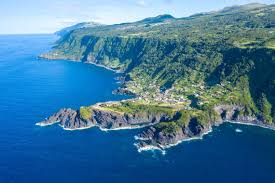
After a four-day trip through the island’s municipalities – Velas and Calheta de São Jorge – with stops at the two municipalities’ main points of excellence, with a breathtaking view from Velas to the island of Pico – painted white by snow – on days of freezing cold, hail, wind, rain and sun breaking through the hills, the climatic factor that sets us apart, the sustainability and preservation that the region has was the dominant theme of the conversations that ran throughout the debate. Passing through mountains made up of volcanic cones of different ages and a younger plateau, and through breathtaking cliffs where the cloudiness and the sun’s rays mingled, with the sudden appearance of rainbows, and at the same time seeing cows moving to the pastures accompanied by their owners and/or helpers, are images that stick in the retina and that you won’t soon stop seeing. Also worth mentioning is the entire hillside with cliffs modulated by various species that cut and intertwine with the beautiful pebbles along the coast that, on a rough day, transport us to the power of nature at its most raw and enchanting. Throughout the island, we come across imposing viewpoints, properly cared for, and in Calheta, we gaze into the depths of its fajãs, such as the fajã de São João, the fajã dos Vimes, images that the world needs to know because their landscape is so imposing. With very typical houses, each fajã has its own uniqueness. But it’s no longer just the locals who benefit; there are foreigners in these places. One of the winners of the 7 Wonders of Portugal in the Sea Villages category is worth a visit – Fajã dos Cubres -. As a curiosity, one of the houses in this fajã was bought for half a million euros. The Caldeira do Santo Cristo, which gives its name to another fajã, is also a paradise, among other beauties, such as the garden of Silveira in Ribeira Seca, with its beautiful streams intertwined with beautiful vegetation and basalt stone on its banks. This speaks volumes about the potential of the places and the potential for tourism in São Jorge. The view of the Topo islet is also worthy of note, as is the Francisco Lacerda Museum, lined with stone, set on top of a beautiful bay and fishing port. On these trips to both Calheta and Velas, it’s important to highlight their imposing churches, hermitages, and the Holy Spirit triathlons. It’s a faith that unites the people of this land, who have already been hit by several storms and earthquakes, such as those of 1757 and 1980.
Tasting the products of the land and the sea
São Jorge’s gastronomy is also noteworthy, both from the sea and land. First of all, the different cheeses from São Jorge, which are known across borders, and then, among others, the tuna, limpets, and swordfish that are cooked there, delight our palates, but also the meat, beef, and goat, which delight visitors, not forgetting the typical sweets such as the species and the yam and coffee cheesecakes. In the case of coffee, it is a product that São Jorge produces and can be seen in Fajã dos Vimes.
The charm of the land and its people invites visitors to visit the island, which, in addition to its air links, has sea links with the neighboring islands of Pico, Graciosa, and Faial. In good weather, you can also see Terceira from the island’s balcony.
Décio Pereira, Mayor of Calheta de São Jorge, highlights that a good image speaks more than many words, which applies to the island. Fortunately, in all its nine islands, the Azores have great pictures and a lot to convey.
In Velas, where the island’s airport is located, the highlight is its architectural heritage, as well as the beautiful landscapes, such as Parque Florestal das Sete Fontes and Fajã de João Dias, and natural pools, such as Preguiça. Hermitages and churches, such as São Jorge or Senhora do Livramento, are examples of what to visit. There are also viewpoints and beautiful bays to enjoy. I don’t think visiting the island can be done quickly; it has to be a long visit because the island has much to offer.
Long and also known as the “dragon island,” São Jorge offers a wide range of tourist options, such as the Rural Tourism houses. In addition to accommodation, these houses offer experiences of living with the locals, who are generous and warm.
Nélia Câmara is a journalist for Correios dos Açores and Atlântico Express newspaper.
Translated to English as a community outreach program from the Portuguese Beyond Borders Institute (PBBI) and the Modern and Classical Languages and Literatures Department (MCLL) as part of Bruma Publication and ADMA (Azores-Diaspora Media Alliance) at California State University, Fresno, PBBI thanks Luso Financial for sponsoring NOVIDADES.

 Novidades - The Islands and the Diaspora