

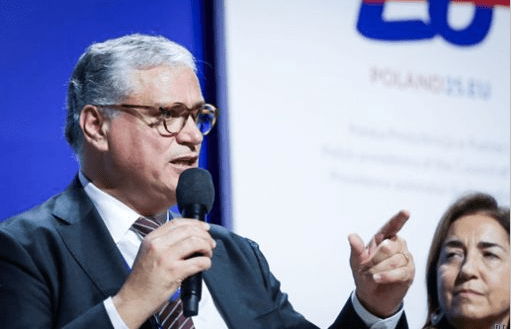
The members of the Commission for Territorial Cohesion Policy and the Budget of the European Union (COTER) yesterday elected Vasco Alves Cordeiro as president and Emil Boc, the first vice president, to lead the work of the regions and cities.
Despite admitting that he is preparing to leave active politics, the Socialist will “help out as president of COTER, which is in charge of territorial cohesion,” a challenge made by his political group.
The COTER Committee plays a key role in defending and promoting cohesion policy in the European Union’s legislative process. It also monitors strategic issues such as the Multiannual Financial Framework, the European Union (EU) budget, transport policy, housing, territorial development, cross-border cooperation, spatial planning, and urban issues.
Vasco Cordeiro, former president of the Committee of the Regions (CoR), former president of the Regional Government of the Azores, current member of the Azorean parliament, and member of the CoR since 2004, has completed a two-and-a-half-year term as CoR president.
One of his main priorities during this time has been defending and committing to a strong, sustainable cohesion policy adapted to current challenges.
Emil Boc, former Prime Minister of Romania, is currently Mayor of Cluj-Napoca and has been President of the COTER Commission since September 2022.
The new president and first vice-president of COTER were co-rapporteurs of the Committee of the Regions’ first two opinions on the future of cohesion policy.

For this new mandate, the COTER Commission “will continue to advocate for an EU budget that is both flexible, to respond to new priorities and emergencies, and stable in the long term, to ensure local and regional investments in line with the Union’s priorities and the principle of ‘do no harm to cohesion.’
It will reinforce the need to maintain and strengthen cohesion policy after 2027, ensuring a just transition and balanced development.
In mobility, it will support the completion of the Trans-European Transport Network (TEN-T) and accompany the green transition of the automotive industry, ensuring that no territory is left behind.
Vasco Cordeiro said, “with this new mandate, the COTER Commission faces significant challenges and opportunities.”
“The European Commission’s proposal on the multiannual financial framework is the first major dossier we have to analyze. Cohesion policy, in particular, must remain a powerful, decentralized instrument that invests in local and regional needs, presenting tangible solutions for citizens. Transport, housing, territorial cooperation and just transition are the other key policies that we will address at COTER in order to transform people’s lives,” he said.
“Only with a solid cohesion policy, which puts regions and cities at the heart of the implementation of EU policies, will the EU be able to strengthen the internal market and reap the full benefits of European integration,” he stressed.
With the start of the new 2025-2030 term, which saw the election of the new president, Kata Tüttó, and the first vice-president, Juan Manuel Moreno Bonilla, the members of the Committee of the Regions also elected the new presidents and vice-presidents of the six political commissions of the assembly of local and regional leaders.
In Diário Insular – José Lourenço-director
Translated to English as a community outreach program from the Portuguese Beyond Borders Institute (PBBI) and the Modern and Classical Languages and Literatures Department (MCLL) as part of Bruma Publication and ADMA (Azores-Diaspora Media Alliance) at California State University, Fresno, PBBI thanks Luso Financial for sponsoring NOVIDADES.

 Novidades - The Islands and the Diaspora