

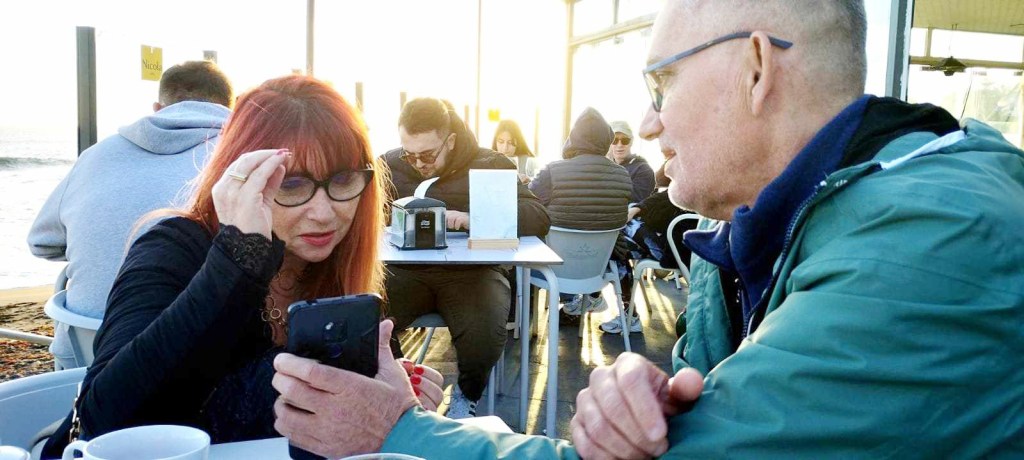
Anabela Da Rocha, born on the island of São Miguel, left early to study biochemistry and piano in Porto, mainland Portugal.
With 20 years of experience as a quality and new products manager in a French multinational, she has always focused on the integrated development of processes and people. With her expansive vision of life and the world, she has led several networking groups and founded the artistic brand Bela7 Art Collections and Espaço Art Seven Porto, a place for cultural, social, and business dynamization. Author of two books and with a long career as a painter, Anabela Da Rocha, after completing her master’s degree in holistic psychology, created her methodology for developing human potential by merging all her vast experience.
“Life is made by walking and we learn by walking.”
In this informal conversation with Anabela Da Rocha, our interlocutor shared with our newspaper why she is involved in so many activities, emphasizing that life is made by walking and that this is how you learn to live, with joys and sorrows. “Life is made by walking and it is by walking that we learn to live, between victories and defeats, joys and sorrows… this is how we grow and mature. Our greatest wealth is the result of everything we do, think, feel and, above all, the result of everything we pass on to others – it doesn’t matter how, what matters is the mark we leave. This diversity of experiences is expressed in a profound knowledge of life and, for me, there is no greater wealth than knowledge, not only acquired knowledge, but also philosophical, scientific and bio-spiritual knowledge, because in the end, it is the integration of all of them that helps us define who we really are, everything else is a handful of nothing, pure appearance in human survival mode.”
“I don’t follow formats…”
Anabela Da Rocha recently created a methodology for developing human potential, completely outside existing formats, “believing it to be a useful tool for the existential crisis that people in general are going through at this remarkable time in human history, where advances in science and technology are impacting people’s lives. Therefore, there is a need to prepare them for this great change that we are going through, leaving behind old paradigms that are felt at all levels. All of them! Don’t forget one thing: there can be no socio-economic development without coherent, conscious and consistent human development. What is no longer useful must be let go and we must help people to free themselves from old patterns of life. I don’t follow formats and I’m intolerant of what no longer makes sense.”
Her new project is Matrix Mentoring, which follows on from her last book, “Rose Blood, Sexuality & Spirituality,” which she considers to have been “the starting point for something more complex.”
He stresses that “life is a succession of processes in permanent transformation, where understanding them is the basis for acceptance, motivation and overcoming obstacles.”
“I’m an islander!”
Anabela Da Rocha has a funny way of expressing the feeling of being an islander. In fact, she likes the expression “being an islander”, and adds. “On this woman’s island, I always say that our island is feminine, between curves and curvatures (laughs). Being an islander, perhaps with the combination of the piano from a very early age in my life, which lasted for 20 years, has contributed to everything I am today, as a human being, as a woman, as a professional. It’s a privilege to be born on an island in the Azores – I don’t know if most people realize this! Being born and growing up among the land, the sea, the air and the fire, to the sound of classical music, is something that is impregnated in the skin and in the soul. It’s impossible not to see the world in a different way, where the horizon is limitless and the sky merges with the earth. Every stone, every tree that has seen me grow speaks to my heart, it knows who I am. What more can we ask of life?”
“Progressive return”
Anabela Da Rocha has an office in the Porto Business Center, where small, medium, and micro businesses operate. She also has a small exhibition of tile paintings with a Portuguese soul there.
“Marilu, Reino das Sete Cidades” is also a children’s book by Anabela Da Rocha.
Anabela Da Rocha is returning to the island where she was born. When asked who is returning, whether the executive, the author, the painter, the lecturer, or the mentor, she replied, “It’s a progressive return with everything the island needs most, but the area of human development is undoubtedly my main focus.”
Marco Sousa is a journalist for Correio dos Açores-Natalino Viveiros, director
.

 Novidades - The Islands and the Diaspora