

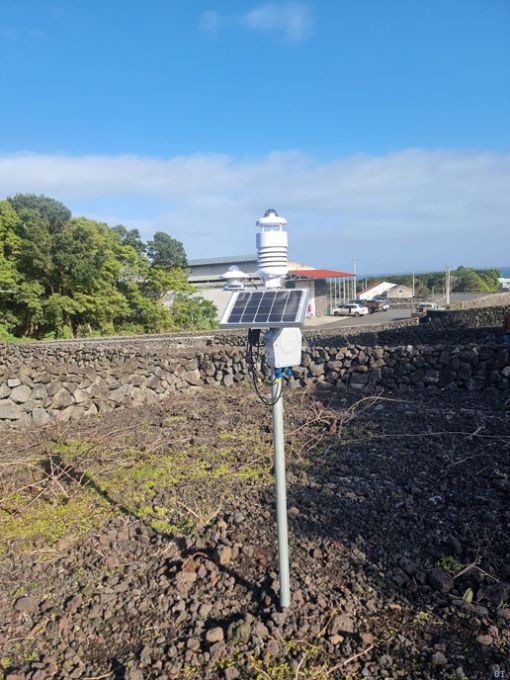
An automatic weather station, installed this month in Biscoitos on Terceira Island, is ready to support winegrowers.
The step is part of the Azores Agricultural Monitoring and Warning Network (RMAAA), a project of the Regional Secretariat for Agriculture, whose partners are specialists in phytosanitary problems of various crops and the collaboration of producers’ associations and cooperative wineries from various Azorean islands, including Adega Cooperativa dos Biscoitos and also the Cultural Association of Oenophiles of Terceira Island (ACEITE).
The president of Adega Cooperativa dos Biscoitos, Cecílio Faustino, considers the measure positive. “It’s important to support farmers in real time. We can find out various things, such as when we can or can’t sulphate the vines and what’s happening in our area,” he explained.
He said a preliminary study is being carried out to determine the reality of the Biscoitos vineyards.
“It’s a project that we’ve been asking for for a long time, it was a gap, a very big gap that existed, that the winery didn’t have access to this kind of information in real time, so that we could treat the vines at the ideal times,” he stressed.
He stressed that making the right decisions can make the difference between a good harvest and a bad one in increasingly unstable weather conditions.

MAIDOT is leading the project, which is financed by European funds through the Recovery and Resilience Plan (PRR).
The network covers the nine islands of the Azores and Terceira Island. It focuses on phytosanitary problems affecting vineyards, especially in Biscoitos.
The aim is to install automatic weather stations to forecast and monitor vine diseases, particularly mildew, oidium, and botrytis (gray rot).
“The aim of this station is to collect various climatic data and validate a model for predicting the appearance of mildew,” says Adega Cooperativa dos Biscoitos.
It will monitor the population evolution of two pests, the spotted wing fly (Drosophila suzukii) and the bunch moth.
In addition, the incidence of various wood diseases in the vines of each selected plot will be examined.
In Diário Insular – José Lourenço, director
Translated to English as a community outreach program from the Portuguese Beyond Borders Institute (PBBI) and the Modern and Classical Languages and Literatures Department (MCLL) as part of Bruma Publication and ADMA (Azores-Diaspora Media Alliance) at California State University, Fresno, PBBI thanks Luso Financial for sponsoring NOVIDADES.

 Novidades - The Islands and the Diaspora