

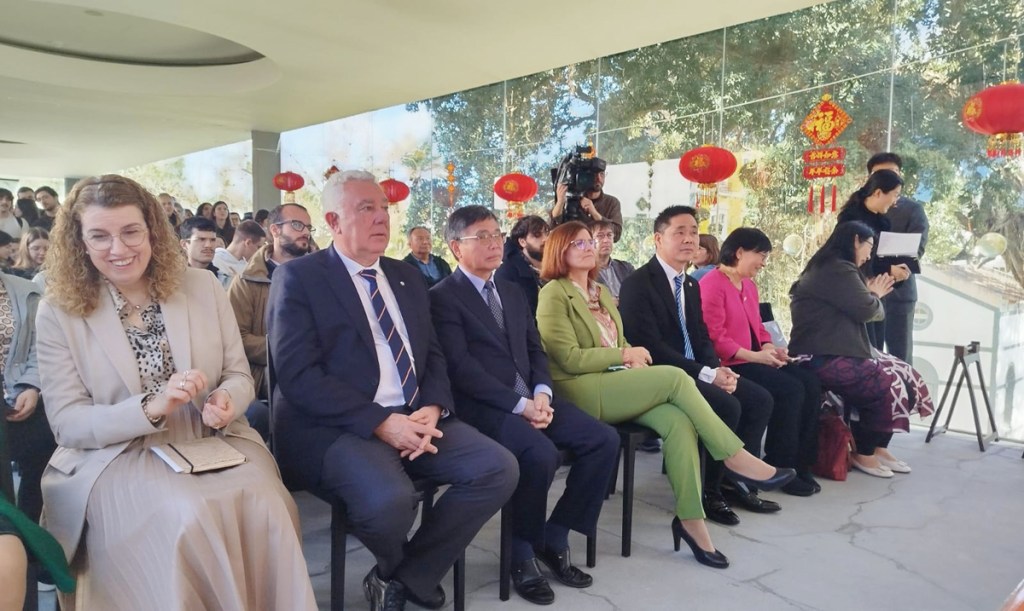
Yesterday, the University of the Azores held an event dedicated to celebrating Chinese culture and language, ‘Itinerant Exhibition of Chinese Illustrated Books’, in the hall of the Amphitheater Body (Aula Magna) on the Ponta Delgada campus of the University of the Azores (UAc).
One of the main announcements at the event was the University of the Azores’ intention to create a Confucius Institute in collaboration with the Chinese Embassy. The aim is to give students and the community the opportunity to learn Mandarin and deepen their knowledge of Chinese culture. This initiative follows the model already implemented in several higher education institutions in Portugal.
Artur Lima, the Vice President of the Regional Government of the Azores; Susana Mira Leal, the rector of the University of the Azores; Zhao Bentang, the Chinese ambassador to Portugal; and Li Jinhu, the president of the Azores Chinese Community Association, attended the event.
UAc Rector values Chinese culture and its impact on the Azores.
Rector Susana Mira Leal stressed the importance of this meeting in enhancing multiculturalism and knowledge of one of the world’s oldest civilizations. She announced the University of the Azores’ intention to create a Confucius Institute, in collaboration with the Chinese Embassy, to give students and the community the opportunity to learn Mandarin.
During the event, the rector emphasized the importance of the Chinese language in the global context, noting that Mandarin is the second most spoken language in the world, with around 1.5 billion speakers.
She also highlighted the Azores’ historical connection to Chinese culture, recalling that the introduction of tea cultivation in the region in the 19th century resulted from the knowledge passed on by a master and his Chinese assistant interpreter. In return, the university offered the Chinese ambassador a selection of Azorean products.
Li Jinhu highlights the pride of the Chinese community in the Azores.
Li Jinhu, president of the Azores Chinese Community Association, highlighted the community’s pride in preserving its traditions and actively contributing to the region’s economic and social development. Over the years, Li said that the Chinese community in the Azores has maintained a commitment to the values of hard work, honesty, and solidarity, integrating fully into Azorean society without losing its cultural heritage.
In addition to the economic impact, the Chinese community has sought to promote intercultural dialogue, encouraging greater knowledge of China in Portugal and deepening relations between the two nations. Li Jinhu stressed the importance of initiatives that allow traditions, customs, and artistic expressions to be shared, contributing to a more connected and inclusive world.
Artur Lima strengthens bilateral relations with China and investments in innovation in the Azores
The Vice-President of the Government of the Azores, Artur Lima, discussed the close collaboration between the region and China, highlighting the advances in scientific, cultural, and economic cooperation between the two countries. During the event’s organization, Artur Lima stressed the importance of foreign investment and the promotion of the Azores region on the international stage.
Artur Lima pointed out that since President Xi Jinping visited the Azores in 2014 and the recent expansion of collaboration with the University of the Azores, cooperation has been renewed and built on in various areas, such as marine sciences, scientific research, and academic exchanges. He also recalled the creation of the Association of the Chinese Community in the Azores in 2023, which shows the increasing presence of the Chinese community in the archipelago. Today, the association has around 300 members.
The Vice-President also highlighted the significant investments made by the Government of the Azores in scientific development, focusing on technological innovation and the strategic areas of cybersecurity, artificial intelligence, renewable energies, sustainable tourism, and agriculture.
In addition, Artur Lima mentioned the strengthening of science and technology parks, such as Nonagon, in São Miguel, and TERINOV, in Terceira, which are home to more than 100 innovative companies.
Zhao Bentang highlights the cultural and educational between China and Portugal.
The Chinese Ambassador to Portugal, Zhao Bentang, recalled that Chinese illustrated books are a significant part of China’s rich cultural tradition and are widely appreciated for their unique aesthetics and deep cultural content. The exhibition, which has already passed through several cities in Portugal, such as Lisbon, Porto, and Leiria, has been a great success, according to the ambassador, and has received praise and warm participation from the local public.
This event occurs in a symbolic year, marked by the 20th anniversary of the global strategic partnership between China and Portugal. The Ambassador stressed that in recent years, cooperation between the two countries has intensified in the economic, educational, and cultural areas, generating positive results. Holding the exhibition at the University of the Azores is seen as another achievement in academic collaboration. Zhao also highlighted the uniqueness of the Azores islands, which are known for their natural beauty and open cultural atmosphere, attracting global attention.
The Ambassador expressed the hope that, in the future, Chinese universities and the University of the Azores can further strengthen their collaboration, contributing to a lasting friendship and the deepening of bilateral relations.
Confucius Institute could a reality in the next academic year in the Azores
Zhao Bentang, China’s Ambassador to Portugal, told journalists of the growing interest in learning Chinese culture and language as a result of the development of bilateral relations between China and Portugal.
The Ambassador pointed out that Portugal is one of China’s main partners in the European Union, with relations covering various areas, including politics, economics, education, and culture.
Regarding the importance of teaching Mandarin, the Ambassador explained that, with the growth of cooperation between China and Portugal, many Chinese companies need workers who speak Mandarin. “China is the fourth country in terms of investment in Portugal, with around 12.3 billion euros invested. Many companies are looking for professionals who can speak Mandarin,” he said. He mentioned the creation of a Confucius Institute at the University of the Azores as part of the project to teach Mandarin to Azoreans, including descendants of the Chinese community.
“It will be a course accessible to everyone, with the possibility of taking it at weekends. With government support, it will be easy for those interested to enroll and begin their studies,” said the Ambassador.
The Rector of the University of the Azores, Susana Mira Leal, also confirmed to journalists that the creation of the Confucius Institute to offer Mandarin courses is underway. She said the aim is for the Confucius Institute to become a reality in the next academic year.
When asked about the advantages of learning Mandarin, Mira Leal stressed the importance of knowing foreign languages and interculturality in the globalized job market. According to the Rector, learning Mandarin opens new professional opportunities, especially with Chinese companies and in diplomacy, international relations, culture, and science.
The event included a series of cultural activities, including a traveling exhibition of Chinese illustrated books later donated to the university library. Participants had the opportunity to try their hand at Chinese calligraphy and the traditional art of paper-cutting, which originated in the Han dynasty. The event also included music, dance, and singing performances. There was also a gastronomic event where guests could learn to use Chinese chopsticks and taste typical Chinese dishes.
Filipe Torres is a journalist for the Correio dos Açores-Natalino Viveiros, director.
Translated to English as a community outreach program from the Portuguese Beyond Borders Institute (PBBI) and the Modern and Classical Languages and Literatures Department (MCLL) as part of Bruma Publication and ADMA (Azores-Diaspora Media Alliance) at California State University, Fresno, PBBI thanks Luso Financial for sponsoring NOVIDADES.

 Novidades - The Islands and the Diaspora