


The first group of 55 pilgrims (romeiros) to travel this year will set off today.
For a week, the pilgrims will make their way around the island of São Miguel, rosary in hand, fulfilling more than a penitential ritual, a journey of hope and conversion.
It is perhaps the largest mobilization of men in the country, a manifestation of faith over 500 years old and about to be inscribed on the National Inventory of Intangible Cultural Heritage.
“We want these pilgrimages of ours to be an awakening for us to become more involved in our daily lives, particularly in our families, in our communities, in greater social and cultural intervention in our communities,” João Carlos Leite told Sítio Igreja Açores.
The event, which is more than 500 years old, hasn’t undergone any major changes, except in terms of logistics, since there are areas of the island that, due to their reduced capacity to respond to the number of host families, stay overnight in pavilions or social and parish centers.
“Basically, it’s an event that has been going on from year to year with little variation, let’s put it that way,” acknowledges the São Miguel Pilgrims Coordinating Group president, who is particularly attentive to social media issues this year.
“What we call for every year, and this year with greater incidence too, is for all the ranches to observe the greatest possible discipline, so that they can concentrate on prayer and the reflections they are making, and also as respect for others, respect for nature,” he adds.
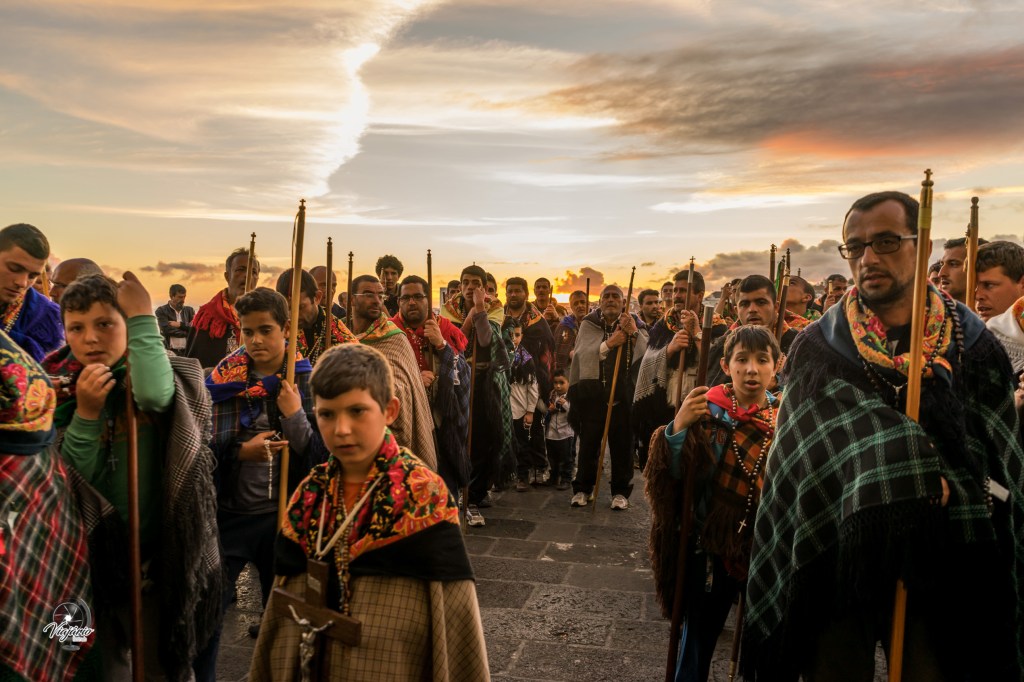
“This year, especially, as a result of some exaggeration that happened, particularly last year, in relation to the abusive use of cell phones, capturing images and recordings of the ranches in prayer and on the walk, we ask for greater restraint,” he justifies, pointing out that ”most of the pilgrims don’t like or accept so much exposure, not least because it disturbs those who are making the walk.”
“The same appeal we make to our brothers and sisters, we also make to those outside,” he explains, insisting that this is a ‘time of retreat.’
“The Pilgrimages are always a huge time, they are eight consecutive days, uninterrupted, in which we are in retreat, but also on a spiritual journey, including in the recollection in families or in the halls, in the overnight stays, we try to ensure that our behavior, our conduct, is in line with our experience as pilgrims during all those days,” he says.
Among the intentions that the pilgrims bring to these days is prayer for the Pope and, this year, particularly for his recovery. The Coordinating Group, which was received by the Pope in December 2014 and presented him with a spiritual bouquet containing thousands of prayers in his intention, is even considering the possibility of counting the prayers made in the Holy Father’s intention.
“Pope Francis, not least because of his social dimension and the involvement he has particularly with the most unprotected, the poor and migrants, is very dear to us,” said João Carlos Leite.
Pilgrims from Fenais da Ajuda exchange ideas with parishes from the Lisbon Patriarchate.
A delegation of pilgrims from the Fenais da Ajuda parish (São Miguel Island—Azores) will exchange places with the parishes of Turquel and Évora de Alcobaça (Lisbon Patriarchate) from the 12th to the 16th of this month.
This activity aims to “disseminate and allow the religious experience that is very characteristic of the island of São Miguel to spread to the mainland,” reads a note sent to the ECCLESIA Agency.
“Being a movement of Marian spirituality, the pilgrims will set off from the Shrine of Our Lady of Nazareth, with the celebration of the Eucharist, on the 13th at dawn, and are scheduled to arrive at the Shrine of Fatima on the 14th in the afternoon, in order to take part in the Rosary and Mass in the Chapel of the Apparitions.”
This pilgrimage to the Shrine of Fatima is particular because it includes men from the parishes of Turquel and Évora de Alcobaça, thus allowing an “exchange and sharing of experiences in the faith and in the dialog of different cultures.”
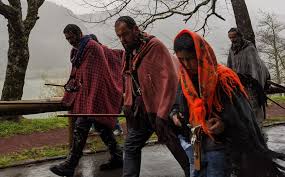
Reflecting on the Prayer of the Our Father
This year, the Coordinating Group of the São Miguel Pilgrims proposes that all the ranches reflect on the Our Father Prayer at the start of their daily walk.
The meditation suggested by the Coordinating Group was prepared by the movement’s spiritual assistant, Father Francisco Rodrigues. It aims to ensure that all these pilgrims of hope on this year’s Lenten pilgrimage can be attuned to this year’s theme, “Pilgrimage—time and steps of hope!”
Each day, a theme is recommended to be prayed and meditated on after breakfast and shared by each brother after lunch and before the overnight stay.
The outline of the meditation always begins with a question with three questions, followed by the suggestion of clues for individual reflection, then a meditative text, and finally, the sharing of each person’s resonance.
On the first day, an introduction to the Our Father is suggested – What does it mean to me to pray for the Our Father? What place does the Our Father have for me? How do I see this Our Father prayer as a spiritual journey? Does it help me to grow in intimacy with God?” A meditative text follows.
On the second day, the theme is “Father and hope – Our Father in heaven”; on the third day, the reflection is on “Name and hope – hallowed be your name”, in which the pilgrim is asked to question himself and his desire for holiness. On the fourth day, the reflection is based on “Kingdom and hope – your kingdom come,” in which a reflection is proposed on the kingdom of God, what is announced on the pilgrimage, and what is lived on the ranch.
On the fifth day, the theme is “Will and hope—Your will be done on earth as it is in heaven,” and we will examine the Father’s will and how we act according to that will.
On the sixth day, a reflection is proposed on “Give us this day our daily bread” based on the Day and Hope, namely what the Lord’s Day means and the importance of the Eucharist.
Finally, on the seventh day, the proposal is to reflect on temptation and hope, starting from the last call of Our Father’s prayer: “Lead us not into temptation.”

Further information
Romeiros are Catholic pilgrims who make a week-long pilgrimage on the island of São Miguel in the Azores. The tradition began in 1522 after an earthquake destroyed the city of Vila Franca do Campo. [1, 2, 3]
How the pilgrimage takes place [2, 3, 4]
- The pilgrimage begins in February or March
- Pilgrims walk in groups of 30 to 200
- They walk clockwise around the island
- They visit churches and chapels
- They pray, sing religious songs, and ask for forgiveness of their sins
- They give thanks for blessings in their lives
- They ask for peace and blessings for the church and families
Significance of the pilgrimage [3, 5]
The pilgrimage is a way to honor the Virgin Mary and to pay homage to her. It’s also a way to atone for sins and to ask for God’s protection. [1, 3, 5]
Other places with Romeiros [2]
The tradition of the Romeiros has also been observed in Southeastern Massachusetts. [2]
[1] https://azorieden.com/the-romeiros-pilgrims-of-sao-miguel-tradition-belief-and-emotions/
[3] https://lusolife.ca/romeiros-walking-with-the-faithful/
[4] https://playground-earth.com/travel-stories/the-romeiros-of-sao-miguel/
Translated to English as a community outreach program from the Portuguese Beyond Borders Institute (PBBI) and the Modern and Classical Languages and Literatures Department (MCLL) as part of Bruma Publication and ADMA (Azores-Diaspora Media Alliance) at California State University, Fresno, PBBI thanks Luso Financial for sponsoring NOVIDADES.
 Novidades - The Islands and the Diaspora