

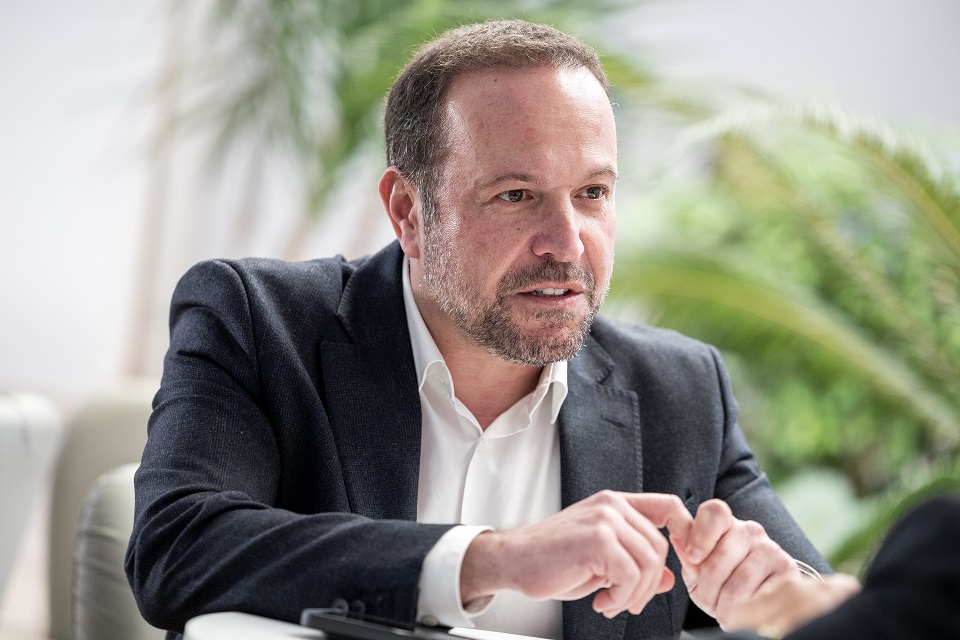
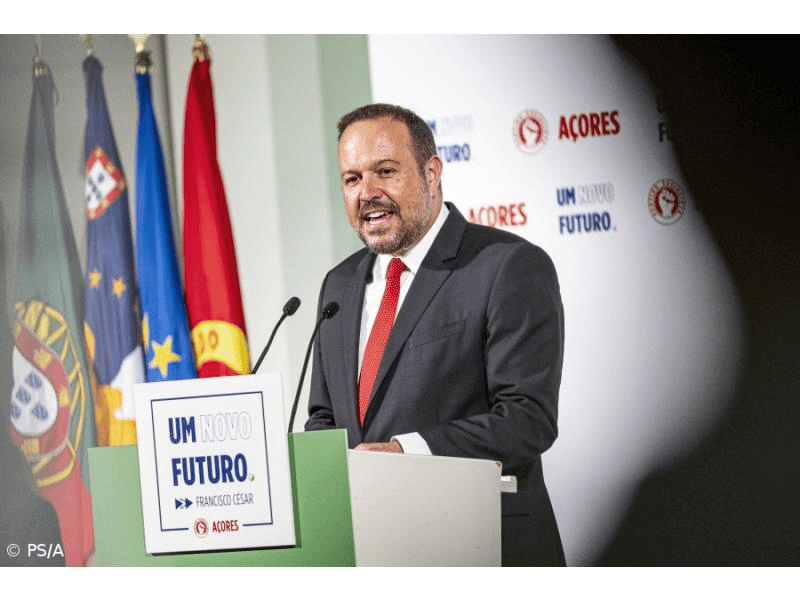
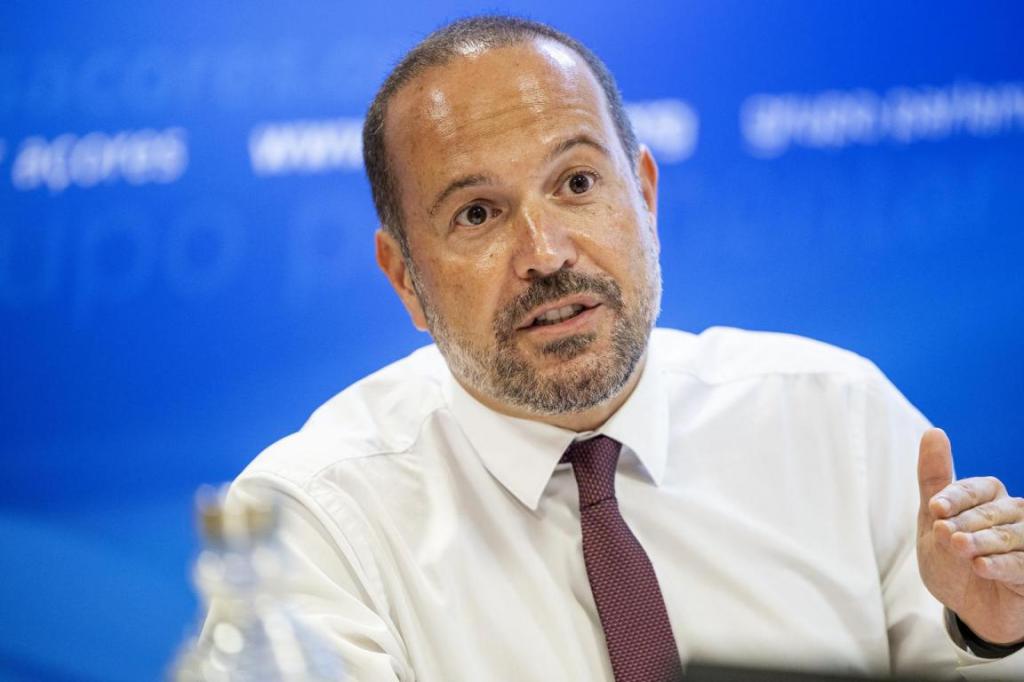
An interview by Diáriod a Lagoa qirg the Leader of the leading opposition party in the Azores (PS) Francisco César.
He became involved in politics early because politics was the most talked-about subject at home. Francisco César, 46, was born in Lisbon and came to São Miguel when he was three. He is an economist, a fervent Sports fan, president of the PS Açores, and a member of the Assembly of the Republic. In a brief career history, he tells us what he thinks of the present and future of the region without forgetting the past.
DL: Your father is linked to politics; you’ve always lived in a family environment linked to politics. What was it like growing up in that environment?
I’ve worked in this environment for as long as I can remember. I grew up in the middle of political campaigns, ever since I was a kid. My father and mother met in politics. My mother worked in the national PS; my father was here in the regional PS, and they met. At meetings, I would sit in the meeting and listen quietly. I set up a radio studio in my house to read the party’s political manifestos and record and compose music. I would record airtime, and my mother would make fun of me because I called it Radio Feteiras. After all, at the time, my parents had a house in Feteiras.
DL: And that’s where you did it?
Yes, politics came naturally to me. My house has always been full of books. And today, so much so that it’s the same for my son.
DL: You never felt obliged to read?
On the contrary, I liked it. My parents would have preferred it if I hadn’t gotten into it. I think that’s the feeling of any parent because I look at my son, who will be 13, and let’s see… This political thing is funny, but it hurts and is not easy. Politics means subjecting yourself to scrutiny and appreciation from third parties, which is both gratifying and cruel.
DL: How do you protect your family from that?
This is a process. My parents and I were particularly affected by the issue of family in politics. That hurts; in other words, people judge others based on assumptions or prejudices about others. And we are always considered. I try to protect my family through a good family nucleus.
DL: Who is the man behind the politician?
That’s one of the most interesting questions, but also one of the most difficult. I really wish I had been an economist. An economist, in other words. I’m very impatient. But I’m profoundly normal in all my ways. I like reading, I like going out, I even like singing. Badly. I’m very absent-minded, people don’t know. I sometimes switch off. It’s one of the good things I can do. And I’m in my own world, with my son, doing my own thing, with my family. I like going to the beach, I like boxing, I like exercising, I like going to the supermarket. I like doing what normal people like to do. I like trying new things.
DL: What are the region’s main challenges?
The first challenge we have is the challenge of knowledge and qualification. I often say that the competitiveness train has already left. It’s been a long time in these regions, and the Azorean locomotive is still on the platform. And so, if we are to get there, we have to prioritize the qualification of Azoreans. It’s good that the internal market works, but it can’t survive. I fear that big companies aren’t betting on the international market. How is that possible? First of all, we have to help our companies to invest. There has to be sensitivity. We have to reduce the risk of betting. But above all, we have to bring companies here.
DL: Is the sea the future?
The sea is one of the sectors. The sea, energy. The first of all is knowledge. Because the only way is that we don’t have territorial continuity. The region could end up in a situation of near insolvency or financial rescue. If you invest in the economy and are careful with the budget, this can be resolved.
DL: What is the PS’s position on the modular hospital?
The current option is to build a new hospital, but what is a new one? It’s changing 80% of what’s there and adding another 80%. Who pays for this? Who supports it? We don’t have the financial capacity to support the current Regional Health Service. We don’t. All the hospitals are underfunded. The government says that, not me. So, if we double the size of the hospital, does anyone think it will be cheaper?
The decisions are made on the people’s behalf because we are their representatives. When we make a decision that could compromise the Regional Health Service, or at least have such a big impact from the point of view of the Regional Health Service in the community. This cannot be discussed by technicians. Technicians give their opinions, but it’s the politicians who decide. Politicians are the only ones in a democratic system who are mandated to do this. Why is that? Because no one is going to hold the technicians accountable. The technical studies may find a lot, but democracy decides; it’s the politicians and representatives of the people. But I have hope. Otherwise, I wouldn’t be here.
In Diário da Lagoa, Clife Bothelho-director
Translated to English as a community outreach program from the Portuguese Beyond Borders Institute (PBBI) and the Modern and Classical Languages and Literatures Department (MCLL) as part of Bruma Publication and ADMA (Azores-Diaspora Media Alliance) at California State University, Fresno, PBBI thanks Luso Financial for sponsoring NOVIDADES.

 Novidades - The Islands and the Diaspora