


The fishing fleet in the Azores has grown from 675 vessels in 2010 to 523 in 2016 and 493 boats in 2023. At the same time, the economic situation of fishermen has not improved either. Over the years, there have been many complaints and reports that poverty reigns in the sector. Over time, the parties have been warned about the problem. The Socialist Party has already stressed that the fishing sector is facing growing problems on some Azores islands. CHEGA has said on several occasions that fishing and the Azorean fishermen deserve to be defended for everything they represent for the economy and even for the culture of the Azores, stressing the great dificulties that fishermen are going through.
Last week, the Free Fishermen’s Union once again exposed the hardships faced by fishermen, pointing out that in the space of 25 years, income from fishing has been deteriorating, with successive falls in volume and value. This has led to the fact that, although the accumulated inflation rate over this time has exceeded 35% in the value of the first sale, in 2024, the value was practically identical to that of 2010.
“In the 1st quarter of this year, through a random sample of 15 local fishing boats on the island of São Miguel, the average net income per crew member was between €80 and €260.00, the latter being exceptional and limited to just one boat, all the others had incomes of between €100.00 and €200.00 per month, and there were even boats that had no income at all in March.”
For the union, what is happening in fishing is “a situation of hardship and discrimination affecting the island’s fishing population,” which can be seen when the minimum wage now stands at 913.50 euros. In fishing this is not possible because to calculate net income there are both deductions at source (around 25%) and part of the operating costs borne by the companies as a whole (examples: fuel, bait and tackle) which, in general, exceed 10% of the gross value of the catch. Disposable income from work is generally just over 60% of the gross value of the catch.
“Only fair remuneration for work can combat poverty,” says the Union board, which recalls that the latest report on the risk of poverty in Portugal (June 2024) revealed that the Azores have the highest poverty rate in Europe – 16.4%, compared to 7.5% in the Lisbon metropolitan area and 10% for the national average. Although there is no data for each socio-economic area, we have no doubt that in Azorean fishing the poverty rate is well over 60%”
The union’s leadership says that it is incomprehensible that “a professional sector that performs stressful and high-risk jobs lives in extreme poverty, and therefore considers it absolutely necessary to provide extraordinary support in the amount of 10 million euros to compensate for the losses to professionals resulting from the establishment of 30% of the ‘Azores Sea’ as a maritime reserve. This is an opportunity to put an end to a cycle of poverty and begin the optimal exploitation of existing resources in both the EEZ and the limit zone. By promoting an in-depth restructuring of the fleet that simultaneously promotes greater selectivity and higher yields.”
To overcome the difficult situation in fishing, the Free Fishermen’s Union advocates adopting measures to increase selectivity in fishing gear, such as financially supporting the scrapping of gear such as plastic traps and gillnets.
They are in favor of financially supporting a reduction in fishing effort between January and March, the breeding season for the main species, and a reduction in fishing effort along the coast by financing the decommissioning of vessels with little autonomy. Today, these vessels can neither fish along the coast nor have conditions beyond 5 nautical miles from the coastline.
They also propose financing the construction of vessels with the capacity to fish within and beyond 200 nautical miles, as well as to exploit existing resources at bathymetric depths of more than 600 fathoms, where the bulk of the Azorean fishing fleet’s activity is concentrated, and the adoption of a set of proposals aimed at ensuring that fishermen’s average incomes are equivalent to the regional minimum wage, as well as retirement pensions, which are currently less than €520.00 for small-scale fishing.
Furthermore, they denounce the existence of discrimination when the regional supplement is not awarded to elderly people who own their own boat and also state that, given that professional accident insurance, which in other activities is a cost of employers, in the small-scale fishing sector is borne by the companies, it should be integrated into social security, with the possibility of updating the percentage to bring it into line with other sectors of activity.
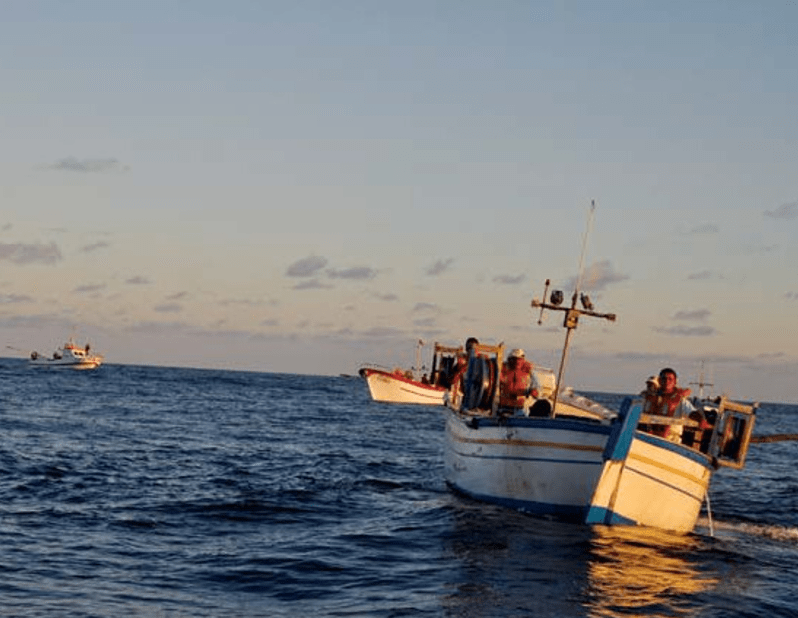
Marine areas and recreational fishing are among the causes of degradation.
The signatories of the communiqué “point to the main causes of the deterioration in fishermen’s incomes, in addition to that caused by bad weather, as those resulting from the extension of marine protected areas, which today practically cover all existing fishing grounds accessible to small-scale fishing. Another of the main causes is the extension of maximum catch quotas to practically all species, even local ones, without there being any proven scientific verification that these resources are overexploited.”
They also justify the drop in income by the fact that there is “disproportionate growth in recreational fishing in counter-cycle to the constant decline in the commercial fleet: In 2024, the professional fleet was limited to 490 active vessels, while recreational fishing, which has been practically non-existent for 25 years, has 1324 vessels, almost three times as many as those engaged in professional fishing, without any knowledge of the effective impact of this fishing on coastal resources, to which must be added the effort of diving fishing, which also has a licensing level of more than 1,000.”
The Free Fishermen’s Union believes that “the demand for sustainability in the exploitation of resources must be accompanied by the demand for stability in income”.
As the signatories point out, “the sea is an economic asset. It is no coincidence that the exclusive economic zone (EEZ) is the area around 200 miles from the coastline, whose priority exploitation rights belong to the coastal states (1982 Convention of the Sea), to which today is added the right of jurisdiction of coastal states over the seabed up to 350 miles. An economic asset means that the resources are wealth and must provide income for the coastal populations that depend on them.”
They endorse the principle of optimal resource exploitation and believe it is right to set limits on the exploitation of the seabed, especially since only large multinationals are in a position to exploit these resources.
Having established margins to safeguard coastal protection, which we endorse, we nevertheless object to the fact that economic interests linked to maritime activity, such as naval tourism and the observation of coastal seabeds through scuba diving, set themselves up as environmentalists and join forces with researchers in the field of marine biology as heralds of the sustainability of coastal resources.
Fishing is the oldest recreational activity, it is the one that provides the population with a high quality supply of animal protein and this activity, along with the past, also has a future,” the signatories of the memorandum say in the statement about what is happening in fishing from their perspective and what they advocate to improve the sector.
Nélia Câmara is a journalist and chief editor at Atlântico Expresso in Ponta Delgada.
Translated to English as a community outreach program from the Portuguese Beyond Borders Institute (PBBI) and the Modern and Classical Languages and Literatures Department (MCLL) as part of Bruma Publication and ADMA (Azores-Diaspora Media Alliance) at California State University, Fresno, PBBI thanks Luso Financial for sponsoring NOVIDADES.

 Novidades - The Islands and the Diaspora