

Francisco was born in Arrifes, near the historic center of Ponta Delgada, where tourists now pay a fortune to enjoy the privilege of visiting the Azores, and residents pay the same to breathe. From a young age, he worked with his family in the fields, alongside his brothers, cousins, uncles, and an injured father, who had lost two fingers in an accident on the high seas. When he was little, he used to lie on the living room floor in front of the old television set, which at the time only showed RTP Açores, dreaming of another life, far from the shadow of a city of doctors and molds. At school, he always behaved well. Even in the face of threats and temptations, he never touched a piece of dope, never thought of smoking a cigarette, and rarely drank alcohol. However, on feast days, his uncles encouraged him to down two glasses of wine and a shot of local brandy to make himself look like a little man.
He finished compulsory school with grades above the regional average, thanks to the many visits he made to the town library to borrow books that his parents couldn’t afford. In the few moments he had to himself, he would hide away from his family to read, taking refuge in a corner of his own. At his own risk, he arranged all the paperwork and got his mother to sign it without his father even knowing. He got two scholarships and some additional support. He went to university, followed the course he wanted, grew in height and knowledge, while also becoming an adult in terms of passions and contentment. When he returned, his father and mother had already died of exhaustion and purple lips, buried by his brothers. The business continued with his uncles.
Francisco decided that this was the place to make up for old mistakes. With the management course already done, the fishery became a pillar in Arrifes. It stood up, alongside his blood, and soon they were exporting fish to other horizons. After a while, the family made a good living. Then came the first crisis. He started drinking a lot at the end of the day. He smoked copiously, ever since one day he’d fallen into temptation on the steps of the school he’d attended. The crises multiplied, and there was not enough support for his life. He ended up sleeping on the living room floor, in front of the television, alone as before, supported only by the empty bottle and the cigarette butt on the floor.
From there, he moved to the street, as the house had to be sold to pay off some debts he had incurred with his brothers. He lived in the cold of Arrifes for months until he found a new job. Drugs, which he had never known as a young man, were what guided his days now. He sold almost as much as he consumed, a refugee in his own world, excommunicated by his family, lulled by synthetic chemicals. In the mists, he still kept his dreams and the pages that had remained unread. He still showed affection and kindness to others. But his hands were grimy, and his eyes clouded by the society that had failed a man who had worked his way up from the fields to college.
The change he was given at the supermarket door and in the churchyard wasn’t enough to eat and consume. Choices had to be made, and addiction rarely allows us to have compassion for ourselves. He walked skeletally along the old sidewalks of the historic center, where as a child he had sworn he would never return. Francisco had tried to do everything he could to avoid being, but life had taught him that even the best of hearts are never far from being left without a place to live.
Convicts like the one in the story you’ve just read exist by the hundreds in our archipelago. According to the study that Secretary Monica Seidi recently presented, there are 386 people flagged as homeless, and this social problem is particularly acute in Ponta Delgada. She explained the issue of drug addiction as the driving force behind all this. However, doubts remain, as it seems to be an issue that should be considered in association with the growing rate of poverty and exclusion, where the Azores are the tip of the unfortunate spear. There is indeed a serious problem with illicit consumption, but it is also true that those who consume often do so to escape other ghosts, such as lack of money, bad luck, or illness itself.
Recognizing the social problem that is spreading across our region, the head of Health and Social Security, when she announced the figure I mentioned, also announced an action plan for homeless people. It’s a strategy that will start in Ponta Delgada, but is expected to extend to the rest of the archipelago. We don’t yet know the details of the action, and can only express a few thoughts on the initiative and its implementation.
A person on the street, as we normally call them here, is not necessarily a dangerous person, nor a violent criminal. Most of them end up committing some kind of illegal act, and many resort to attacking as a necessary means to defend themselves from the misfortunes they have fallen into. However, a person walking down the street is a human being who needs to be looked at carefully. They need psychological assessments, work on addictive behaviors, and referrals to social housing, and the possibility of recovering the dignity of their past lives. That’s why I hope the regional plan for the homeless will do everything it can to honor the humanity that unites us, because we all have life stories, and we don’t know what the future holds for us.
I would like to personally express my appreciation for this initiative. In times of extremism and populism, I hope that the work carried out can be consensual and will not fuel the ambitions of profiteers who profit from tragedies. Like the recent campaign for including ideas and behaviors, this is also a unique opportunity to make the Azores better. Well done to the Secretary, with whom I have some political differences, so often unjustly erased by the men around her. We need more women like that.
Post Scriptum: For obvious reasons, the name is fictitious. The story is real.
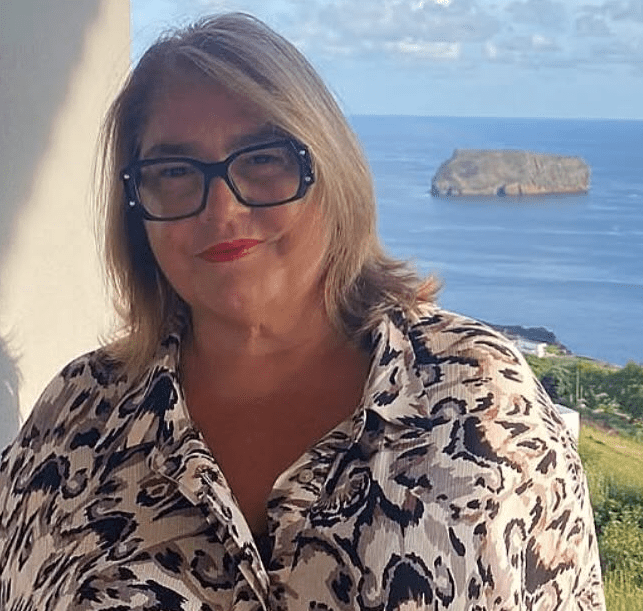
Alexandra Manes is from Flores Island but lives on the island of Terceira in the Azores. She is a regular contributing writer for several Azorean newspapers, a political and cultural activist, and has served in the Azorean Parliament.
NOVIDADES will feature occasional opinion pieces from various leading thinkers and writers in the Azores, giving the diaspora and those interested in the current state of the Azores a sense of the significant opinions on some of the archipelago’s issues.
Translated to English as a community outreach program from the Portuguese Beyond Borders Institute (PBBI) and the Modern and Classical Languages and Literatures Department (MCLL).
 Novidades - The Islands and the Diaspora