

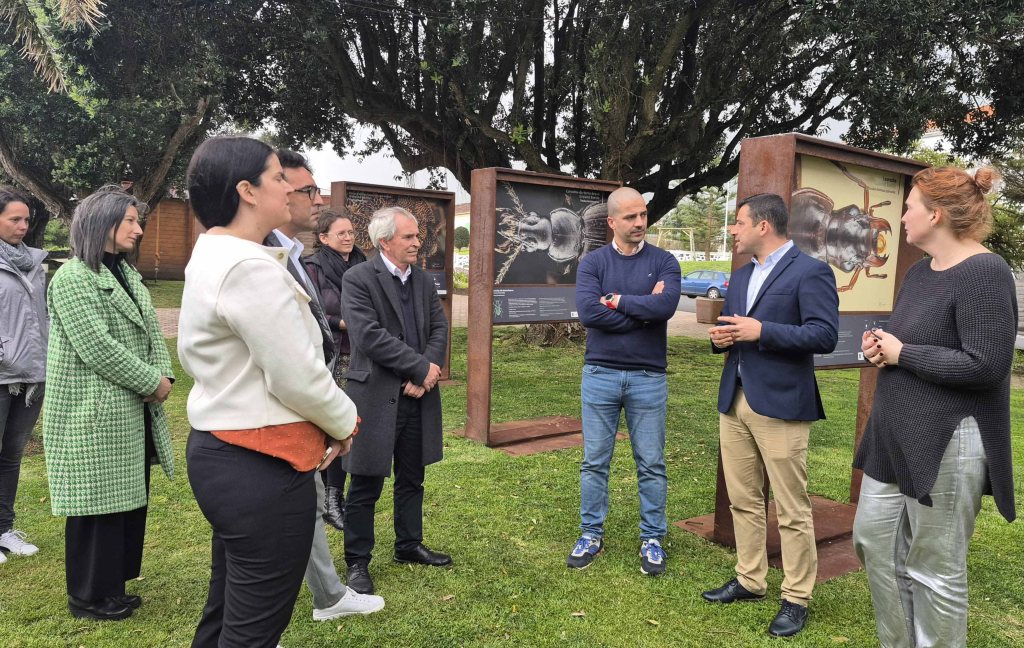
On Tuesday, the Regional Secretary for the Environment and Climate Action, Alonso Miguel, presided over the opening of the macrophotography exhibition of endemic insects from the Azores, “LIFE BEETLES: Small in a big way”, in the Municipal Garden of Lajes das Flores.
On the day that marked two events of great importance for environmental awareness, World Earth Day and National Geological Heritage Day, Alonso Miguel highlighted “the importance of the LIFE BEETLES project, for its solid and consistent contribution to the conservation of the region’s biodiversity, as well as its ability to raise awareness and bring communities closer to the natural values that define the island’s identity”.
The Regional Secretary pointed out that “the macrophotography exhibition, which has now been inaugurated, plays an essential role in bringing the local community closer to insects, a group of living beings that often goes unnoticed and is not always properly valued”, with the aim of “deconstructing the negative perception often associated with these small beings, revealing their vital importance to the balance of ecosystems and the functioning of the nature that surrounds us”.
Alonso Miguel explained that this initiative aims to showcase the best of what is being done in the region in terms of research, conservation, and environmental education. It is only the second initiative of its kind in the Azores. It has toured the three islands covered by the LIFE BEETLES project, having already been presented in Terceira and Pico.
“The photographs exhibited, with technical rigor and artistic sensitivity, allow us to see more closely, with detail and clarity, what normally escapes our gaze: the beauty, complexity and value of these small great inhabitants of our natural heritage,” he added.
He stressed the firm commitment of the Regional Government of the Azores “to valuing nature conservation, biodiversity and environmental sustainability as fundamental pillars for public policies in the area of the environment, materialized in a very concrete way through the continued commitment to LIFE projects”.
According to Alonso Miguel, “these projects, which are heavily funded by the EU and coordinated directly by the Regional Secretariat for the Environment and Climate Action, represent a unique opportunity to empower the region in the field of protecting our natural resources, as they are an essential lever for implementing excellent public environmental policies, helping to ensure that the Azorean natural heritage, which is unique and irreplaceable, is preserved, valued and passed on to future generations”.

The Regional Secretary acknowledged that the LIFE BEETLES – Bringing Environmental and Ecological Threats Lower to Endangered Species project is, in this context, an excellent example of what can be achieved with a concerted, well-designed strategy based on a long-term vision.
With a duration of six years, from January 2020 to December 2025, this nature conservation project represents an overall investment of around 1.77 million euros, 55% co-financed by the European Union, and its main objective is to increase the population, distribution area and conservation status of three species of beetles endemic to the Azores: the cascudo-da-mata beetle (Tarphius floresensis), on the island of Flores, the laurocho (Pseudanchomenus aptinoides), on Pico, and the terracotta beetle (Trechus terrabravensis), on Terceira.
He stressed that “the project’s area of intervention on the island of Flores covers around 182 hectares, spread over the areas of Ferros Velhos, Lagoa Rasa and Ribeiras do Fundão and Anel, in Lajes das Flores, where work has been carried out to recover and renaturalize the habitat of the target species on this island, the cascudo-da-mata beetle, through the control and removal of invasive flora species, the planting of around 4,500 specimens of endemic species and the application of natural engineering solutions in highly degraded river areas”.
Alonso Miguel revealed that, “within the scope of the LIFE BEETLES project, the Regional Secretariat for the Environment and Climate Action has invested more than 300 thousand euros on the island of Flores, creating three local jobs, which also represents a significant contribution to the local economy and to the qualification of human resources in the environmental field.”
To mark World Earth Day and National Geological Heritage Day, the Regional Secretariat for the Environment and Climate Action has scheduled around two dozen environmental awareness activities on all the islands of the archipelago until April 30, including information sessions, interpretive tours, interpretive visits to the Environmental Centers and educational activities aimed at both schoolchildren and the general public, to raise awareness of the importance of environmental preservation, knowledge of our geological heritage and sustainable management of natural resources.
From Press Release

 Novidades - The Islands and the Diaspora