

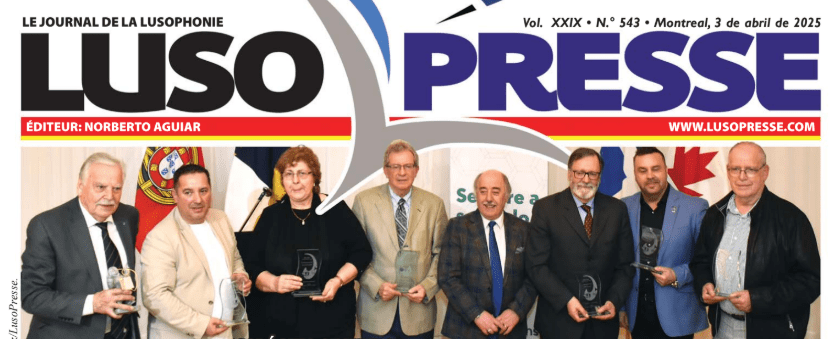
On March 29 and 30, the House of the Azores (Casa dos Açores) in Montreal, Quebec, Canada, hosted the colloquium “The Portuguese Community – Vision of the past, present, and future,” an initiative organized by Norberto Aguiar, responsible for the newspaper LusoPresse and LUSAQ TV. The event was considered by its promoters to be a “Second Colloquium”, alluding to the meeting held, with other approaches, in November 2023.
The two-day program featured a diverse lineup. On Saturday the 29th, the event was opened by the Consul General of Portugal in Montreal, Francisco Saraiva, and by José Andrade, Regional Director of the Communities of the Government of the Azores, who mentioned, among other things, the historical matrices of Portuguese emigration and the importance of promoting and valuing citizenship in the communities.
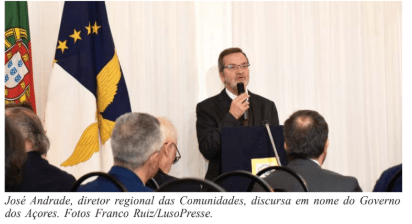
During his opening speech, José Andrade, Regional Director for the Communities, stressed that this second colloquium “confirms and consolidates its mission to inform with social responsibility and community spirit” and that it serves to “make a contribution to improving the present and preparing the future of the Portuguese communities, mostly of Azorean origin, in Montreal, Quebec, Canada, North America”.
“This initiative by the community itself, which comes from the media in partnership with Casa dos Açores, is an important step in this joint journey of collective responsibility. As far as the Azorean government is concerned, the Regional Directorate for Communities has also tried to fulfill its mission, with dedication and even passion, of bringing the Azorean diaspora closer together and valuing it,” he said. José Andrade also reiterated that, in Montreal, the colloquium brought together speakers from Canada, the United States and Portugal, with the “strategic concern of motivating and involving the new generations of the Azorean diaspora in order to attract and engage the children and grandchildren of our emigrants in the process of rejuvenating the associative movement that guarantees the future of the Portuguese communities”.
“The future of the diaspora is a common concern of public authorities and private entities, in the Azorean archipelago and on the American continent, calling for the contribution of each one for the benefit of all,” said José Andrade.
LusoPresse, founded on December 1, 1996, and LusaQTV, started on December 11, 2017, are two projects that “dignify” the Canadian media and “give prestige” to the Portuguese community in Quebec. Andrade also points out that both media outlets “don’t just tell what happens,” because “they make it happen.”
It should be noted that the province of Quebec is today home to around 70,000 Portuguese, mostly from the Azores, especially from the island of São Miguel, with a concentration in cities such as Montreal, Laval, and Santa Teresa.
The first panel, at 9am, dealt with “Politics and Youth” and was coordinated by Carlos de Jesus. The speakers included Carlos Leitão, Luís Miranda, Armando Melo, Isabel dos Santos, Patrick Rebelo, Daniel Loureiro, Victor Faria, Michael Gouveia, Ricardo Torcato, Tiana Arruda, Alexander Norris, representatives from local political parties, and José António Garcia, Ribeira Grande City Councillor. The event was marked by a discussion on the importance of mobilizing and involving young people in political parties and municipal authorities.
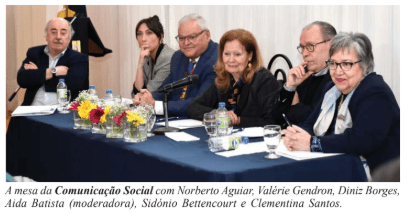
At 10:30 a.m., a panel on “Social Communication” was coordinated by Aida Batista, featuring names such as Diniz Borges, Sidónio Bettencourt, Clementina Santos, Norberto Aguiar, and Valérie Gendron. The focus was on the importance of these bodies in preserving, maintaining, and disseminating the values and identity symbols of the Azorean community, as well as the written and spoken language, customs, and culture.
After lunch, at 12 noon, it was time for the “Commemorating” panel, coordinated by José Morais, with participants Arlindo Vieira, who spoke about the “50 years of April 25”; José Andrade, who addressed the “50 years of Autonomies (Madeira and the Azores); and Onésimo Teotónio Almeida, who spoke about the ‘500 years of Gaspar Frutuoso’.
At 4 pm, the central theme was “Women’s Day,” coordinated by Paula Ferreira, president of the Quebec House of the Azores. The speakers were Aida Batista, Ludmila Aguiar, Marisol Ribeiro, and Maria do Rosário Gaspar, who shared their professional journeys and experiences of affirmation, resilience, and achieving goals.
The following day, Sunday, at 10.30 a.m., the panel “Community/Emigration/Immigration” took place, with Onésimo Teotónio Almeida as coordinator and José Carlos Teixeira, Victor Pereira da Rosa, Paula Bernardino, Duarte Miranda, and Vítor Carvalho as speakers.
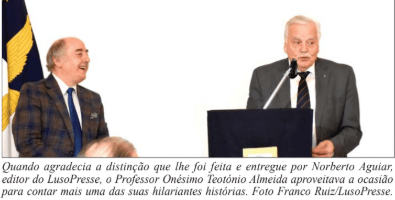
At 1.30pm, there was the “Final Party”, with entertainment, speeches, and the presentation of the Corte-Real 2024 Awards to Arlindo Vieira, Joe Puga, José Carlos Teixeira, Victor Carvalho, and, posthumously, to Maria José Raposo.
Azorean writer Onésimo Teotónio Almeida, Professor Emeritus at Brown University, was awarded the Career Prize by the LusoPresse newspaper.
The colloquium ended with a Festive Lunch at the House of the Azores of Quebec, prepared by Chef José Artur Cabral, who travelled from the United States to Canada at the invitation of the organization. There were also moments of poetry by Ludmila Aguiar, Joaquim Eusébio, and Sidónio Bettencourt.
Igor Lopes, journalist (in Diário da Lagoa, Clife Botelho, director). The photos are from Luso Presse
Translated to English as a community outreach program from the Portuguese Beyond Borders Institute (PBBI) and the Modern and Classical Languages and Literatures Department (MCLL) as part of Bruma Publication and ADMA (Azores-Diaspora Media Alliance) at California State University, Fresno, PBBI thanks Luso Financial for sponsoring NOVIDADES.

 Novidades - The Islands and the Diaspora