


With 849 inhabitants, the parish of Altares, in the municipality of Angra do Heroísmo, is one of the oldest on Terceira Island. Founded before 1480 and located about 19 kilometers from the city, it preserves its historical, geological, and religious heritage and stands out for its involvement in dairy farming. Cidália Parreira, president of the Parish Council since 2021, emphasizes the importance of valuing this potential, but acknowledges the challenges that remain: the loss of young people, the shortage of affordable housing, and the lack of labor, compounded by budgetary and infrastructure constraints. Nevertheless, she believes the parish’s future lies in a development model that can exploit its peripheral identity and the sustained growth of rural and sustainable tourism.
Correio dos Açores – How would you describe Altares?
Cidália Parreira (President of the Altares Parish Council) – The parish of Altares, in the municipality of Angra do Heroísmo, is one of the oldest on the island of Terceira, founded before 1480, located in the fertile northwest of the island, with an area of 31.20 square kilometers, about 19 km from the city. According to the 2021 census, 849 inhabitants were distributed among 292 households. This parish was one of the first to be populated by the Pamplonas and Valadões nobles, who settled in the Arrochela area and quickly realized the fertile land’s potential for wheat and pastel production. Couples came with the land and seeds to work it and raise their children. Occupying the territory was a priority for the King and the Captains of the Donatário. With the surplus production came the export of agricultural products and, with them, trade with Flanders. From those times, a Processional Cross and a Christ between Thieves remain in the noble sacristy.
Located in a radial fracture zone in relation to the Santa Bárbara Volcano, in the vicinity of Pico Rachado, it extends northwards towards the coast. It is characterized by good agricultural land, which is now almost entirely dedicated to dairy farming, currently the parish’s main activity. This parish has important geological and landscape heritage.
The origin of the name Altares is ambiguous. Still, according to the oldest writings, from the 16th and 17th centuries, by Gaspar Frutuoso and Father António Cordeiro, respectively, the name derives from the fact that in this parish there is a peak by the sea that looks like an altar, which is geographically aligned with the other altar in the chancel of the original church, hence the name of the parish of Altares. More recently, in the 18th and 19th centuries, it is common to see the name Altos Ares, especially in references and writings by D. Frei Valério and Monsignor Alves da Silva.
From a natural point of view, the parish of Altares stands out for its rich and diverse natural vegetation, with remnants of the Azores laurel forest. Among the native and endemic species that still persist in the more humid and elevated areas, such as the area surrounding the Serra de Santa Bárbara, are the juniper (Juniperus brevifolia), heather (Erica azorica), laurel (Laurus azorica), and holly (Ilex azorica). This vegetation plays a fundamental role in biodiversity conservation, soil protection, and water regulation, and is a valuable natural heritage that must be known, preserved, and valued.
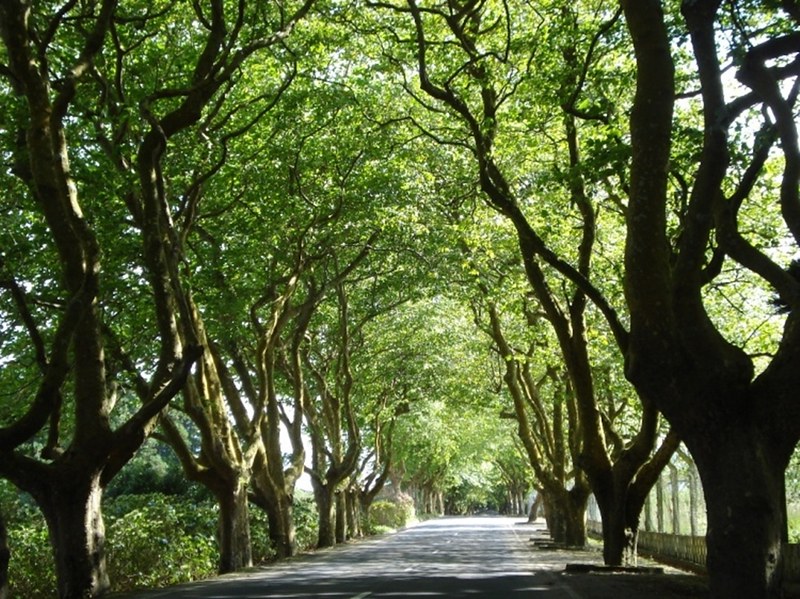
The following are some of the main tourist attractions: Pico Matias Simão, a cone of lava spatter located on a radial fracture of the large volcano of the Serra de Santa Bárbara, and heavily affected by marine erosion. It is composed of basaltic materials that are distinguished by their peculiar shapes; Lagoa do Negro, a picturesque circular lake that is easily accessible, has recently become better known and more popular, partly due to the passage of a walking trail and the installation of a shelter for birdwatchers on its banks; Alameda dos Plátanos, is located on the access road to the parish of Altares. It is approximately 830 m long and, due to its unquestionable beauty in all seasons, was classified on February 21, 2015, as a “Tree Ensemble of Municipal Interest.”
We also have the Altares Museum Center, which is housed in a building adjacent to the parish churchyard. This is not a simple ethnographic space, like others scattered around the island, but a museum space that aims to preserve the cultural and natural memory of the parish of Altares. It is open to the public from Tuesday to Sunday, 2:00 p.m. to 5:00 p.m., at Largo Monsenhor Inocêncio Enes, 9700-301 Altares.
I would also like to highlight the Tile Panel of Traditional Agricultural Industries and Cultures of Altares. Among others, it depicts three of the most important industrial and agricultural activities that developed in the parish of Altares: tile making, pastry making, and corn, which began soon after the settlement of this northern part of the island.
The Church of São Roque dos Altares is also a popular tourist attraction. Although the parish’s patron saint is São Roque, the community’s main religious festival takes place annually on the first Sunday of September and is dedicated to Nossa Senhora de Lurdes. We also have the Império do Espírito Santo dos Altares (Holy Spirit of the Altars Empire) and the Irmandade do Divino Espírito Santo e da Santíssima Trindade (Brotherhood of the Holy Spirit and the Holy Trinity), built in 1903.
Finally, it is worth mentioning Caneta, a family-run restaurant that is spacious and pleasant, with a regional touch. All beef and pork are produced in-house.

What are the main challenges, needs, and difficulties facing the parish?
The greatest challenge is keeping young people in the parish, which leads to other situations. The migration of young people to urban areas in search of better opportunities results in a reduction in the population and an increase in the proportion of elderly people, which makes it difficult to maintain local services and activities.
Overcoming these challenges requires coordinated action between communities and local authorities, promoting the enhancement of local potential.
Are the funds available sufficient to manage the parish throughout the year?
From my point of view, the funds for the basic management of the Parish Council’s services are sufficient. The problem is that, being close to the population, we are constantly confronted with needs that we try to resolve, even though they are not within the Parish Council’s competence. And that is where we no longer have the funds to cope. We have resorted to protocols, with great support from the Municipality of Angra do Heroísmo during this term of office.
How big is tourism in the parish? Is the number of local accommodations increasing?
As is the case on the island as a whole, there has also been an increase in tourism in the parish, accompanied by growth in the number of local accommodations.
Is the lack of housing a problem for young couples?
Yes, there is a lack of housing in the parish. Even when there is some supply, prices are already high—a reality also beginning to be felt in outlying parishes, such as Altares.
In my view, there are two main problems: on the one hand, access to credit for buying or building your own home remains difficult; on the other hand, there are no longer so many houses available to rent. Many are used as summer homes, others have been converted into local accommodation, and several are still in an advanced disrepair.
Do you experience problems related to the lack of labor in the parish?
Yes. As is the case across the island, there is also a labor shortage in Altares, especially in the primary sector.

Are there any essential services or infrastructure lacking in the parish? If so, which ones? Are the agricultural roads in good condition?
The parish has made an effort to preserve the existing infrastructure. However, we need a space with better conditions and access for gatherings and festivities, as the current space has limitations.
In terms of accessibility, Altares has many agricultural and forest trails. In the farming and municipal areas, we have been working with the Angra do Heroísmo City Council to rehabilitate some roads every year, which has allowed us to maintain their general good condition as far as possible.
How would you describe Altares’ cuisine?
It is a rich cuisine that combines elements from the sea and the land, closely linked to our traditions. During the Holy Spirit celebrations, for example, the highlight is Alcatra de Carne (beef dish) — the most famous recipe — prepared in a locally made clay bowl and cooked in a wood-fired oven, which is a unique structure in vernacular architecture due to its generous dimensions and associated with the typical chimney with hands clasped together. Also noteworthy are the massa sovada (sweet bread), wood-fired bread, and Sopa de Carne (or Sopa do Espírito Santo), traditionally enjoyed by the locals with stale bread and typical seasonings.

What have been the main cultural promotion activities in the parish?
From the Parish Council’s point of view, we value the personal enrichment of the population. In addition to infrastructure, which is fundamental, we have developed activities such as: time management training; creative reading and writing workshops for children; the launch of the book Altares da Memória by Assunção Melo, awarded by the Portuguese Academy of History; presentation of the book Campo de Aviação da Achada, by Manuel Martins and Lieutenant Colonel Pedro Horta; and the Serão da Lã, where we rigorously stage the entire artisanal process of wool preparation. We also support initiatives promoted by other entities in the parish, such as the Festas de Nossa Senhora de Lurdes, organized by the respective committee; the Sports Group, part of the Casa do Povo dos Altares; and Carnival, organized by the Sociedade do Sagrado Coração de Jesus dos Altares.
Does Altares have potential for further development? Under what conditions and in what areas?
Altares is a parish with great heritage and natural value. I believe it has the potential to develop further and even take advantage of its peripheral location.
Because it is far from urban centers, it is a more picturesque parish. Following trends, we can grow mainly in tourism, valuing our cultural and natural heritage, and promoting responsible and sustainable tourism.
Daniela Canha is a journalist for the newspaper Correio dos Açores-Natalino Viveiros is the director.
Translated to English as a community outreach program from the Portuguese Beyond Borders Institute (PBBI) and the Modern and Classical Languages and Literatures Department (MCLL) as part of Bruma Publication and ADMA (Azores-Diaspora Media Alliance) at California State University, Fresno, PBBI thanks Luso Financial for sponsoring NOVIDADES.

 Novidades - The Islands and the Diaspora