

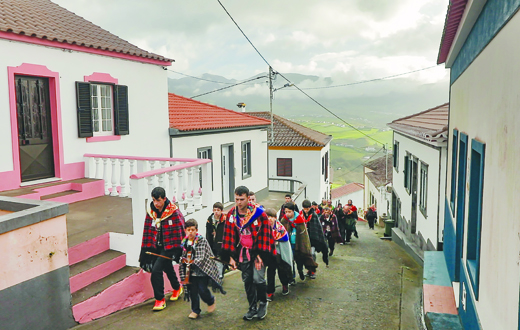
The Cultural Heritage Public Institute (PC, IP) revealed yesterday that it has approved the inclusion of the “Romeiros de São Miguel” event in the National Inventory of Intangible Cultural Heritage (INPCI), by the Order of March 26, 2025, signed by the president of the Board of Directors, João Soalheiro, and also published yesterday in the Diário da República. According to the information provided by the PC, this registration reflects the criteria set out in Article 10. of the Annex to Decree-Law No. 149/2015, of August 4, highlighting the importance of the manifestation of intangible cultural heritage as a religious practice that is part of the identity of the population of São Miguel, particularly for the various groups of pilgrims that exist and extend to other islands of the Azores archipelago.
This registration also took into account the dynamics of the Lenten pilgrimages of São Miguel today and how they are passed down from generation to generation, with a strong presence of the communities.
The practice of the “Romeiros de São Miguel,” also known as Lenten pilgrimages—formerly called Visita às Casinhas de Nossa Senhora (Visits to the Houses of Our Lady)—is an ethnographic phenomenon of great interest due to the originality of certain elements inherent to it, as well as its persistence over the centuries. Natural disasters in the 16th and 17th centuries, notably the earthquakes of 1522 and 1563 and one of the island’s largest volcanic eruptions in 1630, are events that gave rise to this practice.
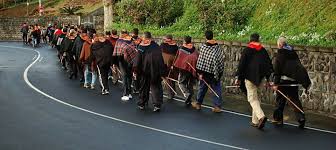
Over time, the mixed pilgrimages came to be carried out only by men during a specific period, Lent. During this period, the Romeiros de São Miguel, organized into groups by locality, visit as many churches and chapels on the island as possible on foot, singing and praying. The fulfillment of a promise, gratitude for a blessing received, penance, curiosity, challenge, and the desire for transcendence are the main motivations for this manifestation of faith. Each ranch is composed of a Master, a Contramestre, a Procurador das Almas (Attorney of Souls), a Lembrador das Almas (Reminder of Souls), two Guides, a Cruzado (Crusader), one or more Despenseiros (Stewards), and Ajudantes (Helpers). The pilgrims’ groups are heterogeneous in age, optimizing the transmission of traditions from generation to generation. There are 54 parishes (2023) with pilgrims’ groups on the island of São Miguel, joined by two groups from two parishes in the Diaspora: Santa Maria and São Mateus de Toronto, Canada.
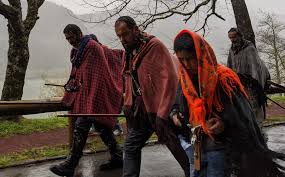
The shawl, the scarf, the staff, the bag or cevadeira, and the pilgrim’s rosary are the main insignia that constitute the identity of the pilgrims of São Miguel. The pilgrimage begins on a Saturday and ends on the following Saturday, or begins on Sunday and ends on the following Sunday. On the day of departure, before dawn, the pilgrims go to the parish’s main church where the “farewell mass” is celebrated. The celebration ends with the singing of “Adeus” (Farewell), when families say goodbye to the pilgrims.
In this spirit of unity and brotherhood, the pilgrims travel the island’s roads, paths, and trails for eight days, in daily stages of 35 to 40 kilometers, totaling 280 to 300 kilometers. The route is always clockwise, with the sea on the left.
The Quaresmas Pilgrimages are most popular on the island of São Miguel. Still, they also occur on the islands of Terceira, Graciosa, and Santa Maria, as well as in the diaspora (Canada and the United States). Also noteworthy are the children’s pilgrimages organized by schools, which last an afternoon, and the women’s pilgrimages on the islands of São Miguel and Terceira, which have been held as a day-long walk since 2004.

Considered a marginal practice until the mid-20th century, held outside the religious and institutional context due to its image as a “poor relative of culture,” the “Romeiros de São Miguel” is now recognized as a unique phenomenon of the cultural and religious heritage of the Azores. The same source adds that the proposal to include the “Romeiros de São Miguel” in the INPCI was submitted by the Associação Movimento de Romeiros de São Miguel, based on research and documentation coordinated and supervised by Carmen Ponte, a PhD researcher in Portuguese Culture, assisted by the Association and with the collaboration of photographer Fernando Resendes. The request made by the Romeiros aims to ensure the legal protection of this cultural manifestation, and the registration is the first step towards formalizing a broader application for Intangible Cultural Heritage of Humanity status.
In Diário dos Açores-Osvaldo Cabral, director
Translated to English as a community outreach program from the Portuguese Beyond Borders Institute (PBBI) and the Modern and Classical Languages and Literatures Department (MCLL) as part of Bruma Publication and ADMA (Azores-Diaspora Media Alliance) at California State University, Fresno, PBBI thanks Luso Financial for sponsoring NOVIDADES.

 Novidades - The Islands and the Diaspora