

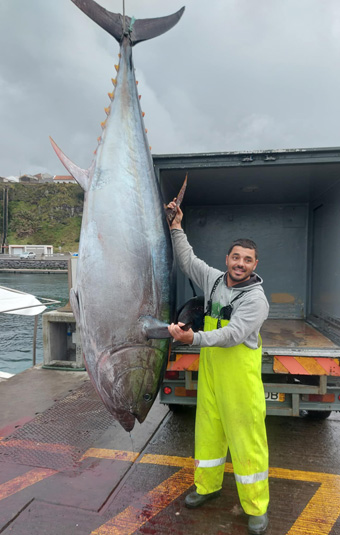
“If I’m still a fisherman, it’s thanks to my family and my colleagues,” says Heitor Penacho
“Before I was discharged, the doctor said: If you want to live longer, you have to give up fishing (…) I thought, ‘What am I going to do now?’ I’ve been fishing for 19 years…” Heitor Penacho, or Heitor Barquinho, as he is known, was born in Rabo de Peixe and has been at sea since he was 17. On this National Fishermen’s Day (May 31), he talks about the challenges of the profession, what has changed in the sector, the dangers and lessons of the sea, and shares what it’s like to live with a diagnosis of diabetes in a risky profession that, despite everything, he doesn’t plan to abandon it.
Correio dos Açores – What led you to choose fishing as your profession?
Heitor Penacho (Fisherman) – My parents were fishermen, and in our family and in our area, most of them were involved in fishing. I started when I was 17, and that was 20 years ago. I didn’t like school at the time. I wanted to be a man, and for that, you had to work. I’d already been fishing a lot, I’d go to the port, to the trough, to see the boats coming in, to unload fish, and I knew I wanted to give it a go. Initially, my father worked alongside my uncle, who was also a fisherman. That’s not to say that we always worked with family members; it could be a neighbor or a friend with a boat. We’d first get close, see how we reacted to the sea, to fishing, and so on, one leap at a time.
Do you remember the first time you went to sea? What was that experience like?
To be honest, the first time, I didn’t realize how dangerous the sea could be, with its potential for bad weather or accidents, but I was afraid of the dark. Especially at that time, there was little light, and I realized that night was the most dangerous. Nothing was the same as being on land or in another profession, but what impressed me most was being in the middle of nowhere, in the dark of night.
Can you tell us about the history of your boat?
When I started fishing on my uncle’s boat, I went with the conviction that one day I would own a boat. Perhaps there weren’t many people with that mentality; many worked out of necessity or for their parents, helping out at home. But I had the mindset of one day owning a boat. I used to say “little boat”, my cousins used to tease me for saying “little boat”, and today it’s no longer a little boat, it’s a barge. I encouraged my parents, and today my father has his own boat (the “My Guardian Angel”) with my brother, my brother-in-law, and me.
How would you describe life as a fisherman?
It’s tough. And there’s one thing people have to understand about fishing: it’s one of the few professions where you’re completely dependent on what you catch. If you don’t fish, you don’t earn. And that’s a struggle. A day-to-day struggle to be able to fish, to see, and to make a living.
There are good times and bad times. There’s bad weather, but there’s also good weather and no fish, or good weather and cheap fish. And sometimes, with certain fishing trips, we can earn a little more.
What picture do you see of the fishing sector today?
There’s very little squid these days. Ten, fifteen, twenty kilos. Whoever catches that is king. Some fishermen don’t want to go to sea because fish is so cheap. Where have you ever seen red seabream at ten or twelve euros a kilo? The normal price is thirty to forty euros.
Another issue is tuna. It’s an uncertain, migratory fishery, but when it arrives, it disrupts everything. In the last two or three years, it has completely failed. The government became involved because tuna generates significant revenue when it comes in large quantities. However, it’s now available for one euro or less. They banned us from fishing in certain areas where there was an abundance of tuna, imposed quotas on boat sizes, and required us to unload only after 48 hours. All so that there would be fewer fishing days. But that was a failure. Last wee,k there was tuna at 90 cents.
It’s also unacceptable for them to force us to waste fuel unnecessarily. The live bait is often located outside Vila Franca, particularly in Santa Maria. We have to unload in Ponta Delgada, return to Vila Franca to collect the bait, and then return to Santa Maria. Who pays for all that fuel? Some boats come from Ribeira Quente and Nordeste and have to make an even longer journey. That doesn’t make sense. If tuna were still worth more than a euro, we’d understand, but at the current price, it’s very serious.
There’s another detail. People who buy always buy, but then they buy cheap. Sometimes it’s because there’s no outlet on the market, sometimes it’s due to the plane, or other issues. But we also have to look at the other side: if it’s one euro, if it’s ninety cents, and they always buy at that price, how are they going to sell it? There’s the cost of the containers, maintenance, keeping them cool, and shipping them out… All this has a price. And fish is still always bought at ninety cents, one euro, one and a half euros. How do you sell it afterwards? Who suffers? It’s us. This goes on from year to year.
There are more and more demands on us, fishermen. We need more ice, better quality fish, and to bleed them one by one so they don’t get hurt. No one can imagine the amount of work that is involved. We sell it for a euro and a half after so much effort. What’s more, nobody knows how the fish arrives for sale the next day. We deliver it in perfect condition, but by the time we sell it, it may not be in such good condition. We’re the losers.
We’re here to collaborate with everyone. I speak from a position where I want the best for myself and for all fishermen, but I also want to hear the other side. But that’s where decisions on fishing fail: it can’t just be politicians who decide. We are the ones who know about the sea and catch the fish. Fishermen must have their say before decisions are made, because they are the ones at sea, they know what they are talking about, and they will have to deal with the consequences of decisions made by people who don’t understand fishing, but who still decide without listening to us. There are measures that only we can determine whether they will work or not, because we’ve been living by the sea for many years and have seen a lot. In my opinion, political decisions fail because fishermen are not included.
I’ll give you a practical example: Lota Açor. If we keep the box in which we store our fish for several days, we have to pay for it. That’s unacceptable. We go far away, we don’t know how many days we’ll be at sea, and in the end we still have to pay for the box. But this is just one example among many.
I participated in BlueAzores, a program aimed at protecting species, and I’m fine with that. But there are some things you just don’t understand. They closed the Silver Sea, the Southern Bass, and the Middle Bass because of the lack of red seabream, and that’s fine because we need to protect this species. But squid fishing doesn’t harm the red seabream. It’s fishing with shows, without hooks. So why ban squid fishing on these banks? They say that there may be people who don’t respect it and go fishing for red seabream anyway, but that’s no longer a squid fishing problem; it’s an enforcement problem. More than half the fishermen go squid fishing, and banning them because of the red seabream doesn’t make sense. It’s unfair.
What are the biggest changes you’ve seen in fishing in recent years?
There are more good things in fishing today. There’s now the Azores Sea School in Horta and there’s more and more training available. This has been a great opportunity for fishermen. Twenty or thirty years ago, there was still a significant amount of illiteracy. However, fishing is now a well-structured profession, and not just anyone goes fishing. Now there are rules and training. There are more opportunities to obtain a GMDSS license, a driver’s license, among others. There is more and more training, which is really encouraging fishermen and putting an end to the idea that they have to drop out of school to go to sea.
Apart from training, other aspects of fishing have changed. For example, more care is taken with the quality of the fish, both when fishing and at the fish market. And there’s also a lot more rigor in the boats, especially when it comes to safety. And there really should be. I say this because, in twenty years of fishing, I’ve been through a lot and seen some very serious situations.
There is also increased environmental awareness, and we have taken the initiative to help clean up the ocean ourselves. Our boat was one of the first to have a bin on board to store garbage. But people have to understand one thing: garbage doesn’t come from the sea. Most of the trash originates from the land. With bad weather and swells, everything that’s on land or on the rocks ends up in the water, and that harms us. Of course, sometimes we lose anchors, ropes, or hooks, but that’s just the nature of things. Nobody wants to lose their gear, and it’s unfair to blame us for leaving garbage at sea.
What are the main challenges or difficulties you face at sea?
Bad weather is always the biggest danger, or an accident or illness that requires immediate help. But the weather isn’t as bad as it used to be. There was no meteorology, and people went out to sea in the dark, unsure if the wind would be favorable or not. They looked at the stars and went out without knowing what might happen.
Nowadays, we can easily check the weather forecast, determine when the wind changes, and see when the weather conditions change; we just need to look at our cell phones. Boats have also made significant advancements in terms of safety.
What’s the most dangerous situation you’ve ever experienced at sea?
I have many stories, but for me, the most serious situation I’ve been in was with my brother. He was complaining about his stomach, and we thought it was just some pain, unimportant. We later learned that it was appendicitis. He ended up undergoing emergency surgery, but if he had spent another hour or two there, he might not have survived.
We were on the high seas, between Santa Maria and São Miguel. We reported the situation, applied all the techniques we had learned, but it was a long time before help arrived. The doctor had no way of knowing how serious the situation was, but he still decided that we didn’t need a helicopter. We had to wait for a semi-rigid boat from the Maritime Police, which took between one and a half and two hours to arrive at our location.
I’m not blaming anyone, and I think that situations like this are the result of the government’s own protocols, because everything has a cost. But in the end, it’s always the fisherman who pays the price. They’re the ones who have to go through things.
Everyone fails, and we must always consider both sides; perhaps they thought it was nothing serious, and there was time to wait. But the fact is that in these situations, especially for those who are calling for help at sea, you can never think like that.
My brother ended up unconscious at sea because help took so long. Fortunately, everything worked out in the end. But I think about it every day, also because of my own situation: I’m one of the few diabetic fishermen dependent on insulin and, of course, ever since I found out, I fish with fear. I’m often afraid of falling asleep on the high seas.
How does diabetes affect your life at sea?
It affects everything. If I’m still fishing, it’s thanks to the support of my companions, as it would be impossible otherwise. Many people think that diabetes is just about sugar, but that’s not how it works. My pancreas no longer produces insulin, and I have to apply insulin several times a day.
At sea, eating is difficult, and resting is even worse. Sometimes we sleep for two or three hours, and that’s not enough. Slow insulin is applied at night, but we can’t always sleep. Physical exertion also takes a toll on us because it lowers our blood sugar levels. We must control everything: food, effort, and rest.
And then one thing I think I’ll always have until I die is the fear of sleeping.
Before I was discharged, the doctor said: ‘If you want to live longer, you have to give up fishing’.
What did you feel or think when the doctor told you that you had to give up fishing?
What was I going to do now? I’d been fishing for 19 years… The truth is that there’s danger everywhere, but at sea it’s much greater, and I was aware of that. I tried to get a job on land, but I felt discriminated against because I was an insulin-dependent diabetic. They immediately started raising issues of “safety”, “hygiene”, and “risk”. And it’s not my fault that I have this condition. We’re talking about diabetes, but it could be any other disease. I’m talking about my experience: I looked for several jobs, but it wasn’t possible. And the way they treated me was very bad, I can assure you.
I followed the doctor’s advice, which was best for me, and I know that it’s really dangerous to continue. I’ve been through serious situations. When your body gets out of balance, you don’t have more than five minutes on the high seas if you don’t get help. Today, I avoid heavier tasks to ensure safety and prevent wear and tear. And I’m grateful to my brother, my brother-in-law, and my colleagues, who make everything as easy as possible for me. If I’m still a fisherman, it’s because of them.
Will you continue fishing as long as possible?
I’ll keep fishing as long as God wants me to. Because faith is what saves us. I can tell you that I was in the hospital and a doctor told me I was going to get worse. But two weeks later, I suddenly got better. That was due to my diet and the way I learned to deal with the illness during the 15 days I was in the hospital. I realized that, with faith, anything is possible. Is it difficult for an insulin-dependent diabetic to go on a seven-day pilgrimage? Yes, but it’s not impossible, as I managed to do it.
I believe we have to learn to listen to our bodies. What the doctors say is important, and we should follow it, but in the end, we are the ones who have to take care of ourselves. When we do something wrong, we know we’re doing it wrong. The doctor isn’t there, so we’re the ones who have to be aware of it. Ultimately, we are our own doctors.
It’s the same with fishing: we’re the ones who know how we feel and what we’re risking. If you ask me when you earn the most in fishing, I’d say it’s in the three hardest months of winter. There are fewer boats at sea, fish is more expensive,e and you end up earning more. But from now on, I know that the best thing for me is to avoid fishing in those months and work as much as possible the rest of the year.
Do you notice an interest among young people in pursuing this profession?
I think there are more young people in fishing today, at least in the case of my town, Rabo de Peixe. That’s because it’s passed down from generation to generation, and also because we’re starting to understand how life exists on land. Many new people are emigrating, but life as an emigrant is no longer what it used to be; it’s more challenging. And without family support, it becomes even more challenging.
That’s why many end up viewing fishing as a profession, rather than a career, unlike in the past, when one would simply say, “I’m going to sea,” and that was it. Nowadays, fishing is a more sustainable profession. Of course, there are still good and bad times, but that’s how we move forward.
I don’t see any young person with a guaranteed job on land. In my case, for example, God willing, I have a job until the end of my life. It’s my father’s boat, and I have an uncle and a cousin. If I don’t fish on one boat, I’ll fish on another. And that’s how we see things: with a long-term horizon.
What message would you like to convey to those who read this, especially the younger ones or those with limited knowledge of this reality?
I’d like to say this to fishermen: take pride in our profession. Being a fisherman is a source of pride.
To the younger ones, my advice is to study first. If you succeed, take advantage of the opportunity. And even if you go into fishing afterwards, everything you learn at school will make a difference to your work. Take the opportunity to train, get your license, and learn, because one day you could own your own boat and business. Don’t leave school to go to sea early. There’s time to be a fisherman.
To people in general, I also leave this message: Respect those who are fishermen. Because fishermen and fisherwomen are not just any people. Fishing was one of the sectors that never stopped, not even during the pandemic. And what we do is essential: you need fish, you need to fish. And we deserve respect.
Finally, a message to the family, especially the fishermen’s wives. Because a fisherman’s wife never sleeps. When I met my wife, people said something bad about her marrying a fisherman from Rabo de Peixe. There was prejudice, because it’s not an easy life. For us, it’s our day-to-day life, we’re used to it, but often they don’t sleep, they sense things, and feel very afraid. We’re not as present when our son is growing up, it’s not easy for her to cope with everything on her own, because she’s the one who’s there when we miss birthdays, when someone is sick, and we’re out at sea. A fisherman’s wife feels what it’s like to be a fisherman, and I think they should be valued more, not as fisherwomen, but as warriors. The life of a fisherman’s wife is not easy, and they deserve the same recognition as the rest of us.
Daniela Canha is a journalist for Correio dos Açores-Natalino Viveiros, director.
Translated to English as a community outreach program from the Portuguese Beyond Borders Institute (PBBI) and the Modern and Classical Languages and Literatures Department (MCLL) as part of Bruma Publication and ADMA (Azores-Diaspora Media Alliance) at California State University, Fresno, PBBI thanks Luso Financial for sponsoring NOVIDADES.
 Novidades - The Islands and the Diaspora