

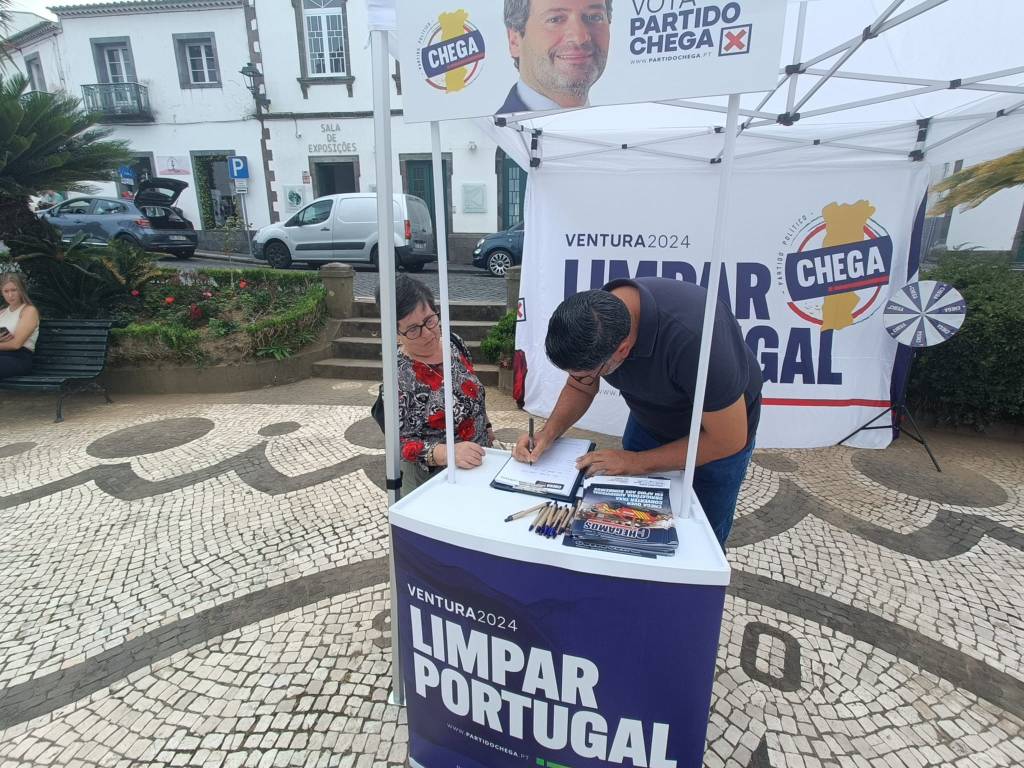
Who is the electorate that votes for CHEGA?
The meteoric rise of Chega has surprised many people, and it remains a question mark how a party that in 2019 had 1.3% and zero deputies, in 2022 reached 6%, in 2024 achieved 15% with 50 mandates, and a year later reached 22% and became the second political force with 60 deputies.
The questions multiply as we see that, apparently, it is a one-man party, albeit with more and more supporters willing to show their faces, but without figures who express the idea of a solid party, with an ideology and defined objectives.
According to data from the EyeData portal, an analysis carried out for the 2022 elections revealed that in municipalities where Chega performed best, the purchasing power per person is lower than the national average (92.81 compared to 100.22 nationally). The average monthly earnings of employees are also lower than the national average in the municipalities where Chega did best.
Looking at the graph, this pattern is evident, for example, in the recent May elections, where the municipalities of the island of S. Miguel and the island of Graciosa saw a higher percentage of beneficiaries of the Social Insertion Income (RSI).
A corollary of this analysis is the fact that he won the parish of Rabo de Peixe with 38% of the vote, with AD coming in second with 30%.
This thesis no longer applies to the municipalities of Corvo, Vila do Porto, S. Roque, and Madalena, where Chega obtained even higher figures, but the RSI percentage is among the lowest. In this case, it could represent a protest vote, as several commentators have said.
Then there is a section of municipalities that don’t seem to follow a specific pattern, where Chega has lower percentages, and the RSI is also less significant.
The fact remains that the reasons for the votes it achieves are still of interest. Indeed, this phenomenon is not unique to Portugal; it’s happening in several European countries, and the reasons are similar. Another situation that has aroused the curiosity of analysts and scholars of these matters is the fact that it is practically a one-voice party, with the remaining elements, even those close to the leadership, being almost invisible.

What weight do Chega and André Ventura carry?
The vote obtained by Chega will always raise doubts, not least because of its inconsistency. Recently, André Ventura experienced a setback when he failed to elect a vice president in the Assembly of the Republic.
Then come the tests of fire. The local elections, where the profile of the figures in each locality counts, sometimes more than the party or its leaders, and then the presidential elections, where everyone has already said they can’t avoid giving their support, but they don’t want André Ventura around.
From this dichotomy, it seems possible to deduce that Chega gets high votes for debatable reasons, but its leader doesn’t linearly represent the corresponding political confidence.
Rafael Cota – an independent journalist
Translated to English as a community outreach program from the Portuguese Beyond Borders Institute (PBBI) and the Modern and Classical Languages and Literatures Department (MCLL) as part of Bruma Publication and ADMA (Azores-Diaspora Media Alliance) at California State University, Fresno, PBBI thanks Luso Financial for sponsoring NOVIDADES.
 Novidades - The Islands and the Diaspora